Botanical species
Geranium molle
L.
Dove's-foot Crane's-bill
Description
Morphological description
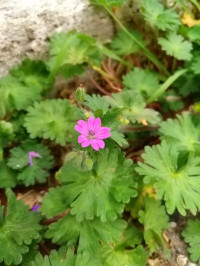
Annual herbaceous plant, Dove's-foot Crane's-bill generally has a prostrate or prostrate-ascending habit, with stems that can reach a height between 10 and 45 cm. The stem is softly pubescent, covered with both glandular and non-glandular hairs, up to 1.7 mm long, giving the plant a slight diffuse hairiness. It does not root at the nodes.
The leaves are alternately arranged along the stem and are characterized by a palmate blade, divided halfway or more to the center into 5-9 lobes, which are oblong-ovate with deeply trifid or trilobed apices. The basal leaves, generally larger, can reach a diameter up to 6 cm and are supported by petioles up to 25 cm long, also pubescent. The cauline leaves, smaller, have progressively shorter petioles. The leaf surface is slightly hairy, with appressed non-glandular hairs, while the margins are dentate or incised with unequal lacinias, sometimes ending with small apical calli. The stipules are broad, oval or oval-lanceolate, with ciliate margins and apices ranging from obtuse to acuminate.
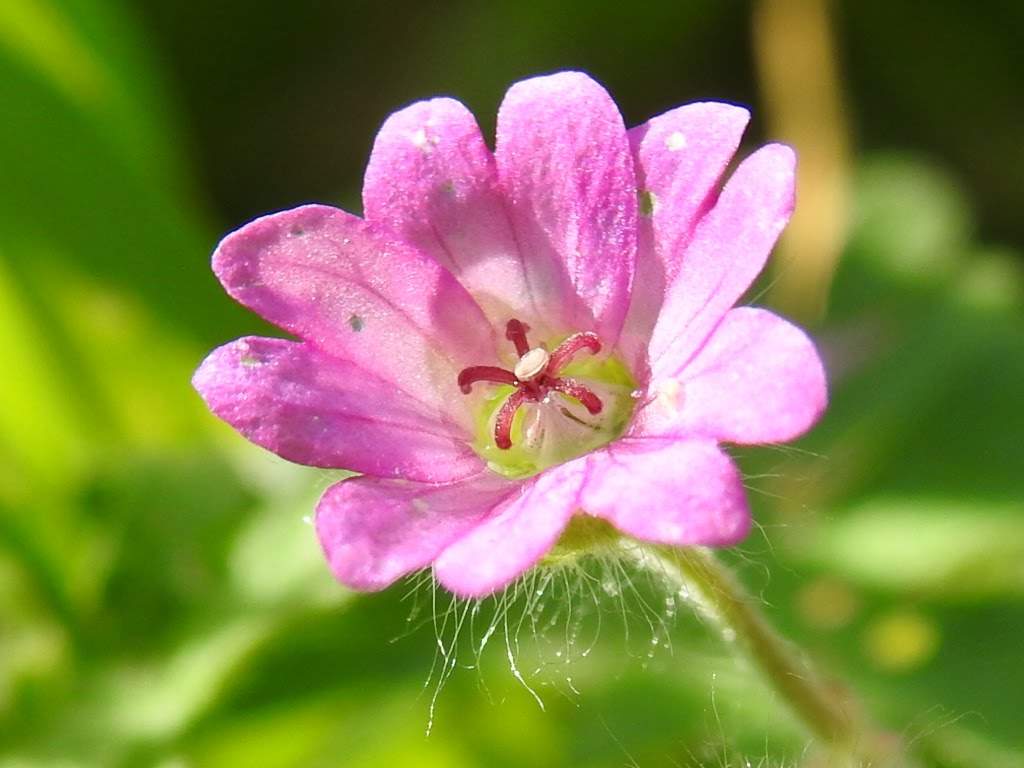
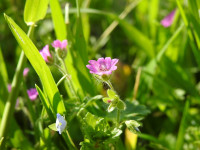
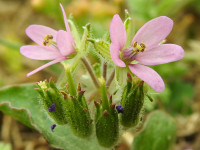
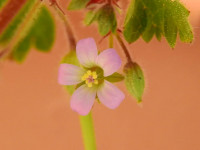
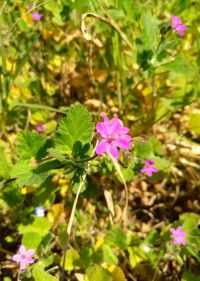
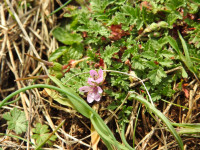
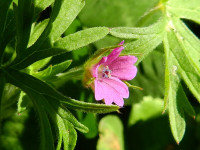
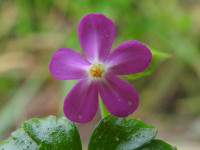
The flowers are small, purplish-pink (fuchsia) in color, and appear in scapose inflorescences, usually composed of two-flowered cymes. The peduncles, 0.5 to 8 cm long, are opposite the reduced upper leaves, while the pedicels supporting the individual flowers are 0.5 to 1.5 cm long, often longer than the leaves themselves. The sepals, oval-lanceolate in shape, are 2.5-6 mm long, with a shortly mucronate apex and covered with patent hairs, both glandular and non-glandular, but glabrous internally. The petals, varying in size from 3 to 10.5 mm, are obovate and deeply bilobed (notched), with a short ciliate claw; their color ranges from pink to violet with darker veins. The stamens are subequal to the calyx, with lanceolate and glabrous filaments in the distal part, while the anthers have a dark violet hue. The nectaries are five, hemispherical and glabrous.
The fruit is an ovate capsule (cassula), 0.8-1.4 cm long, glabrous and transversely wrinkled, with mericarps lacking a basal callus but with some cilia at the base. The beak (rostrum) of the fruit measures from 6 to 11 mm, with a narrowed apex of 1-3 mm. The seeds are smooth, about 1.4-1.8 mm long.
Habitat and distribution
This species is widespread throughout Italy, including mountainous environments, and is widely distributed in the Mediterranean basin, as well as in Europe, Western Asia, and North Africa. It preferably grows along roadsides, in fields, uncultivated areas, ruins, and disturbed soils. It favors sunny or partially shaded exposures and adapts to a wide range of soil types, from dry to more moist and fresh soils, often on calcareous or siliceous substrates.
The growth altitude ranges from sea level up to medium mountain elevations, where it is found in association with other species of hill and mountain environments. Typical habitats include southeast-facing slopes, humid and shady places, but also clearings and forest edges.
Flowering period
Flowering extends from spring to early autumn, typically from March-April to September, with some geographic variations related to local climate. In Italy, flowers can be observed as early as March in milder areas, while in mountainous zones flowering is concentrated more towards late spring and summer.
Ecology and pollination
Dove's-foot Crane's-bill presents an entomogamous pollination strategy, with flowers that mainly attract pollinating insects such as bees and other small hymenopterans. The vivid coloration of the petals and the presence of hemispherical nectaries favor the attraction of these insects, which facilitate cross-fertilization.
Seed dispersal occurs mainly through autochory mechanisms, thanks to the rosary-like structure of the fruit which, upon opening, can project the seeds in the immediate vicinity. No particular involvement of animals in long-distance dispersal is known.
Curiosities and traditional uses
No particularly relevant food or medicinal uses are documented for this species, probably due to its small size and common occurrence in wild areas. However, Dove's-foot Crane's-bill, like other geraniums, may have had some use in folk medicine in the past for astringent or anti-inflammatory properties typical of many species in the Geraniaceae family.
No specific traditions linked to this plant emerge in local folklore, which is mainly appreciated for its ecological and ornamental value in meadows and natural roadside edges.
Etymology
The scientific name Geranium derives from the Greek "geranos" meaning "crane," referring to the shape of the fruit which resembles the beak of this bird. The specific epithet molle means "soft" or "tender," referring to the delicate texture and soft hairiness of the stems and leaves.
The Italian common names “geranio minore” and “geranio selvatico comune” respectively emphasize the smaller size of the plant compared to other species of the genus and its wide distribution in spontaneous environments.
Sources
- Prof. P.V. Arrigoni, "Flora analitica della Toscana", "Flora dell'Isola di Sardegna"
- Tela Botanica / H. Coste, "Flore descriptive et illustrée de la France"
- World Flora Online (WFO)
Characteristics
Scheda botanica
| Famiglia | Geraniaceae |
|---|---|
| Fioritura | marzo – settembre |
| Forma biologica | Scapose |
| Habitat | with fuchsia flowers, annual plant, plant with a prostrate-ascending habit |
Domande frequenti
- Quando fiorisce Dove's-foot Crane's-bill?
- Dove's-foot Crane's-bill fiorisce marzo – settembre.
- Che tipo di pianta è Dove's-foot Crane's-bill?
- Dove's-foot Crane's-bill è una Therophytes (Scapose) secondo la classificazione di Raunkiaer.
- A quale famiglia appartiene Dove's-foot Crane's-bill?
- Dove's-foot Crane's-bill appartiene alla famiglia botanica Geraniaceae.
Where I found it (7 sightings)
Classification
- Kingdom
- Plantae
- Family
- Geraniaceae
- Full name
- Geranium molle L.
- Synonyms
- Geranium brutium Gasp.; Geranium molle L. subsp. brutium (Gasp.) Graebn.
- Life form
- Therophytes scapose
Similar species
Search for species with similar characteristicsNoticed an error in the identification? Write to me
Other species of the same family
Geraniaceae
Explore
Other species of Geraniaceae