Botanical species
Geranium robertianum
L.
Herb-Robert
Description
Morphological description
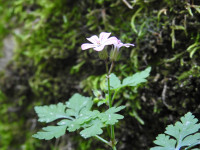
Biennial herbaceous plant, sometimes annual, characterized by a prostrate or ascending habit with cylindrical, branched stems swollen at the nodes, reaching a height between 10 and 55 cm. The stem is often reddish, covered with spreading hairs (length 0.4-2 mm) both glandular and eglandular, giving a tomentose and slightly velvety surface. It does not root at the nodes.
The leaves are opposite, with a petiole ranging from 3 to 8 cm long, hairy on both sides and with ovate, glabrous, and slightly ciliate stipules of reddish color. The leaf blade has a pentagonal-palmate shape, varying in size between 3 and 9 cm in width, divided into five rhomboid or lanceolate lobes, often deeply divided up to the midrib. The terminal segments are lanceolate, toothed, and rounded at the apex with a short red mucro. The basal leaves form a persistent rosette at ground level, while the upper ones are smaller and opposite.
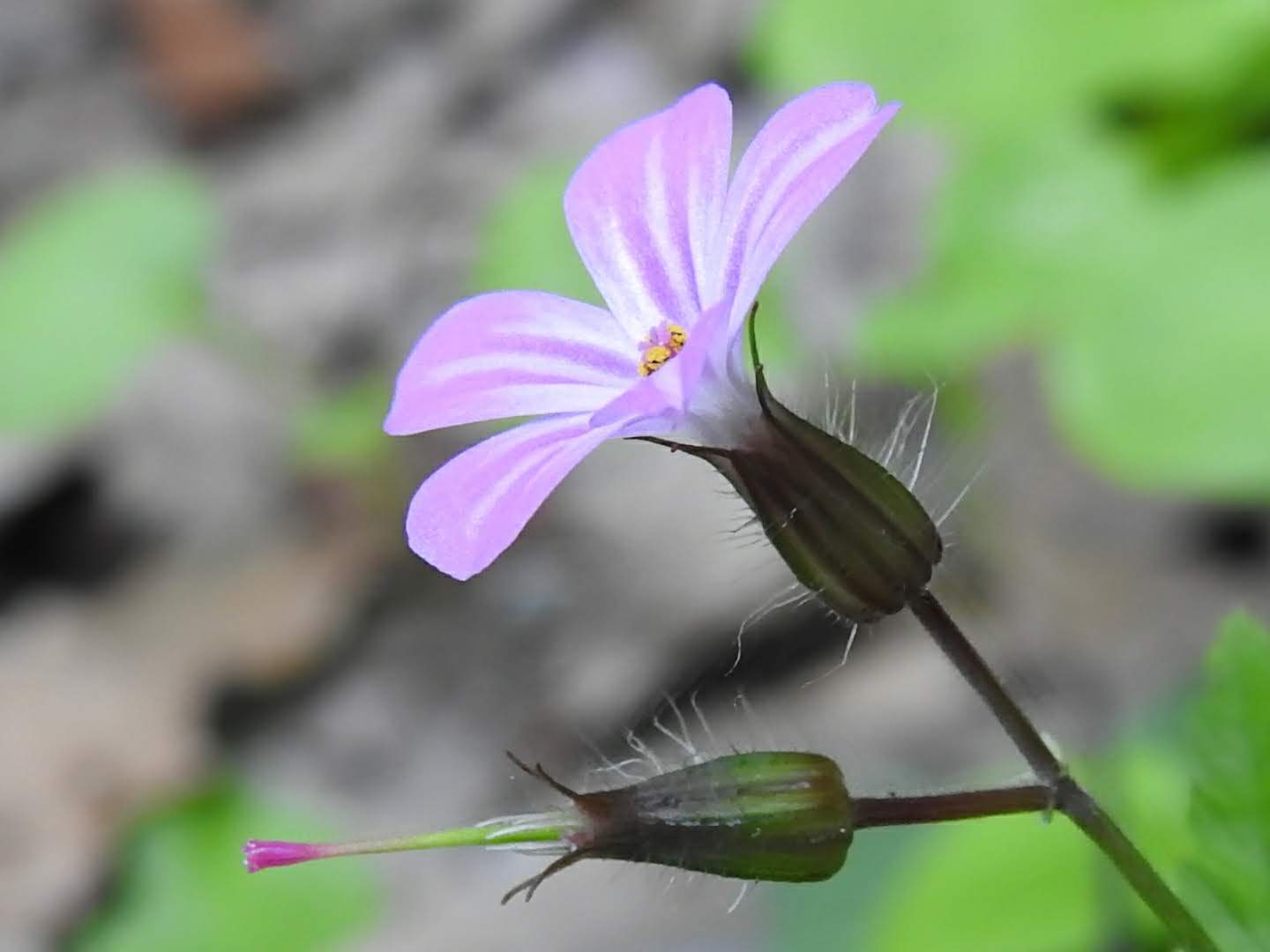
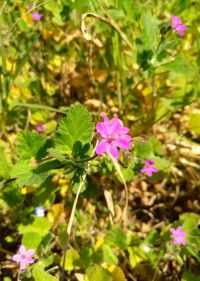
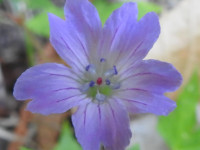
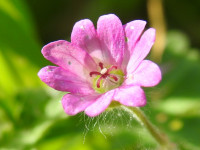
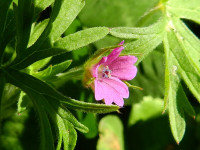
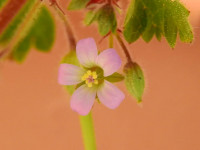
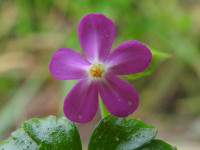
The inflorescence consists of two-flowered racemes, with erect and hairy peduncles 1.5-6 cm long that surpass the axillary leaf. The flowers are erect, with five petals colored violet-lilac, pink, red, or occasionally white, 9-13 mm long, with a broad claw of 6 mm and a rounded apex. The petals are glabrous, with three visible longitudinal white stripes. The sepals are 6-8 mm long, erect, convergent, mucronate (mucro of 1.8-2.5 mm), velvety and glandular. The stamens are ten, with glabrous pink filaments and orange or violet anthers, while the pollen is yellow-orange. The pistil is formed by five fused carpels, extended into a long beak (rostrum) about 1.7-2 cm long, which constitutes the fruit.
The fruit is a schizocarp composed of five reticulated and rough mericarps, which at maturity separate and disperse individually. The mericarps are glabrous or with few eglandular hairs, 1.9-3.1 mm long. The beak is about 1.7-1.9 cm long, with a narrowed apex of 4-5 mm. The root is taproot, red in color, with a thin axial portion.
Habitat and distribution
The species is widely distributed in Italy and the Mediterranean basin, present in almost all Italian regions up to 1600 m altitude. It grows in very varied environments, preferring shady woods, hedges, walls, anthropized areas, and places with soft, nitrogen-rich, and moist soils. It is also common on disturbed grounds and along paths. The species is subcosmopolitan, distributed in Europe, Western Asia, North Africa, and North America.
Flowering period
Flowering mainly occurs between April and September, with possible geographical variations linked to local climate. In Italy, flowering is observed from spring until early autumn.
Ecology and pollination
The plant is pollinated by various pollinating insects attracted by the color and shape of the flowers. The presence of numerous stamens and colored anthers favors entomophilous pollination. The species adopts a reproductive strategy that includes efficient seed dispersal: the schizocarpic fruit, composed of five mericarps, splits at maturity and the seeds are launched far from the mother plant thanks to the hygroscopic coiling of the beak which acts like a spring, facilitating colonization of new territories.
Curiosities and traditional uses
Also known as "Herb-Robert" or "Red Hemlock," this plant has a long tradition of medicinal uses. Its properties include tonic-astringent, anti-inflammatory, antihemorrhagic, and antidiarrheal actions. Fresh leaves have traditionally been used to promote the healing of wounds and sores both on the skin and mucous membranes, thanks to their hemostatic and antiseptic properties.
Moreover, the plant has been used to extract natural repellents and dyes. In popular tradition, it was believed that keeping sprigs of Herb-Robert together with horse chestnuts in wardrobes could keep moths away.
From an ethnobotanical point of view, it is a herb that has inspired numerous common names and beliefs, some of which are linked to its unpleasant odor and the reddish color of its stems and roots.
Etymology
The genus name "Geranium" derives from the Greek "geranos," meaning crane, referring to the shape of the fruits which resemble the beak of this bird. The specific epithet "robertianum" is dedicated to Saint Robert, who according to tradition was associated with this plant. The Italian common name "Herb-Robert" reflects this dedication.
Sources
- Prof. S. Pignatti, "Flora d'Italia"
- Acta Plantarum - Flora delle regioni italiane (scheda di Giuliano Salvai)
- Tela Botanica / H. Coste, "Flore descriptive et illustrée de la France"
- World Flora Online (WFO)
Characteristics
Scheda botanica
| Famiglia | Geraniaceae |
|---|---|
| Fioritura | maggio – ottobre |
| Forma biologica | Scapose |
| Habitat | with lilac flowers, plant with a prostrate-ascending habit |
Domande frequenti
- Quando fiorisce Herb-Robert?
- Herb-Robert fiorisce maggio – ottobre.
- Che tipo di pianta è Herb-Robert?
- Herb-Robert è una Therophytes (Scapose) secondo la classificazione di Raunkiaer.
- A quale famiglia appartiene Herb-Robert?
- Herb-Robert appartiene alla famiglia botanica Geraniaceae.
Where I found it (18 sightings)
Classification
- Kingdom
- Plantae
- Family
- Geraniaceae
- Full name
- Geranium robertianum L.
- Life form
- Therophytes scapose
Similar species
Search for species with similar characteristicsFurther reading
Noticed an error in the identification? Write to me
Other species of the same family
Geraniaceae
Explore
Other species of Geraniaceae