Botanical species
Neotinea maculata
(Desf.) Stearn
Dense-Flowered Orchid
Description
Morphological description
Perennial herbaceous plant belonging to the Orchidaceae family, it has an erect and slender habit with a height ranging between 10 and 20 cm. The stem is glabrous, slightly striated, and often spotted with brown, giving the plant a characteristic appearance. The vegetative base consists of two small ovoid undivided tubers, generally sessile or one sessile and the other shortly pedunculate, which serve as perennial organs from which the stem, leaves, and flowers develop each year.
The basal leaves, numbering 2-3, are arranged in a rosette and have a lanceolate, obovate, or ovate-lanceolate shape, about 5 cm long. They have a herbaceous texture, are mucronate, and finely spotted with purplish or black, with a visible reticulation. The cauline leaves are narrower, clasping the stem and decreasing in size upwards.
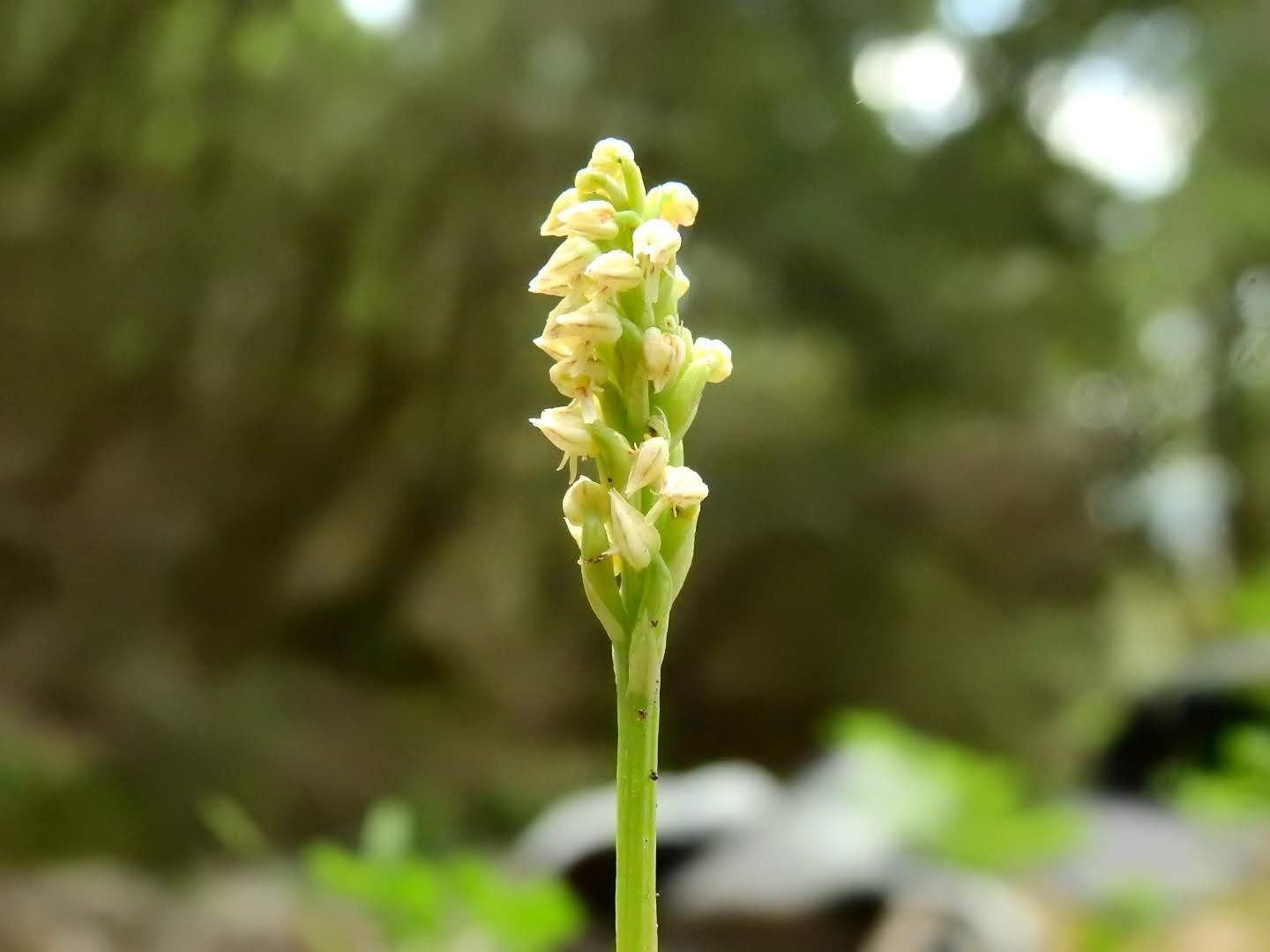
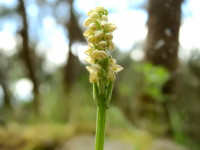
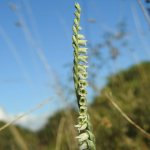
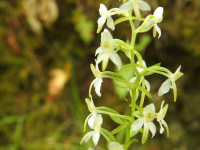
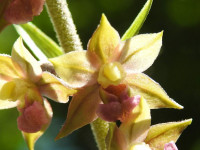
The inflorescence appears as a dense cylindrical spike, often unilateral, with numerous small flowers, 3 to 5 mm long. The flowers are zygomorphic, whitish-green or very pale pink, scented with vanilla. The perianth is formed by outer and inner tepals converging into a helmet shape, partially fused together and free only at the apex. The labellum is trifid, with the outer lobes narrower and the central lobe wider, bifid, often bearing a small central tooth and with purplish streaks at the base. The spur is short and obtuse, 0.8 to 2 mm long. The ovary is inferior and semicontorted.
The fruit is an oblong capsule, erect and fissuricidal with three ribs, about 7.5-9 mm long and 2.5-4 mm wide, containing numerous very small reticulated seeds. The roots are tuberous, deep, and constitute the plant's storage organs.
Habitat and distribution
A typically Mediterranean species, the plant is mainly distributed along the coasts of the Mediterranean basin, particularly in areas characterized by the so-called “Olive area.” In Italy, it is found mainly in woodland environments, thickets, and shrubs, but also in meadows and grassy places. It prefers substrates that are both dry and moderately moist, with a preference for sunny or partially shaded exposures.
The growth altitude ranges from 0 up to about 400 meters above sea level. The species is thermophilic, adapting well to the warm climates typical of Mediterranean regions.
Flowering period
Flowering occurs in the spring period, generally between March and May. In some areas with particular climatic conditions, the period may vary slightly, advancing or delaying by a few weeks.
Ecology and pollination
The flowers, thanks to their vanilla scent and light color, attract various pollinating insects, mainly hymenopterans and dipterans, which play a fundamental role in pollination. The flower structure, with converging tepals and a trifid labellum, is adapted to facilitate insect access to the reproductive organs.
Seed dispersal occurs through the capsule that opens along three ribs, releasing numerous very small and light seeds, facilitating their dispersal by wind. Like many Orchidaceae, the species has a geophytic bulbous biological cycle, with underground storage organs that ensure survival under adverse conditions.
Curiosities and traditional uses
No particular ethnobotanical applications or traditional food and medicinal uses are known for this species. Like many wild orchids, it is mainly appreciated for its aesthetic value and ecological importance in the natural habitats where it grows. It is also protected by specific regulations for the conservation of wild flora and biodiversity.
Etymology
The genus name, Neotinea, is a tribute to Vincenzo Tineo (1791-1856), a Sicilian botanist who published important plant catalogs. The specific epithet maculata derives from the Latin maculatus, meaning “spotted,” referring to the typical dark spots present on the leaves and stem of the plant. The Italian common name, Neotinea macchiata, directly recalls this distinctive characteristic.
Sources
- Acta Plantarum - Flora delle regioni italiane (scheda di Anja Michelucci)
Characteristics
Scheda botanica
| Famiglia | Orchidaceae |
|---|---|
| Fioritura | marzo – maggio |
| Forma biologica | Bulbous |
| Habitat | with white flowers, Perennial plant |
Domande frequenti
- Quando fiorisce Dense-Flowered Orchid?
- Dense-Flowered Orchid fiorisce marzo – maggio.
- Che tipo di pianta è Dense-Flowered Orchid?
- Dense-Flowered Orchid è una Geophytes (Bulbous) secondo la classificazione di Raunkiaer.
- A quale famiglia appartiene Dense-Flowered Orchid?
- Dense-Flowered Orchid appartiene alla famiglia botanica Orchidaceae.
Where I found it
The sighting locations of this species are not public for conservation reasons.
Classification
- Kingdom
- Plantae
- Family
- Orchidaceae
- Full name
- Neotinea maculata (Desf.) Stearn
- Synonyms
- Neotinea intacta (Link) Rchb.f.; Orchis intacta Link; Satyrium maculatum Desf.; Tinea cylindrica Biv.
- Life form
- Geophytes bulbous
Similar species
Search for species with similar characteristicsFurther reading
Noticed an error in the identification? Write to me
Other species of the same family
Orchidaceae
Explore
Other species of Orchidaceae