Botanical species
Epipactis helleborine
(L.) Crantz
Broad-leaved Helleborine
Description
Morphological description
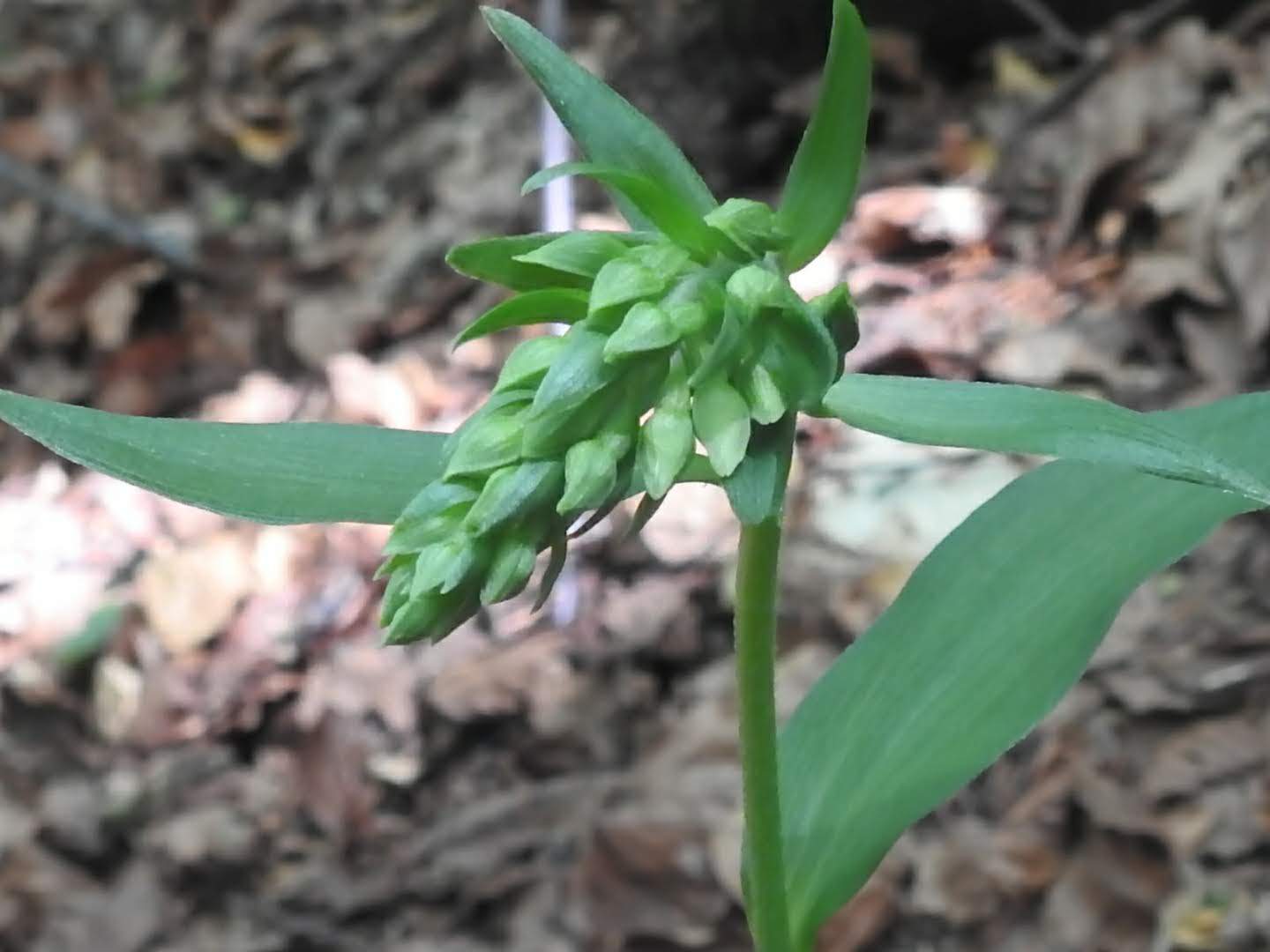
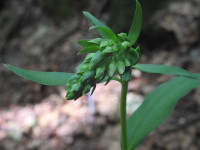
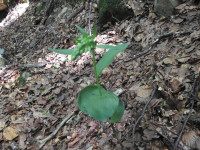
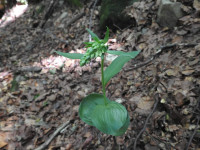
Perennial herbaceous plant 20 to 80 cm tall, robust, with a short and non-stoloniferous rhizome. The stem is erect, cylindrical and leafy, densely pubescent especially in the upper part, while at the base it can be almost glabrous. It has 6-15 leaves, variable in shape and size: the lower ones are ovate-elliptical and clasping, generally measuring 3-4 cm wide by 5-6 cm long, while the middle ones are thinner and elongated, wavy at the margins and can reach up to 18 cm in length. The upper leaves become progressively smaller and narrower. The leaf veins are well visible, with nerves appreciable also to the touch.
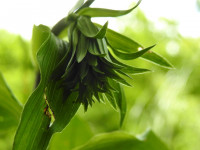
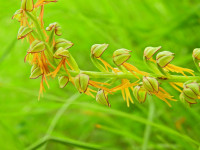
The inflorescence is a linear spike, almost unilateral, with numerous spaced and slightly pendulous flowers. The lower floral bracts are similar to the leaves but narrower and pendulous, up to 5-6 cm long, while the upper ones are smaller, from 1.2 to 1.8 cm. The flowers are medium-sized, with acute and spreading tepals about 7-8 mm long, of variable color from green to white, sometimes with pale violet shades on the labellum.
The labellum, about 4-6 mm long, is formed by a subglobose hypochile and a subtriangular or oblate epichile, with veins sometimes thicker near the apex and with fleshy reliefs or small erose lamellae at the base. The labellum is generally white on the green background of the tepals, sometimes tinged with violet. The column is short, 2-5 mm long, without a mesochile, with a well-visible anther. The ovary is pyriform, 5-10 mm long, on a curved peduncle of 2-3 mm, covered by fine yellow-brown hairs.
The flowers are resupinate and slightly pendulous, emitting a faint scent. The pollinia have a spherical viscidium, which allows attachment to pollinating insects, and do not disintegrate on the stigma, indicating an obligatorily entomogamous fertilization.
The fruit is an obovoid-ellipsoid capsule, about 10 mm long, with a slightly pubescent surface.
Habitat and distribution
Broad-leaved Helleborine is widespread throughout temperate Europe, North Africa and temperate Asia, present in almost all Italian regions up to hill and submontane altitudes between 500 and 1000 meters. It prefers woodland environments, particularly beechwoods, oak woods and hornbeam woods, as well as shady places with fresh and well-drained soils. It is also found in drier and rocky environments, always with vegetation cover and in humus-rich soils.
It prefers shaded or semi-shaded exposures, where the humid microclimate favors development. It is also present along forest edges and clearings, with a certain ecological plasticity that allows it to colonize various habitats in the Mediterranean area.
Flowering period
The flowering extends from June to September, with a higher concentration between June and July. In some cooler or mountainous areas, flowering may be slightly delayed. The duration of the flowering period may vary depending on altitude and local climatic conditions.
Ecology and pollination
The species is obligatorily entomogamous, meaning it reproduces exclusively through cross-pollination mediated by pollinating insects. The flowers produce a sticky viscidium that attaches to insects, facilitating the transport of pollinia from one flower to another. The pollen is contained in pollinia that do not disintegrate on the stigma, thus ensuring cross-fertilization.
Cases of autogamous populations are known, in which the rostellum is rudimentary or absent and the pollen disperses inside the flower; in Italy the presence of these forms needs further study, while in central Europe several autogamous subspecies have been identified.
Seed dispersal occurs through capsules that release very small seeds, easily carried by the wind, facilitating colonization of new woodland areas.
Curiosities and traditional uses
No particular ethnobotanical applications or food uses of this species are known, nor common folkloric references in the Italian or Mediterranean cultural heritage. Like many wild orchids, their collection is discouraged or prohibited for conservation reasons.
Etymology
The scientific name of the genus, Epipactis, derives from the Greek “epipaktis”, a term used by Dioscorides to indicate plants with medicinal properties. The specific epithet helleborine (from helleborus, hellebore) refers to the similarity of the leaves to those of hellebore, a plant known for its medicinal and toxic uses.
The Italian common name “elleborina comune” precisely recalls this leaf similarity with hellebore, emphasizing its widespread presence and frequent occurrence in Italian woods.
Sources
- Prof. S. Pignatti, "Flora d'Italia"
- Tela Botanica / H. Coste, "Flore descriptive et illustrée de la France"
- World Flora Online (WFO)
Characteristics
Scheda botanica
| Famiglia | Orchidaceae |
|---|---|
| Fioritura | giugno – settembre |
| Forma biologica | Rhizomatous |
| Habitat | with white flowers, with yellow flowers, with green flowers |
Domande frequenti
- Quando fiorisce Broad-leaved Helleborine?
- Broad-leaved Helleborine fiorisce giugno – settembre.
- Che tipo di pianta è Broad-leaved Helleborine?
- Broad-leaved Helleborine è una Geophytes (Rhizomatous) secondo la classificazione di Raunkiaer.
- A quale famiglia appartiene Broad-leaved Helleborine?
- Broad-leaved Helleborine appartiene alla famiglia botanica Orchidaceae.
Where I found it
The sighting locations of this species are not public for conservation reasons.
Classification
- Kingdom
- Plantae
- Family
- Orchidaceae
- Full name
- Epipactis helleborine (L.) Crantz
- Synonyms
- Epipactis helleborine (L.) Crantz subsp. latina W.Rossi & E.Klein; Epipactis helleborine (L.) Crantz subsp. moratoria Riech. & Zirnsack; Epipactis helleborine (L.) Crantz subsp. tremolsii (Pau) E.Klein; Epipactis latifolia (L.) All.; Epipactis latina (W.Rossi & E.Klein) B.Baumann & H.Baumann; Epipactis tremolsii Pau; Epipactis tremolsii Pau subsp. latina (W.Rossi & E.Klein) S.Hertel & Riech.; Helleborine latifolia (L.) Moench
- Life form
- Geophytes rhizomatous
Similar species
Search for species with similar characteristicsFurther reading
Noticed an error in the identification? Write to me
Other species of the same family
Orchidaceae
Explore
Other species of Orchidaceae