Botanical species
Cephalanthera longifolia
(L.) Fritsch
Narrow-Leaved Helleborine
Description
Morphological description
Perennial herbaceous plant equipped with a scaly rhizome, the Narrow-Leaved Helleborine presents a slender and graceful habit reaching a height between 15 and 60 cm. The stem is erect, glabrous, sinuous, and covered with leaves up to the inflorescence. The leaves are alternate, linear-lanceolate or lanceolate in shape, with entire margins and herbaceous texture. They are 10 to 15 cm long and about one-tenth as wide as their length, with a well-marked venation (5-9 nerves). The leaf apices are acute or acuminate, and the number of leaves per plant ranges from 6 to 10.
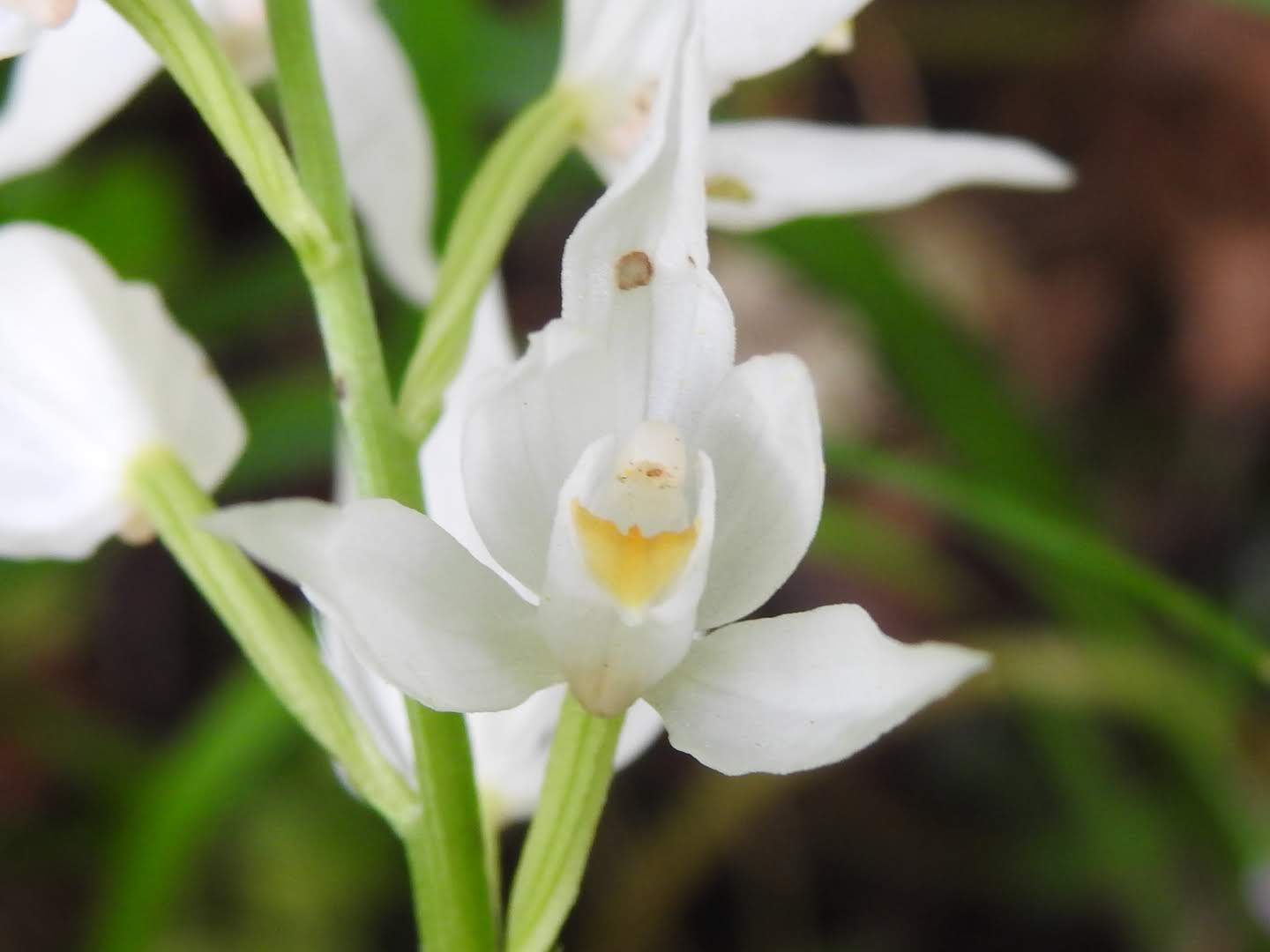
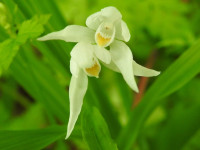
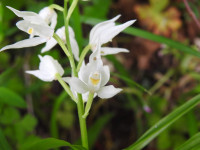
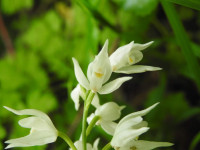
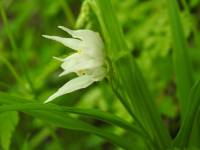
The inflorescence is a loose spike composed of 10-20 flowers of bright white color, generally closed and opening only during the warmest and brightest hours of the day. The flowers are characterized by lanceolate outer tepals with acute apex and shorter, convergent inner tepals. The labellum, 8-9 mm long, is white with a small orange spot at the base (throat). It is divided into two distinct parts: the hypochile, very broad and concave, and the epichile, wider than long and also concave, separated by a deep constriction. The ovary is twisted and the bracts at the flower axils are short, about half the length of the ovary, with the upper ones reduced to scales.
The fruit is an erect three-valved capsule, elliptical, approximately 1.7-2 × 0.6-0.8 cm in size.
The root system consists of an underground rhizome that allows the plant to survive for several years and to annually produce new stems and adventitious roots.
Habitat and distribution
The Narrow-Leaved Helleborine is a Eurasian species present throughout the Italian territory and distributed from the European continent to Japan. In Italy, it grows in various types of woodland environments, including oak woods, beech forests, scrublands, and mixed pine woods. It can also be found on coastal dunes. It prefers generally calcareous soils and mesoxerophilous conditions, thus with moderate moisture. The species adapts well to semi-shaded places or open woods, where light filters but is not excessive.
The growth altitude generally ranges from 0 up to 1,400 m a.s.l., but in rare cases the species can reach up to 1,800 m.
Flowering period
Flowering mainly occurs between March and July, with a peak in May and June. The flowers open especially during the warmest and brightest hours of the day, closing during less favorable hours.
Ecology and pollination
The Narrow-Leaved Helleborine is an autotrophic and leafy plant that relies on a reproductive strategy based on entomogamous pollination, i.e., mediated by insects. The white flowers, often closed or barely open, seem to favor specific pollinating insects, probably small hymenopterans or flies, attracted by the coloration and the presence of the orange spot on the labellum.
Seed dispersal occurs through capsules that open with three valves, releasing numerous very small and light seeds, typical of Orchidaceae, which are carried by the wind.
Curiosities and traditional uses
No specific traditional food or medicinal uses are documented for this species. However, wild orchids such as the Narrow-Leaved Helleborine are often appreciated for their aesthetic value and ecological importance within forest ecosystems. Its presence is indicative of healthy and high-quality woodland environments.
Etymology
The genus name, Cephalanthera, derives from the Greek "kephalé" (head) and the botanical Latin "anthera" (anther), referring to the globose shape and apical position of the anthers, vaguely resembling a head placed atop the flower column. The specific name "longifolia" indicates the main characteristic of the species, namely the elongated leaves.
In Italian, the plant is commonly called "cefalantera maggiore" or "cefalantera a foglie lunghe," precisely referring to its particularly long and narrow foliage compared to related species.
Sources
- Acta Plantarum - Flora delle regioni italiane (actaplantarum.org)
- Acta Plantarum - Flora delle regioni italiane (scheda di Marinella Zepigi)
- World Flora Online (WFO)
Characteristics
Scheda botanica
| Famiglia | Orchidaceae |
|---|---|
| Fioritura | marzo – luglio |
| Forma biologica | Rhizomatous |
| Habitat | with white flowers |
Domande frequenti
- Quando fiorisce Narrow-Leaved Helleborine?
- Narrow-Leaved Helleborine fiorisce marzo – luglio.
- Che tipo di pianta è Narrow-Leaved Helleborine?
- Narrow-Leaved Helleborine è una Geophytes (Rhizomatous) secondo la classificazione di Raunkiaer.
- A quale famiglia appartiene Narrow-Leaved Helleborine?
- Narrow-Leaved Helleborine appartiene alla famiglia botanica Orchidaceae.
Where I found it
The sighting locations of this species are not public for conservation reasons.
Classification
- Kingdom
- Plantae
- Family
- Orchidaceae
- Full name
- Cephalanthera longifolia (L.) Fritsch
- Synonyms
- Cephalanthera ensifolia Rich.
- Life form
- Geophytes rhizomatous
Similar species
Search for species with similar characteristicsFurther reading
Noticed an error in the identification? Write to me
Other species of the same family
Orchidaceae
Explore
Other species of Orchidaceae