Botanical species
Dactylorhiza maculata
(L.) Soó
Heath Spotted-Orchid
Description
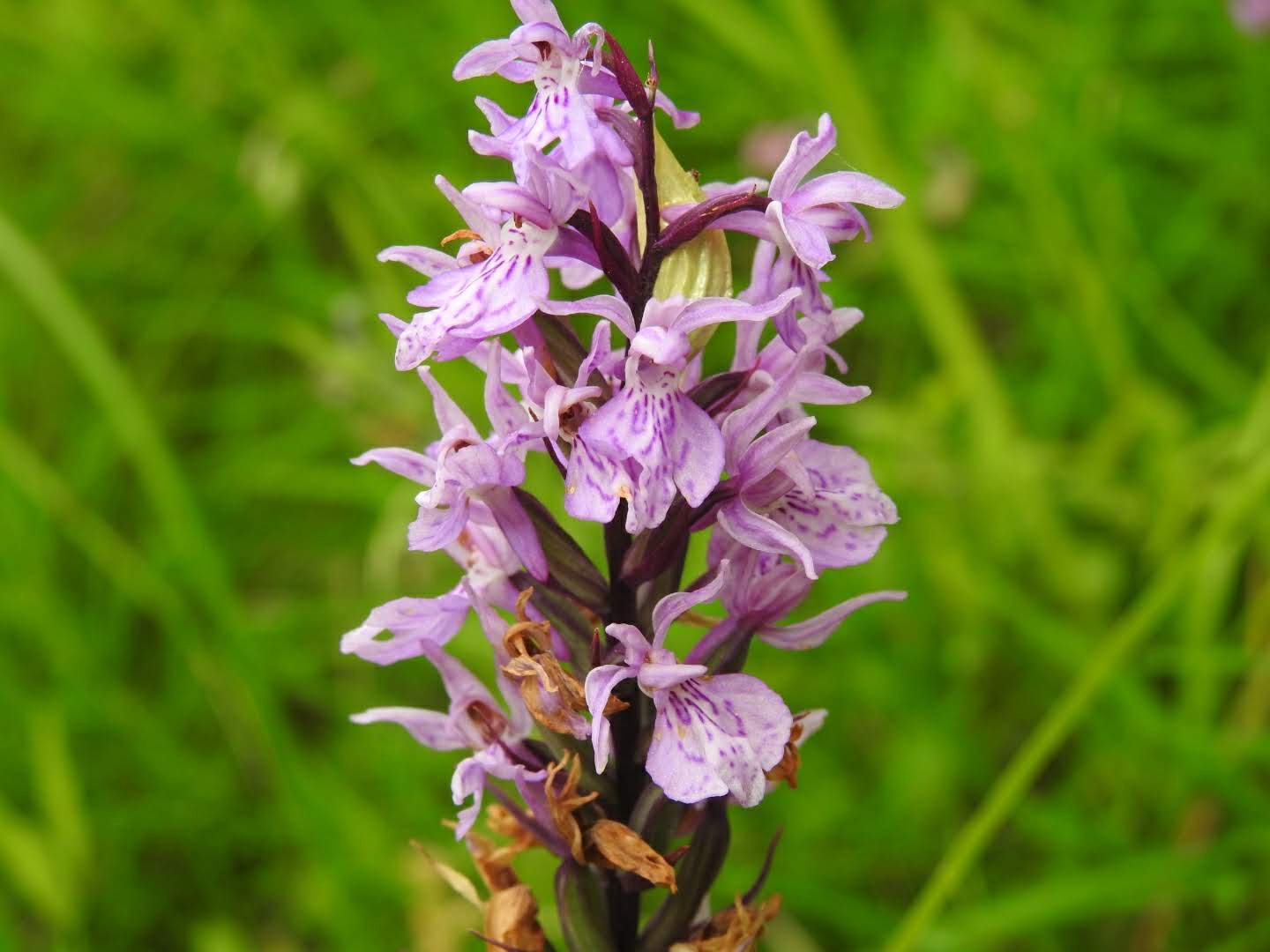
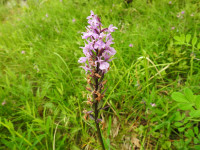
Morphological Description
The Heath Spotted-Orchid is a perennial herbaceous plant belonging to the Orchidaceae family, with a height ranging from 20 to 60 cm. The stem is generally solid or slightly hollow, about 2 mm thick in the upper part, below the inflorescence. The leaves are alternately arranged along the stem, lanceolate in shape, and characterized by the presence of dark brown spots on the upper surface. The upper leaves are narrow, smaller in size, and do not exceed the height of the inflorescence.
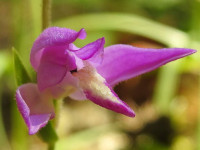
The inflorescence initially has a pyramidal shape, which becomes cylindrical as it matures, and bears numerous flowers varying in color from fuchsia to lilac to white, all decorated with dark violet markings, particularly on the labellum. Each flower consists of six tepals: the dorsal one and the two inner ones merge to form a sort of hood, while the two lateral ones are open sideways. The flower has a filiform spur, thin and straight, which can be horizontal or inclined downward; this is generally slightly shorter than the ovary supporting the flower. The bracts accompanying the flowers are green and do not exceed the height of the flowers themselves.
The root system is typical of terrestrial orchids, with underground rhizomes or tubers from which the plant regenerates annually. The fruit, as in all Orchidaceae, is a capsule containing numerous minute seeds, which are dispersed mainly by wind.
Habitat and Distribution
The Heath Spotted-Orchid is a species typical of woodland environments and montane and submontane wet areas. In Italy, it is mainly found in the alpine and pre-alpine regions, where it prefers fresh and well-drained substrates, often in deciduous and coniferous forests. It grows on medium-textured soils, fairly rich in organic matter, which maintain a certain degree of moisture without waterlogging.
Its distribution extends across the temperate Mediterranean area, with a strong presence in the mountain ranges of central and southern Europe, adapting to varying altitudes ranging from about 500 to 2,000 meters above sea level. The preferred exposure is generally shaded or semi-shaded, typical of the understory.
Flowering Period
The flowering of the Heath Spotted-Orchid mainly occurs between May and July. However, depending on altitude and latitude, there may be slight variations: in more northern areas or at high altitudes, flowering may start later or extend into late early summer.
Ecology and Pollination
This orchid relies mainly on pollinating insects, particularly various species of Hymenoptera such as bees and bumblebees, attracted by the vivid color of the flowers and their dark spots which act as visual signals. The particular shape of the flower and spur facilitates pollination through the contact of insects with the reproductive organs.
Seed dispersal occurs through the wind, as the capsules open releasing a large number of very light and minute seeds, typical of Orchidaceae, which can be carried over considerable distances.
Curiosities and Traditional Uses
No specific traditional, medicinal, or food uses related to the Heath Spotted-Orchid are documented. However, like many terrestrial orchids, it is possible that in the past it was collected for herbal or collector purposes, although today the species is protected and subject to regulations prohibiting its collection in the wild.
Etymology
The scientific name of the genus Dactylorhiza derives from the Greek “daktylos” (finger) and “rhiza” (root), referring to the shape of the underground tubers that resemble intertwined fingers. The specific epithet maculata means “spotted,” referring to the characteristic dark spots that adorn the leaves of the plant. The common name “Heath Spotted-Orchid” directly recalls this distinctive morphological peculiarity.
Sources
- World Flora Online (WFO)
Characteristics
Scheda botanica
| Famiglia | Orchidaceae |
|---|---|
| Fioritura | maggio – luglio |
| Forma biologica | Bulbous |
| Habitat | with fuchsia flowers |
Domande frequenti
- Quando fiorisce Heath Spotted-Orchid?
- Heath Spotted-Orchid fiorisce maggio – luglio.
- Che tipo di pianta è Heath Spotted-Orchid?
- Heath Spotted-Orchid è una Geophytes (Bulbous) secondo la classificazione di Raunkiaer.
- A quale famiglia appartiene Heath Spotted-Orchid?
- Heath Spotted-Orchid appartiene alla famiglia botanica Orchidaceae.
Where I found it
The sighting locations of this species are not public for conservation reasons.
Classification
- Kingdom
- Plantae
- Family
- Orchidaceae
- Full name
- Dactylorhiza maculata (L.) Soó
- Synonyms
- Dactylorhiza maculata (L.) Soó subsp. savogiensis (D.Tyteca & Gathoye) Kreutz; Dactylorhiza savogiensis D.Tyteca & Gathoye
- Life form
- Geophytes bulbous
Similar species
Search for species with similar characteristicsNoticed an error in the identification? Write to me
Other species of the same family
Orchidaceae
Explore
Other species of Orchidaceae