Botanical species
Ophrys sphegodes
Mill. subsp. classica (Devillers-Tersch. & Devillers) Kreutz
Early Spider-Orchid
Description
Morphological description
Perennial herbaceous plant, bulbous geophyte, 10 to 55 cm tall, characterized by an erect habit and a cylindrical, smooth, and glabrous stem. The root system consists of two ovoid rhizotubers, entire and equipped with filamentous roots, which serve as storage organs for the plant.
The leaves are arranged in a basal rosette and are oval-lanceolate in shape, dark green with silvery reflections, while along the stem there are elliptical, acute, sheathing cauline leaves folded like a shower; the upper ones are smaller, herbaceous, and pointed, with green or greenish bracts longer than the ovaries.
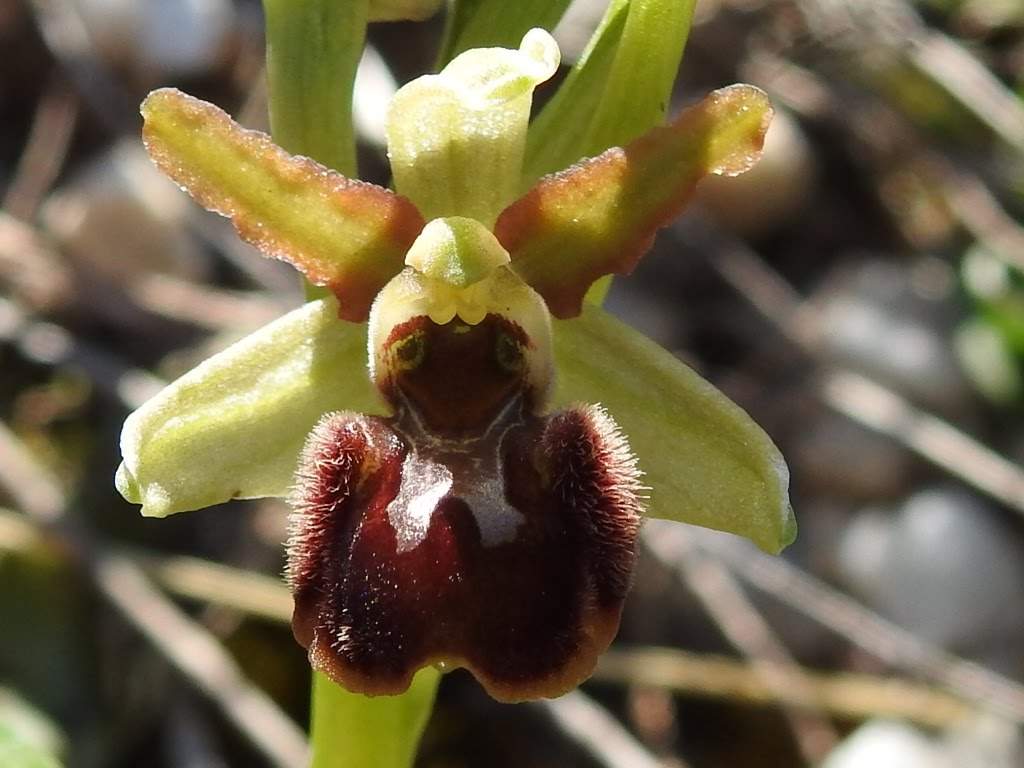
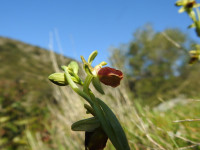
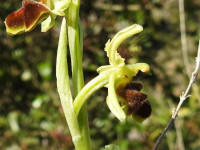
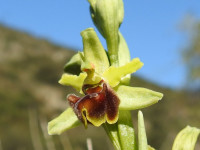
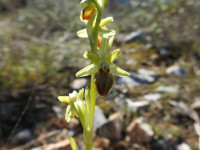
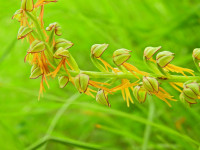
The inflorescence is a loose spike composed of 4 to 10 flowers, which show remarkable morphological and color variability, mimicking the shape of an insect. The outer tepals are oblong, concave, and glabrous, with color ranging from green to yellowish green, with revolute margins; the median tepal is more forward-tilted. The inner tepals are shorter, lanceolate, generally truncate with a wavy margin, and can be concolorous or show variations in lighter or darker shades.
The labellum, the most characteristic part of the flower, is hairy, ovate, rarely trilobed, about 8-15 mm in size, almost as wide as long, slightly notched at the terminal part, and dark brown and velvety in color. It has gibbosities, which can be more or less evident, and at the base presents a small forward-facing appendage. On the labellum, a shiny spot in the shape of an H, II, or X can be observed, varying from brownish to bluish or reddish brown. The ovary is cylindrical and the stamens are usually one per flower.
The fruit is a fissure-dehiscent capsule, erect and oblong, containing flat and reticulated seeds typical of Orchidaceae.
Habitat and distribution
This species has a Eurymediterranean distribution, with a range centered on the Mediterranean coasts but also extending northwards and eastwards in some areas. In Italy, it is present in various environments, especially in dry and grassy places, garrigues, and pine woods, generally on calcareous soils. It grows from the plains up to about 1200 meters of altitude.
It prefers sunny exposures on poor and dry substrates, typical of poor grasslands and calcareous pastures, in hilly and low mountain environments.
Flowering period
Flowering occurs between March and May (months 3-5), with possible variations due to local climatic conditions and altitude. In some more southern areas or at lower elevations, flowering may start slightly earlier.
Ecology and pollination
Ophrys are famous for their complex entomophilous reproductive strategy, based on sexual deception of pollinating insects. The flower's labellum reproduces in shape, color, and ornamentation the female of the pollinating insect, while the plant emits pheromones similar to those of the female, inducing males to perform a pseudocopulation with the flower. This behavior allows the transfer of pollen masses (pollinaria) and pollination.
The main pollinating insects of this species in Italy belong to the genus Andrena, particularly Andrena nigroaenea. In the absence of pollinating insects, the plant can resort to self-pollination (cleistogamy), which nevertheless ensures the species' survival but limits genetic diversity.
Reproduction can also occur asexually through the production of accessory tubers, which detach and give rise to new plants.
The seeds, very small and lacking nutrient reserves, require a symbiosis with mycorrhizal fungi of the genus Rhizoctonia to germinate, which provide essential organic substances during the initial development phase. This symbiosis ends with the formation of the first tuber, when the plant begins to produce fungicidal substances.
Seed dispersal occurs by wind (anemochory) through the capsule that opens at maturity.
Curiosities and traditional uses
This species, like many Ophrys, has sometimes been collected for its rhizotubers, used in some regions for the production of a flour called salep (in Arabic "sahlab"), traditionally employed in the preparation of ice creams, aphrodisiac drinks, and other foods. Intensive tuber harvesting can severely compromise the survival of wild populations, as about one thousand plants must be uprooted to produce one kilogram of salep.
In nature, the tubers are also preyed upon by animals such as wild boars and porcupines, which can cause significant damage to habitats.
No relevant historical medicinal uses or particular folkloric references are known for this species in Italy.
Etymology
The genus name "Ophrys" derives from the Greek ὀφρῦς (ophrýs), meaning "eyebrow," probably due to the resemblance between the labellum of some species and the shape of an eyebrow. Another possible origin is linked to Pliny the Elder, who mentioned a plant called ophrys used to dye horses' eyebrows black, although not belonging to this genus.
The specific name "sphegodes" derives from Greek and means "wasp-like," referring to the flower's shape that mimics the appearance of a pollinating insect.
The Italian common name “Early Spider-Orchid” refers to the green coloration of the outer tepals, characteristic of this subspecies, while “fior di ragno” is a popular name referring to the spider-like appearance of the flowers.
Sources
- Acta Plantarum - Flora delle regioni italiane (scheda di Giuliano Salvai)
- Tela Botanica / H. Coste, "Flore descriptive et illustrée de la France"
- World Flora Online (WFO)
Characteristics
Scheda botanica
| Famiglia | Orchidaceae |
|---|---|
| Fioritura | marzo – maggio |
| Forma biologica | Bulbous |
| Habitat | with brown flowers, with fragrant flowers |
Domande frequenti
- Quando fiorisce Early Spider-Orchid?
- Early Spider-Orchid fiorisce marzo – maggio.
- Che tipo di pianta è Early Spider-Orchid?
- Early Spider-Orchid è una Geophytes (Bulbous) secondo la classificazione di Raunkiaer.
- A quale famiglia appartiene Early Spider-Orchid?
- Early Spider-Orchid appartiene alla famiglia botanica Orchidaceae.
Where I found it
The sighting locations of this species are not public for conservation reasons.
Classification
- Kingdom
- Plantae
- Family
- Orchidaceae
- Full name
- Ophrys sphegodes Mill. subsp. classica (Devillers-Tersch. & Devillers) Kreutz
- Synonyms
- Ophrys classica Devillers-Tersch. & Devillers; Ophrys sphegodes Mill.
- Life form
- Geophytes bulbous
Similar species
Search for species with similar characteristicsFurther reading
Noticed an error in the identification? Write to me
Other species of the same family
Orchidaceae
Explore
Other species of Orchidaceae