Botanical species
Santolina pinnata
Viv.
Apuan mountain lavender-cotton
Description
Morphological description
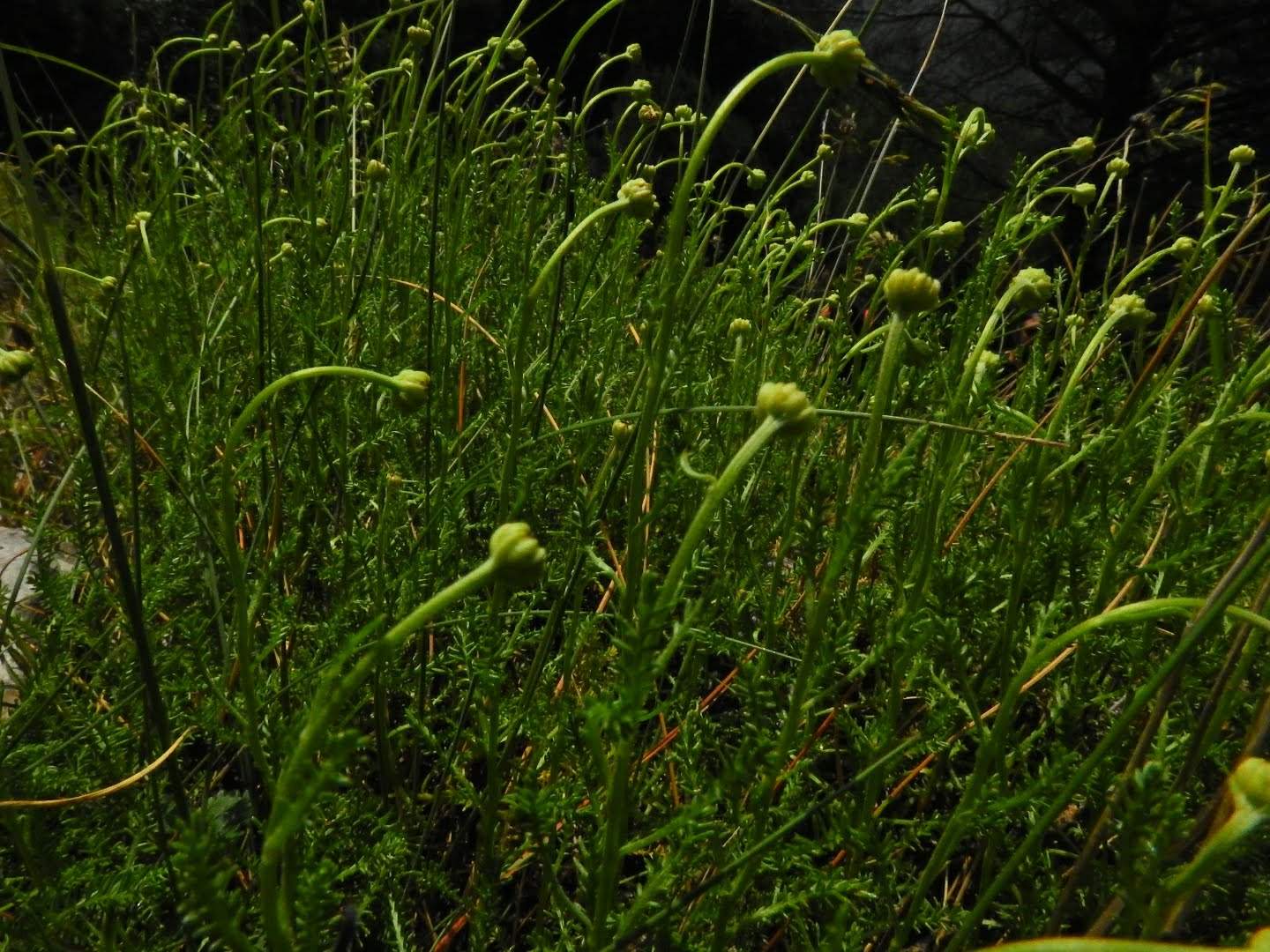
It is a small, bushy, perennial and evergreen shrub, with a compact habit and woody stem, often thickened at the base. The maximum height reached is about 30 cm. The stems are erect, ascending, branched and leafless in the upper part, where they end with the inflorescences. The surface of the stem is glabrous, without hairs.
The leaves are 1 to 3.5 cm long, linear in shape and finely pinnate (paripinnate), with thin lobes 2-4 mm long arranged in two or four opposite and divergent rows (distichous or tetrastichous arrangement). The petiole is well visible, 3-8 cm long, and widens at the base. The leaves have a filiform, almost feathery appearance, from which the specific name derives.
The flowers are gathered in solitary capitula (calathidia), generally spherical, small in size (5-8 mm in diameter). The involucre is composed of keeled involucral scales, appressed and slightly scarious towards the apex. The receptacle is convex and has acute chaff scales, often with a short mucro. The corolla is white or whitish, formed by numerous tubular, actinomorphic flowers, with a limb divided into five triangular and acute lobes, giving a bell-shaped and star-like form. The flowers lack pappus.
The fruit is an oblong, compressed and trigonous cypsela (achene), without pappus, adapted for local dispersal.
Habitat and distribution
The species is an endemic of the Apuan Alps, present exclusively in Tuscany, in the provinces of Massa-Carrara and Lucca. It grows on calcareous substrates, particularly on sun-exposed rocks and cliffs, typical of the mountain environment. The growth altitude ranges between 500 and 1500 meters above sea level. The plant prefers sunny exposures and well-drained soils, typical of calcareous rocky areas.
Flowering period
Flowering generally occurs between June and August, with possible variations related to altitude and local microclimatic conditions.
Ecology and pollination
The tubular and white flowers are probably visited by specialized pollinating insects, such as bees and other hymenopterans, attracted by the bell-shaped form and light color, which facilitates visibility in rocky contexts. The structure of the capitula and the absence of pappus suggest a predominantly barochorous seed dispersal, i.e., by falling near the mother plant, with possible assistance from small animals or secondary transport phenomena.
Curiosities and traditional uses
Santolinas, in general, have been known since ancient times in the Mediterranean area for their aromatic and repellent properties. Traditionally, the plants were used to perfume environments and keep mosquitoes away by placing them in pots on windowsills. The dried flowers were also put in wardrobes to protect linen from moths and other insects. These uses are linked to the volatile and aromatic substances present in the plant. No specific food or medicinal uses are documented for this species, but its use as an aromatic plant and insect repellent falls within the Mediterranean ethnobotanical tradition.
Etymology
The genus name derives from the French term "santoline", attested since 1562, and traditionally interpreted as composed of “sanctus” (holy) and “linum” (flax), referring to the presumed therapeutic and sacred properties attributed to the plant. The specific name "pinnata" refers to the shape of the leaves, which have thin lobes arranged pinnately, similar to feathers or quills. The Italian common name “crespolina a foglie pennate” precisely recalls this finely divided leaf characteristic.
Sources
- Prof. S. Pignatti, "Flora d'Italia"
- Acta Plantarum - Flora delle regioni italiane (scheda di Giuliano Salvai)
Characteristics
Scheda botanica
| Famiglia | Asteraceae |
|---|---|
| Fioritura | giugno – agosto |
| Forma biologica | Fruticose |
| Habitat | with white flowers, endemic plant, Perennial plant |
Domande frequenti
- Quando fiorisce Apuan mountain lavender-cotton?
- Apuan mountain lavender-cotton fiorisce giugno – agosto.
- Che tipo di pianta è Apuan mountain lavender-cotton?
- Apuan mountain lavender-cotton è una Chamaephyte (Fruticose) secondo la classificazione di Raunkiaer.
- A quale famiglia appartiene Apuan mountain lavender-cotton?
- Apuan mountain lavender-cotton appartiene alla famiglia botanica Asteraceae.
Classification
- Kingdom
- Plantae
- Family
- Asteraceae
- Full name
- Santolina pinnata Viv.
- Synonyms
- Santolina leucantha Bertol., nom. illeg.
- Life form
- Chamaephyte fruticose
Similar species
Search for species with similar characteristicsNoticed an error in the identification? Write to me
Other species of the same family
Asteraceae


Explore
Other species of Asteraceae