Botanical species
Dittrichia viscosa
(L.) Greuter
False yellowhead
Description
Morphological description
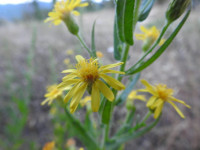
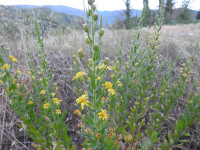
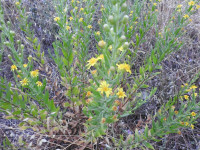
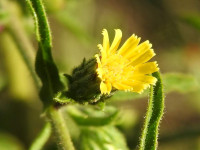
Perennial suffrutescent plant, evergreen, with an erect and highly branched habit, reaching a height ranging from 50 to 150 cm. The stem is woody at the base, covered by a hirsute and rough surface, with hairs and a viscous consistency due to the presence of resinous glands. The branches emerge from the upper part of the stem, giving the plant a bushy appearance.
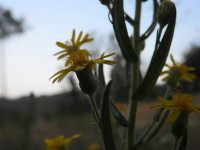
The leaves are alternate, sessile or semi-clasping, lanceolate and linear in shape, measuring between 40 and 60 mm long and 6-12 mm wide. The blade is rough, viscous due to the presence of resinous glands, and may have entire or irregularly serrated margins with sharp teeth. The lower leaves are larger and sessile, the upper ones progressively smaller and amplexicaul, often with a cordate base. The leaf surface emits a strong aromatic odor, somewhat unpleasant.
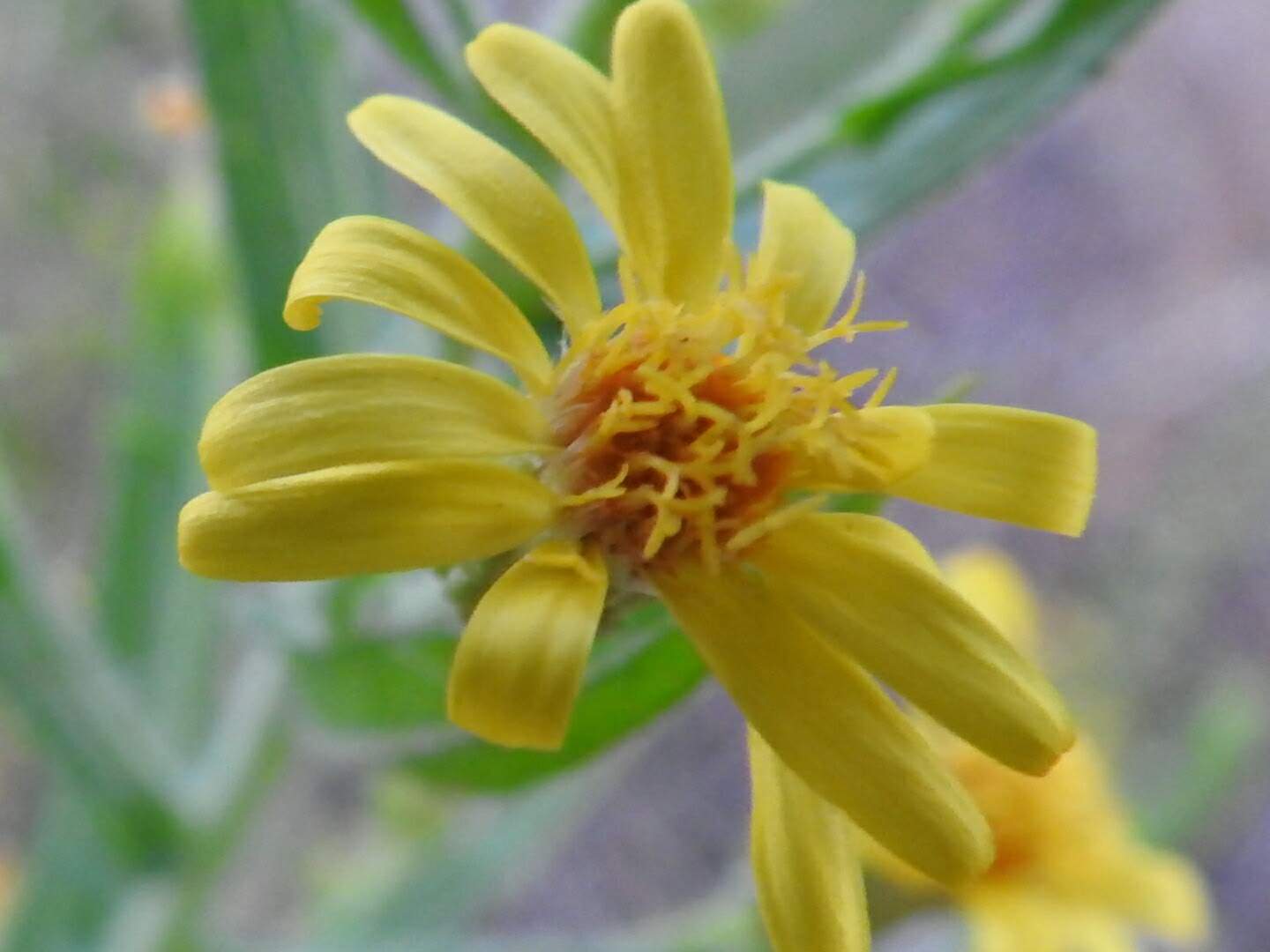
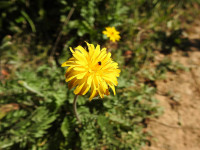
The capitula are numerous, small in size (1-1.5 cm in diameter), inserted on short peduncles and arranged in a more or less dense pyramidal panicle. The involucre is hemispherical-conical, composed of imbricated scales, green with scarious margins. The peripheral flowers are female, ligulate, yellow-golden, with ligules about 5-7 mm long, while the inner flowers are hermaphroditic, tubular, also yellow, with a five-toothed corolla. The receptacle is naked, lacking chaff scales.
The fruit is a whitish cypsela (achene), about 2 mm long, slightly hirsute and glandular, without ribs. It is equipped with a pappus consisting of simple hairs with a finely denticulate membranous crown at the base, which facilitates anemochorous dispersal (wind transport).
The root system is typical of Mediterranean suffrutices, robust and deeply anchored to the soil, but detailed descriptions are not available in the consulted sources.
Habitat and distribution
A typical species of the Mediterranean maquis and coastal areas, Dittrichia viscosa is widespread along Italian regions with a Mediterranean climate, from Liguria to Sicily, but also extends to other areas of the Mediterranean basin with a eurymediterranean range. It is frequently found in anthropized environments such as uncultivated lands, ruins, road edges, embankments, and stream beds, preferring calcareous and clayey substrates.
It prefers sunny exposures and is a heliophilous plant, capable of rapidly colonizing abandoned fields and poor soils. Its growth altitude ranges from 0 up to about 800 meters above sea level.
Flowering period
Flowering mainly occurs between August and October, with possible local variations related to climate and altitude. During this period the plant produces abundant yellow capitula, significantly contributing to late-season pollination, when many other species have already completed their flowering.
Ecology and pollination
The species is entomogamous, i.e., pollinated by insects, and represents an important resource for bees and other pollinating insects, thanks to the production of a large number of flowers rich in pollen and nectar. Its strong aromatic odor, although unpleasant to some herbivores, does not prevent visits by pollinating insects.
Seed dispersal occurs mainly through wind (anemochory), facilitated by the feathery pappus which aids in the transport of achenes over distances.
Curiosities and traditional uses
Dittrichia viscosa is a medicinal species long known in Mediterranean tradition. It contains essential oils and active principles with antimicrobial properties, which have been used in the treatment of various skin conditions such as dermatitis and eczema. The plant is sometimes used in phytotherapy, although it is important to remember that such uses should be considered with caution and under specialist supervision.
It is a significant melliferous plant because it blooms during a period when resources for pollinators decrease, thus helping to support bees and other insects during late summer and early autumn.
In local folklore, its strong odor and viscous consistency have often inspired popular names such as “prucara” or “ceppica,” which recall its sticky nature and invasive character, as it can behave as a weed in some contexts.
Etymology
The genus name Dittrichia is dedicated to Dittrich, a botanist specializing in Asteraceae and director of the Berlin Botanical Garden. The specific epithet viscosa derives from the Latin viscosus, meaning “viscous,” referring to the resinous and sticky surface of the plant.
Italian common names, such as “enula bacicci” and “inula vischiosa,” also recall the characteristic viscosity and the relationship with the genus Inula, from which the species was separated for taxonomic reasons.
Sources
- Prof. S. Pignatti, Flora d’Italia
- Acta Plantarum – Flora delle regioni italiane (scheda di Anja Michelucci)
- Tela Botanica / H. Coste, Flore descriptive et illustrée de la France
Characteristics
Where I found it (8 sightings)
Classification
- Kingdom
- Plantae
- Family
- Asteraceae
- Full name
- Dittrichia viscosa (L.) Greuter
- Synonyms
- Inula viscosa (L.) Aiton
- Life form
- Emicriptofite scapose
Similar species
Search for species with similar characteristicsFurther reading
Noticed an error in the identification? Write to me
Other species of the same family
Asteraceae
Explore
Other species of Asteraceae