Botanical species
Dianthus carthusianorum
L.
Carthusian Pink
Description
Morphological description
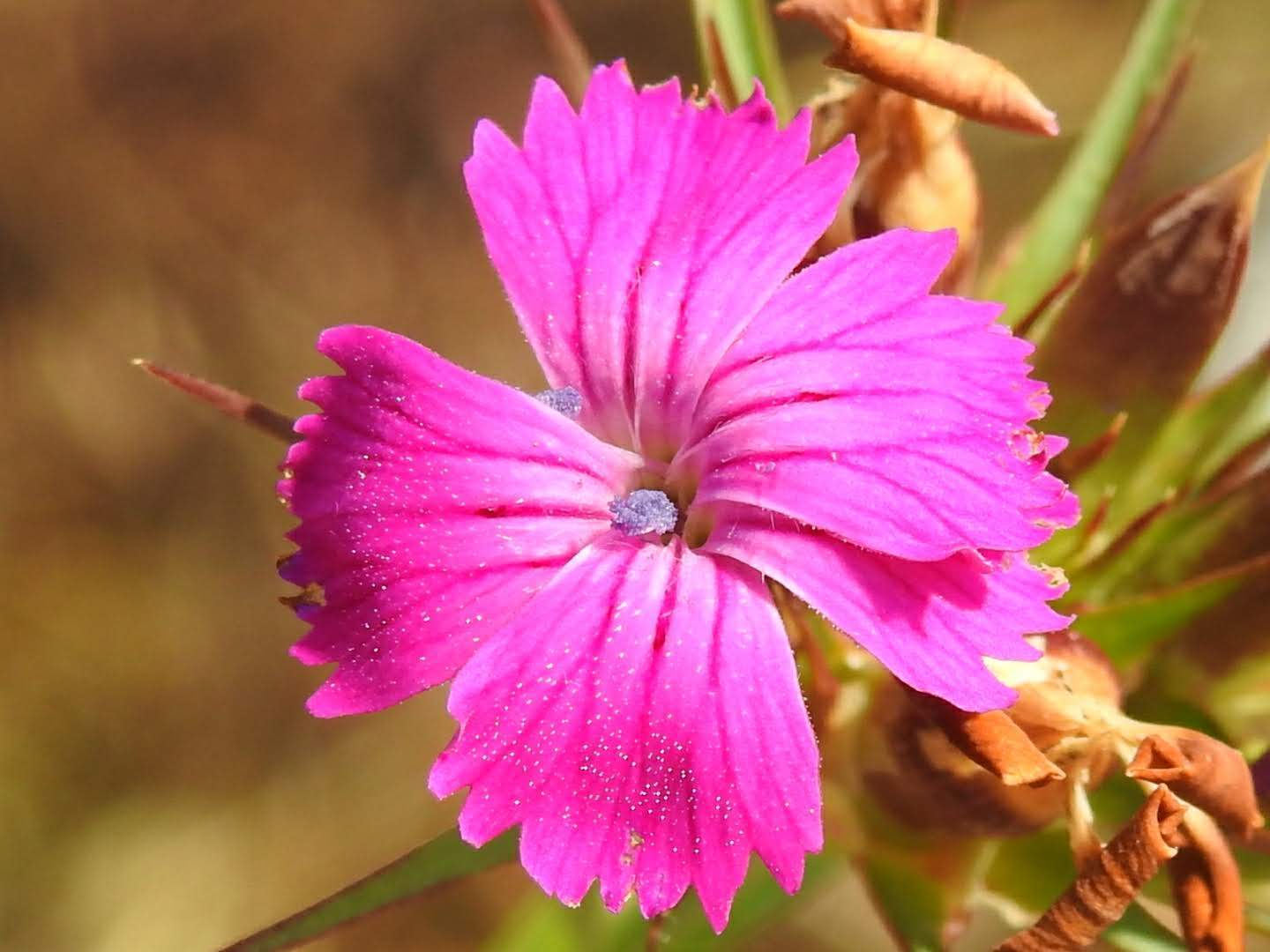
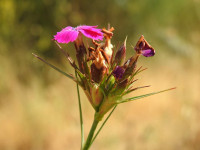
The Carthusian Pink is a perennial tufted plant, characterized by erect stems, simple or sometimes branched at the base, reaching a height between 25 and 65 cm. The base of the stem has a woody texture, while the surface is glabrous and hairless. The leaves are linear, with a sheath that can be 3 to 8 times longer than the diameter of the stem, and a blade ranging from linear to spatulate, green in color with glabrous margins; their length generally extends between 3 and 7 cm, but can reach up to 13 cm.
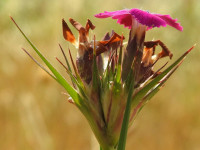
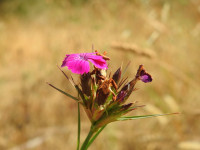
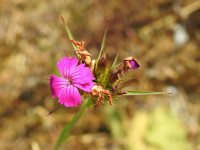
The flowers are gathered in dense inflorescences, formed by apical clusters composed of 4-15 or more flowers, developing in the axil of lanceolate bracts, herbaceous or more or less coriaceous and with an aristate apex. The bracts are as long as or longer than the calyx, which is fusiform, glabrous, with a length of 10-15 mm and 40-45 well-visible veins. The epicalyx scales are abruptly narrowed towards the apex, ending with a distinct awn separated from the laminar portion, a characteristic useful for distinguishing the species from related ones.
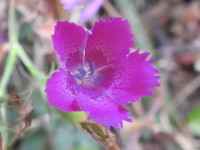
The petals vary in color from intense pink to fuchsia and purple, with a dentate apex, 10 to 15 mm long, and have a bearded base. The flowers are generally subsessile, that is, with very short pedicels (0.1-2 mm). The fruits are capsules 8-10 mm long, slightly shorter than the calyx, which open by means of four teeth; the seeds are about 1.6-2 mm in size. The root system is typically taprooted, allowing the plant good stability in the rocky and sunny habitats where it grows.
Habitat and distribution
The Carthusian Pink is present throughout continental Italy, except for Sardinia, and is not reported in Corsica. Its natural distribution mainly extends in central and southern Europe, with some populations also in the Balkan and Danubian areas. In Italy it preferably grows in sunny environments such as dry grasslands, rocky slopes, and open woods, typical of Mediterranean and temperate ecosystems. It prefers well-drained substrates, often calcareous or with dry soil, and is commonly found at altitudes between 500 and 1500 meters.
Flowering period
Flowering generally occurs from May to August, with a possible extension until September in more southern areas or at lower altitudes. The duration and intensity of flowering may vary depending on local climatic conditions and exposure. Usually, peak flowering is concentrated between June and July.
Ecology and pollination
The Carthusian Pink is mainly pollinated by pollinating insects attracted by the vivid color and scent of the flowers. The presence of bearded petals at the base suggests adaptations to facilitate entomophilous pollination, serving as a guide for pollinating insects. Seed dispersal occurs through the direct fall of mature capsules, which open to release the seeds, which settle in the soil below; no long-distance dispersal strategies are known.
Curiosities and traditional uses
The name "Carthusian Pink" probably derives from the association with the monastic order of the Carthusians, whose monasteries were often located in mountainous areas where this plant is common. Another possible origin of the scientific name is linked to the Karthäuser brothers, German naturalists of the 18th century. No specific traditional food or medicinal uses are documented for this species, nor particular references in local folklore. Its ornamental beauty and the fragrance of the flowers make it a plant appreciated also in rock gardens and botanical cultivations.
Etymology
The generic name Dianthus derives from the Greek “dios” (divine) and “anthos” (flower), translated as “divine flower” or “flower of Zeus,” probably due to the beauty and fragrance of the flowers of many species in the genus. The specific epithet carthusianorum refers to the monastic order of the Carthusians (in Latin Carthusiani), suggesting an ancient relationship or use of the plant in areas related to these monasteries. The Italian common name "Carthusian Pink" reflects this historical connection.
Sources
- Prof. S. Pignatti, "Flora d'Italia"
- World Flora Online (WFO)
Characteristics
Scheda botanica
| Famiglia | Caryophyllaceae |
|---|---|
| Fioritura | maggio – agosto |
| Forma biologica | Scapose |
| Habitat | with fuchsia flowers, with fragrant flowers, plant with a spreading bushy habit |
Domande frequenti
- Quando fiorisce Carthusian Pink?
- Carthusian Pink fiorisce maggio – agosto.
- Che tipo di pianta è Carthusian Pink?
- Carthusian Pink è una Hemicryptophytes (Scapose) secondo la classificazione di Raunkiaer.
- A quale famiglia appartiene Carthusian Pink?
- Carthusian Pink appartiene alla famiglia botanica Caryophyllaceae.
Where I found it (16 sightings)
Classification
- Kingdom
- Plantae
- Family
- Caryophyllaceae
- Full name
- Dianthus carthusianorum L.
- Life form
- Hemicryptophytes scapose
Similar species
Search for species with similar characteristicsFurther reading
Noticed an error in the identification? Write to me
Other species of the same family
Caryophyllaceae
Explore
Other species of Caryophyllaceae