Botanical species
Dianthus deltoides
L.
Maiden Pink
Description
Morphological description
Perennial herbaceous plant, tufted and generally prostrate-ascending in habit, the Maiden Pink reaches a variable height between 10 and 30 cm, with occasional specimens that can exceed 50 cm. The stem is branched, woody in the lower part and covered with a fine pubescence of stiff hairs, especially in the upper part. The stems are many-flowered, with branches giving the plant a dense tufted appearance.
The leaves are distinguished into basal and cauline. The basal leaves are linear-lanceolate, slightly glaucous, with a denticulate margin and dimensions between 10-25 mm in length and 1-3 mm in width. The leaves of sterile shoots are instead linear-spatulate, shorter (about 6-15 mm in length and 1.5-2 mm in width). The cauline leaves are sessile, narrower and acute, up to 25 mm long and about 1 mm wide.
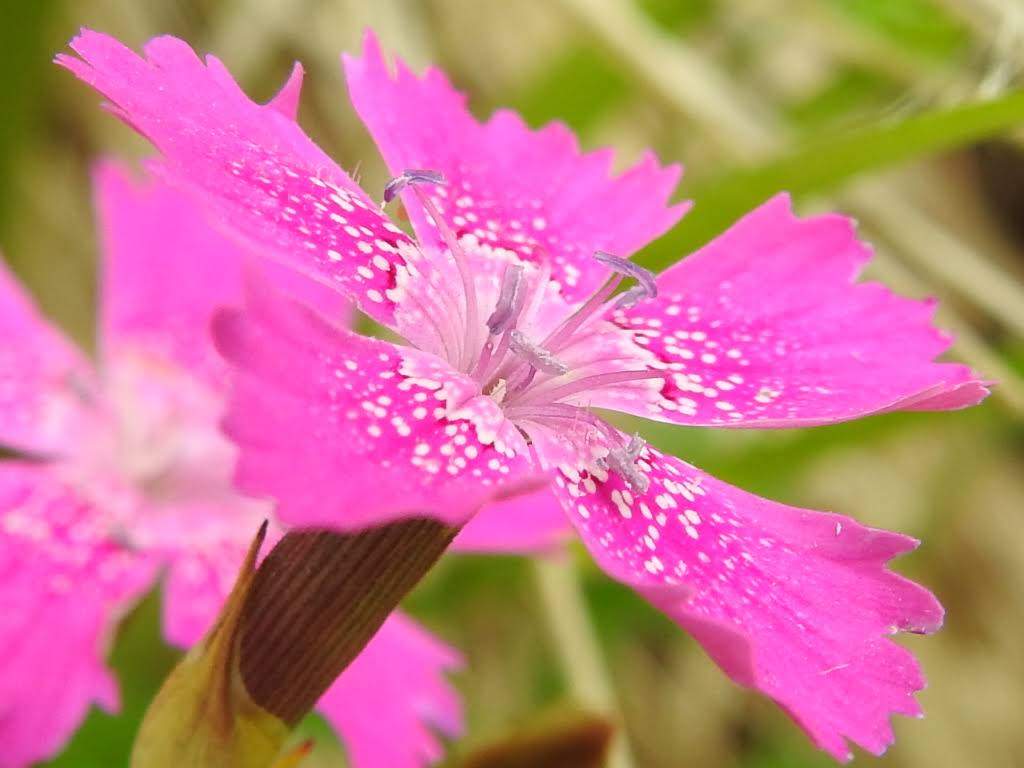
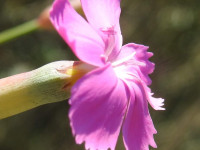
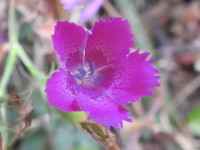
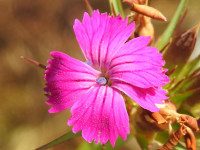
The flowers are solitary or in small groups of 2-3, positioned at the apex of the branches. The corolla measures about 1.5 cm in diameter, with rhomboid-acuminate petals, about 22 mm long. The color is generally purple, pink or fuchsia, with white spots and hairs on the upper surface and a dark ring often present around the center. The petal edges are irregularly dentate, giving the flower a characteristic and delicate appearance.
The calyx is sub-cylindrical, 12 to 20 mm long, reddish and papillose, with sharp teeth about 3 mm long. The calyx scales are 2-4, of which the outer ones are lanceolate-linear and the inner ones ovate and mucronate, reaching about half the length of the calyx. The fruit is an oblong cylindrical capsule, shorter than the calyx, containing numerous small seeds, irregularly ovoid to reniform, compressed and dark brown-black in color.
The root system, typical of tufted perennial plants, is formed by thin rhizomes that allow perennation and the formation of dense tufts.
Habitat and distribution
The Maiden Pink is mainly widespread in the mountainous and hilly regions of Italy and much of central and eastern Europe, extending to Asia (up to Japan). In Italy it is commonly found in dry meadows, pastures and forest edges, mainly at altitudes between 500 and 2000 meters. It is especially present in the mountainous regions of the East, Center and South, while it is absent or rare in the western areas and in the typically warmer and drier Mediterranean zones.
It prefers well-drained soils, often calcareous or stony, with sunny or partially shaded exposure. The typical habitat includes dry meadows, forest edges, mountain and subalpine pastures, where vegetation is sparse and competition with other herbaceous species is limited.
Flowering period
Flowering extends from May to August, with peaks varying depending on climatic conditions and altitude. In cooler mountain environments flowering may start slightly later and continue until September, while in lower and temperate areas it may begin earlier in May-June.
Ecology and pollination
The species is pollinated by pollinating insects, particularly small hymenopterans and dipterans, attracted by the bright coloration and the presence of white spots and dark rings on the petals, which act as visual signals. The presence of hairs and spots on the petals helps to increase the flower's visibility to insects.
Seed dispersal occurs mainly through the capsule which, once mature, opens releasing small and light seeds that can be carried by wind or animals. Perennation occurs through thin underground rhizomes that allow the plant to survive harsh winters and expand locally forming compact tufts.
Curiosities and traditional uses
The Maiden Pink is especially appreciated for its ornamental value: it is often used in rock gardens and alpine borders for its decorative flowering and hardiness. No specific medicinal or food uses are documented in the Italian tradition, but the genus Dianthus in general is known for some species used in herbal medicine and perfumery.
In folklore, the carnation in a broader sense is often associated with symbols of love and protection, but there are no particular references to the Maiden Pink in this regard.
Etymology
The scientific name of the genus derives from the Greek “Thiós” (God or Zeus) and “ánthos” (flower), meaning “divine flower,” emphasizing the beauty and symbolic value attributed to these plants. The specific epithet “deltoides” refers to the triangular shape of some plant organs, recalling the Greek letter delta (Δ).
The Italian common name “Maiden Pink” derives from the resemblance of its flowers to those of the true carnation, but with smaller size and more compact habit.
Sources
- Prof. S. Pignatti, "Flora d'Italia"
- Acta Plantarum - Flora delle regioni italiane
- Tela Botanica / H. Coste, "Flore descriptive et illustrée de la France"
- World Flora Online (WFO)
Characteristics
Scheda botanica
| Famiglia | Caryophyllaceae |
|---|---|
| Fioritura | maggio – agosto |
| Forma biologica | Tufted |
| Habitat | with fuchsia flowers, with pink flowers, Perennial plant |
Domande frequenti
- Quando fiorisce Maiden Pink?
- Maiden Pink fiorisce maggio – agosto.
- Che tipo di pianta è Maiden Pink?
- Maiden Pink è una Hemicryptophytes (Tufted) secondo la classificazione di Raunkiaer.
- A quale famiglia appartiene Maiden Pink?
- Maiden Pink appartiene alla famiglia botanica Caryophyllaceae.
Where I found it (4 sightings)
Classification
- Kingdom
- Plantae
- Family
- Caryophyllaceae
- Full name
- Dianthus deltoides L.
- Life form
- Hemicryptophytes tufted
Similar species
Search for species with similar characteristicsFurther reading
Noticed an error in the identification? Write to me
Other species of the same family
Caryophyllaceae
Explore
Other species of Caryophyllaceae