Botanical species
Moehringia muscosa
L.
Mossy Sandwort
Description
Morphological description
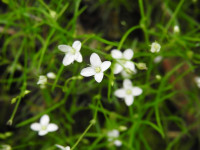
Small perennial herbaceous plant, Moehringia muscosa presents a tufted habit with prostrate or ascending-branched stems, forming loose and fragile tufts. The height generally varies between 5 and 20 cm, with greenish, glabrous stems characteristically thickened at the nodes. These stems branch from the base and are often slightly ascending, rarely completely erect.
The leaves are opposite, thin, from linear to filiform, with a length that can exceed 3 cm (commonly 20-30 mm, rarely up to 50 mm) and very reduced width, never spatulate towards the apex. The texture is herbaceous and the surface glabrous. The leaf venation is generally single, sometimes with three weak veins.
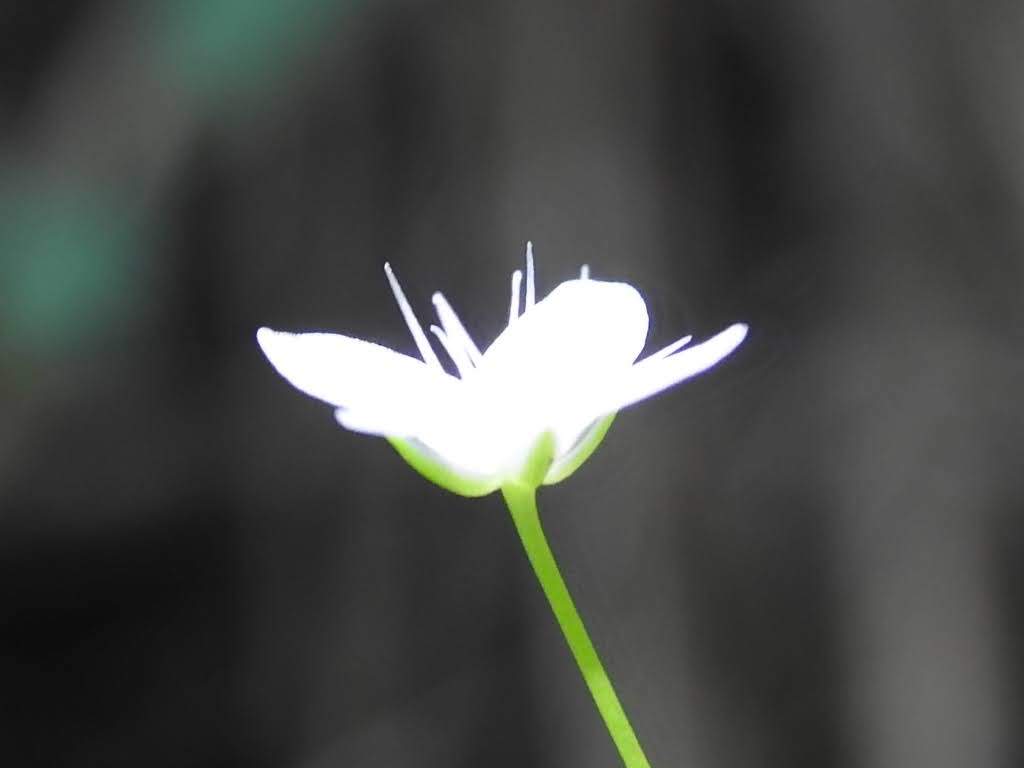
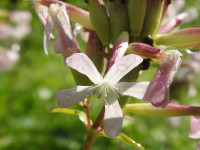
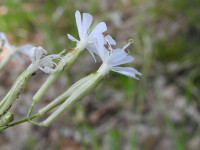
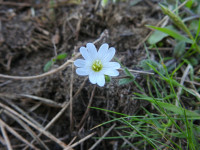
The flowers are small, with an overall diameter of about 6-8 mm. They are generally 4-merous, rarely 5 or more petals, arranged in terminal dicyclic inflorescences, composed of 3-6 flowers on thin peduncles up to 12 mm long, which tend to spread after flowering. The petals are white, obovate in shape, about 7 mm long, approximately 1.5 times longer than the sepals, thin and without a distinct claw. The sepals are narrowly lanceolate, acute, about 3 mm long, with a single vein, with a broad and scarious margin. The plant has 8 stamens and 2 styles.
The fruit is a denticidal capsule, about as long as the calyx, which at maturity releases reniform, brownish, smooth and shiny seeds, 1.2 to 1.5 mm long, characterized by a narrow slit incision. The strophiole is conical, formed by large and short cells, and in some cases fused into a plate with an entire and thickened margin.
The root system is not described in detail in the sources, but like many mountain perennial herbs it is presumably fibrous and shallow, suitable for rocky or mossy soils.
Habitat and distribution
This species is typical of mountainous and submontane environments, with a preference for calcareous substrates. It grows mainly in humid areas, on walls, soil, mosses, shady woods and cliffs, often in rocky and shady places up to 2,400 meters altitude.
In Italy it is mainly reported in the Alps and the northern and central Apennines, with some stations also in the Pollino. Some occurrences have been reported, albeit with reservation, also on Capri and on Etna. The distribution extends within the European orophyte context, with higher concentration in the southern mountain ranges and the Alpine margin.
The preferred environment is calcareous, generally shaded and humid exposure, often in microsites covered by moss, from which the specific name also derives.
Flowering period
The flowering extends from May to August, with possible variability related to altitude and latitude. In the Alpine reliefs the flowering season is mainly concentrated between June and July, while in more southern areas or at lower altitudes it can start as early as May and continue until late summer.
Ecology and pollination
Moehringia muscosa is a species mainly pollinated by pollinating insects, although detailed data on the species involved are not available. The flower structure, with fairly conspicuous white petals and numerous stamens, favors the attraction of pollinators. The presence of terminal inflorescences with multiple flowers facilitates insect visits.
Seed dispersal occurs through denticidal capsules which, at maturity, open releasing small and light seeds, probably dispersed mainly by wind and water. The conical and prominent strophiole could play a role in facilitating dispersal, although no particular strategies of anemochory or zoochory are known.
The plant is a tufted hemicryptophyte, with perennial buds at ground level, allowing it to survive cold winters and even difficult mountain conditions.
Curiosities and traditional uses
No known traditions of specific food or medicinal use for this species are known. The Italian common name "erba paglina" probably refers to the thin and filiform appearance of the leaves, which resemble fine straw or thin threads.
There are no relevant folkloric or ethnobotanical references in the specialized literature, probably due to the modest distribution and the habitat restricted to mountain areas.
Etymology
The genus name Moehringia is dedicated to Paul Heinrich Gerhard Moehring (1710-1792), a German botanist who contributed to the knowledge of European plants.
The specific epithet muscosa derives from the Latin "muscus", meaning moss, alluding to the ecological preference of the plant for environments covered by moss or similar in appearance and habitat to moss.
The Italian common name "erba paglina" probably refers to the thin and filiform shape of the leaves, which recall fine straw.
Sources
- Prof. S. Pignatti, "Flora d'Italia"
- Acta Plantarum - Flora delle regioni italiane (scheda di Giuliano Salvai)
- World Flora Online (WFO)
Characteristics
Scheda botanica
| Famiglia | Caryophyllaceae |
|---|---|
| Fioritura | maggio – agosto |
| Forma biologica | Tufted |
| Habitat | with white flowers, Perennial plant |
Domande frequenti
- Quando fiorisce Mossy Sandwort?
- Mossy Sandwort fiorisce maggio – agosto.
- Che tipo di pianta è Mossy Sandwort?
- Mossy Sandwort è una Hemicryptophytes (Tufted) secondo la classificazione di Raunkiaer.
- A quale famiglia appartiene Mossy Sandwort?
- Mossy Sandwort appartiene alla famiglia botanica Caryophyllaceae.
Where I found it (9 sightings)
Classification
- Kingdom
- Plantae
- Family
- Caryophyllaceae
- Full name
- Moehringia muscosa L.
- Life form
- Hemicryptophytes tufted
Similar species
Search for species with similar characteristicsFurther reading
Noticed an error in the identification? Write to me
Other species of the same family
Caryophyllaceae
Explore
Other species of Caryophyllaceae