Botanical species
Lychnis flos-cuculi
L.
Ragged Robin
Description
Morphological description
Perennial herbaceous plant of modest height, generally between 30 and 80 cm, characterized by an erect habit and thin stems, branched especially in the upper part. The stems have a reddish coloration and are covered by a light pubescence, giving the plant a velvety feel to the touch.
The leaves are arranged oppositely along the stem. The basal ones are linear-spatulate in shape, with variable sizes about 1 to 4-6 cm in length, while the upper cauline leaves are narrower and linear, 3 to 5 cm long and about 8-12 mm wide, with an acute apex and sessile attachment or, for the lower ones, sometimes weakly petiolate. The leaf texture is herbaceous, and their surface appears smooth.
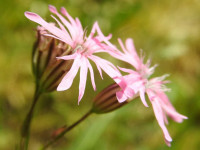
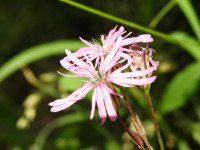
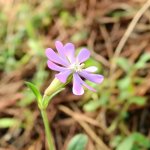
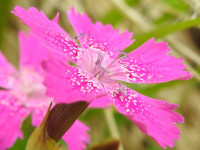
The flowering occurs in large cymes, with paniculated and well-branched inflorescences, producing numerous pink-purple flowers, sometimes also white, of actinomorphic shape. The individual flowers are borne on peduncles about 12-15 mm long and have a diameter of about 2-3 cm. The calyx, campanulate and glabrous in the central part, measures 6-10 mm and has acute teeth 2-3 mm long, with densely ciliate margins.
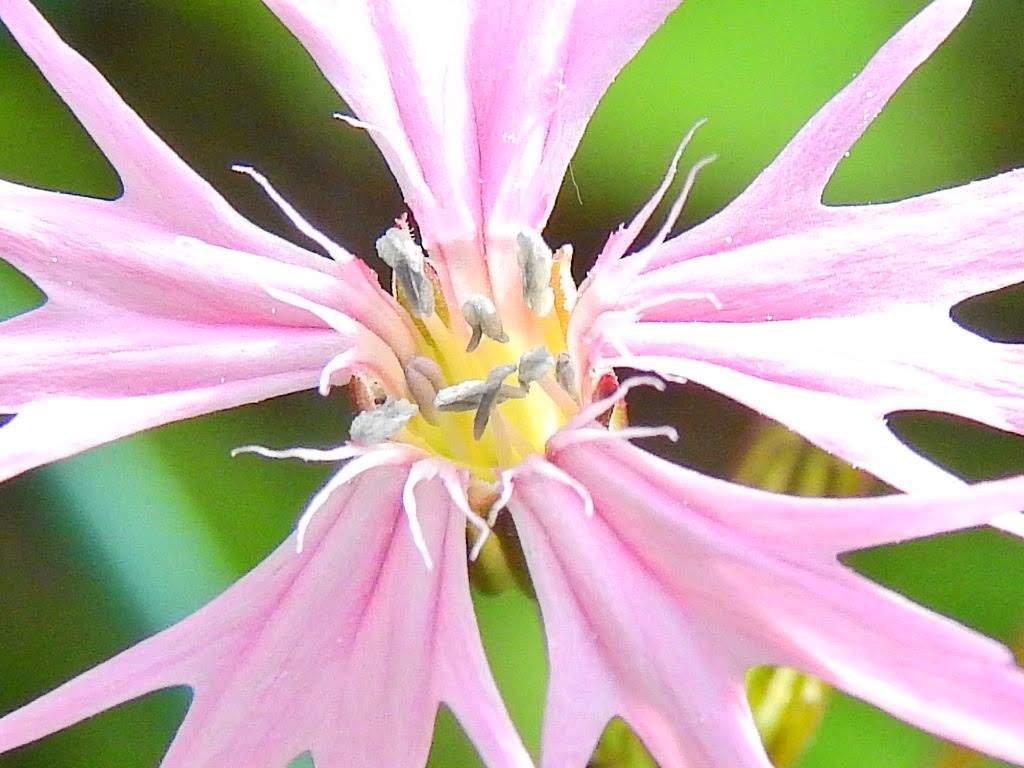
The petals, lacking auricles, are between 15 and 25 mm long and characterized by a deeply fringed or incised limb, divided into four oblong-linear lobes, often with fine lateral denticulations. This particular shape gives the flowers a delicate and "fringed" appearance, from which the common name derives. The fruit is a small capsule (5-7 mm) that opens to release the seeds.
The root system is typical of perennial herbaceous plants, with taproots that allow anchorage and absorption in soils of different nature, although preferably well-drained.
Habitat and distribution
This species is native to Europe and is commonly found in many Italian regions and the Mediterranean area. It prefers humid and cool environments such as meadows, forest edges, clearings, and pasture areas, often on fresh or moderately moist soils. It can grow up to an altitude of about 800-1000 meters above sea level.
It prefers sunny or partially shaded exposures and adapts to medium-textured soils, from neutral to slightly acidic, with good drainage capacity. It is a species typically associated with wet meadows and habitats where shrub or tree cover is not excessive, allowing light penetration.
Flowering period
Flowering mainly occurs in the summer period, from May to August, with a possible extension until September in some areas. The duration and intensity of flowering may vary slightly depending on latitude and local climatic conditions, with earlier flowering in milder climates and later flowering at higher altitudes or in cooler regions.
Ecology and pollination
The flowers of this species are particularly attractive to a variety of pollinating insects, including bees, bumblebees, and butterflies, which are stimulated by the bright color and flower structure, favorable to entomogamous pollination. The actinomorphic shape and the arrangement of the fringed petals facilitate access to nectar and pollen.
The reproductive strategy is predominantly sexual, with seed production that is mainly dispersed by gravity and, secondarily, through the action of small animals and atmospheric agents. The capsule containing the seeds opens once mature, allowing dispersion into the surrounding substrate.
Curiosities and traditional uses
The common name "Ragged Robin" derives from the similarity of the flowers to those of other species called "cuckoo," probably because the flowering coincides with the arrival of the cuckoo in spring or due to folkloric associations linked to this bird species.
No particular medicinal or traditional food applications are known for this plant, nor a consolidated use in phytotherapy or popular cuisine. However, for its beauty and delicacy, it is sometimes cultivated in spontaneous or naturalistic plant gardens for ornamental and educational purposes.
Etymology
The scientific genus name, Lychnis, derives from the Greek "lychnos" meaning "lamp," probably referring to the bright and showy shape of the flowers. The specific name flos-cuculi literally means "flower of the cuckoo," recalling popular traditions or seasonality linked to the observation of the cuckoo bird during the flowering period.
The Italian common name "crotonella fior di cuculo" combines the term "crotonella," probably a diminutive referring to similar or small-sized plants, with "fior di cuculo," referring to the scientific name and the characteristic appearance of the flowers.
Sources
- Prof. S. Pignatti, "Flora d'Italia"
- World Flora Online (WFO)
Characteristics
Scheda botanica
| Famiglia | Caryophyllaceae |
|---|---|
| Fioritura | maggio – agosto |
| Forma biologica | Scapose |
| Habitat | with pink flowers, Perennial plant |
Domande frequenti
- Quando fiorisce Ragged Robin?
- Ragged Robin fiorisce maggio – agosto.
- Che tipo di pianta è Ragged Robin?
- Ragged Robin è una Hemicryptophytes (Scapose) secondo la classificazione di Raunkiaer.
- A quale famiglia appartiene Ragged Robin?
- Ragged Robin appartiene alla famiglia botanica Caryophyllaceae.
Where I found it (25 sightings)
Classification
- Kingdom
- Plantae
- Family
- Caryophyllaceae
- Full name
- Lychnis flos-cuculi L.
- Synonyms
- Silene flos-cuculi (L.) Clairv.
- Life form
- Hemicryptophytes scapose
Similar species
Search for species with similar characteristicsFurther reading
Noticed an error in the identification? Write to me
Other species of the same family
Caryophyllaceae
Explore
Other species of Caryophyllaceae