Botanical species
Dianthus balbisii
Ser.
Balbis' Pink
Description
Morphological description
Perennial herbaceous plant, rhizomatous, belonging to the Caryophyllaceae family, characterized by a scapose habit with erect, glabrous stems of quadrangular or angled section, reaching a height between 30 and 80 cm. The base of the stem is woody and tufted, with rhizomes that ensure its perenniality and regenerative capacity.
The basal leaves are arranged in tufted clumps, linear in shape with entire margins, while the cauline leaves are opposite, sheathing the stem and generally smaller than the basal ones. The stem leaves are patent and linear-acuminate, with a sheath about twice as long as the blade width.
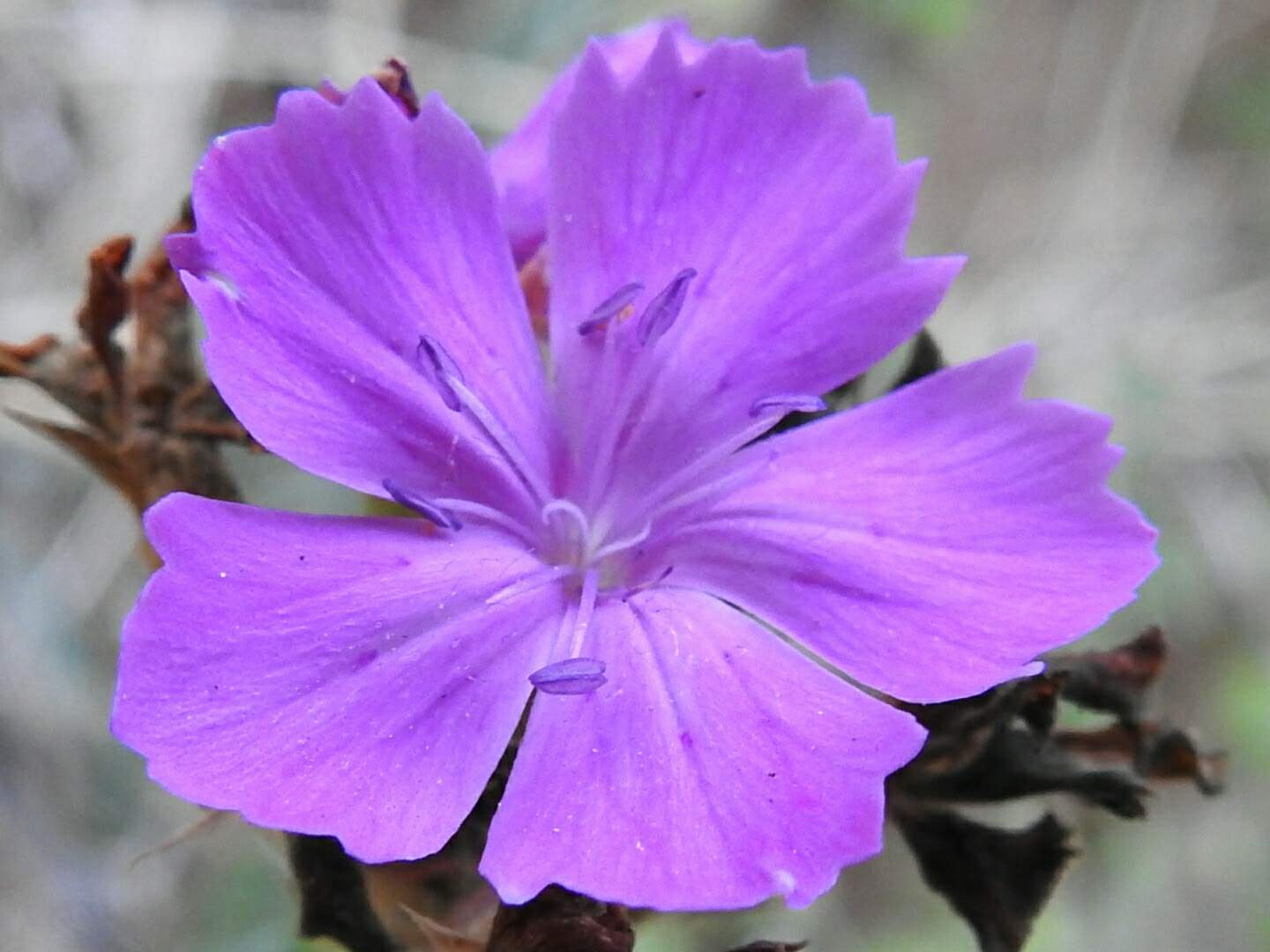
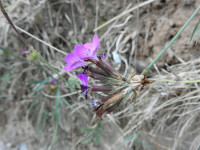
The flowers are grouped in dense apical clusters, generally composed of 2 to 6 flowers gathered in the axil of two herbaceous bracts similar to the leaves, which can exceed the length of the inflorescence itself. The epicalyx is formed by numerous leaf-like scales, leathery at the base and glabrous, gradually tapering and reaching the calyx teeth. The calyx, cylindrical and glabrous, is green with a purplish-violet coloration near the teeth.
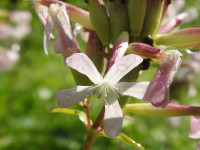
The corolla consists of five obovate, contiguous and glabrous petals, pink-violet in color with dentate margins. The flowering gives the plant a delicate yet compact appearance. The fruit is a cylindrical capsule containing irregularly shaped seeds.
The plant is evergreen, with buds at ground level that allow its survival even under adverse conditions. The scapose structure and general appearance make it similar to other species of the genus Dianthus with flowers grouped in apical clusters, although it presents distinctive characteristics in leaf shape and size and in the calyx.
Habitat and distribution
This species mainly grows in mountainous and hilly environments, preferring dry meadows, forest edges, and slopes exposed to full sun. It is typical of areas with rocky or stony substrate and adapts to well-drained soils, often calcareous or moderately loose.
In Italy it is an uncommon plant, tending to segregate local populations with slightly differentiated characteristics. Its distribution extends across the Mediterranean basin, from the French Provence to Montenegro and southern Russia, including some areas of Algeria. In Italy it is found up to about 1400 meters of altitude.
The species is particularly found in southern and eastern regions, with reports in areas such as the Maritime Alps, Var, Bouches-du-Rhône, and other hilly and mountainous zones of central-southern Italy.
Flowering period
Flowering occurs mainly between June and September, with a peak during summer (June-July). In some more northern or higher altitude areas, flowering may be more concentrated in the central summer months, while in warmer Mediterranean areas it can extend until the end of September.
Ecology and pollination
The plant has a reproductive strategy based on brightly colored flowers (pink-violet), which attract pollinating insects such as bees, bumblebees, and other hymenopterans. The arrangement of flowers in dense clusters facilitates entomogamous pollination, increasing the likelihood of visits by pollinating insects.
Seed dispersal occurs through the capsule which, once matured, opens to release the seeds, which are dispersed mainly by gravity and, secondarily, by external actions such as wind or animal activity. The plant is adapted to colonize sunny environments with poor soils, where it can compete effectively thanks to its resistance and ability to perennate through rhizomes.
Curiosities and traditional uses
No significant ethnobotanical applications or traditional uses are known for this species. Its interest is mainly botanical and naturalistic, given its rarity and particular mountainous and Mediterranean distribution. The common name "Balbis' Pink" honors the botanist Giovanni Battista Balbis, but it is not associated with documented medicinal or food uses.
Etymology
The genus name "Dianthus" derives from the Greek "Ziós" (flower) and "Zeús" (Jupiter), translatable as "flower of Jupiter", referring to the beauty considered "divine" of the flowers of this genus. The specific name "balbisii" is a tribute to Giovanni Battista Balbis (1765-1831), a Piedmontese botanist who made an important contribution to Italian botany.
The Italian name "Balbis' Pink" reflects this dedication and the resemblance to common pinks, emphasizing its belonging to the Dianthus group.
Sources
- Prof. S. Pignatti, Flora d'Italia
- Acta Plantarum - Flora delle regioni italiane (scheda di Mirna Medri)
- Tela Botanica / H. Coste, Flore descriptive et illustrée de la France
Characteristics
Scheda botanica
| Famiglia | Caryophyllaceae |
|---|---|
| Fioritura | giugno – settembre |
| Forma biologica | Scapose |
| Habitat | with purple flowers, Perennial plant, plant with a scapose habit |
Domande frequenti
- Quando fiorisce Balbis' Pink?
- Balbis' Pink fiorisce giugno – settembre.
- Che tipo di pianta è Balbis' Pink?
- Balbis' Pink è una Hemicryptophytes (Scapose) secondo la classificazione di Raunkiaer.
- A quale famiglia appartiene Balbis' Pink?
- Balbis' Pink appartiene alla famiglia botanica Caryophyllaceae.
Where I found it (8 sightings)
Classification
- Kingdom
- Plantae
- Family
- Caryophyllaceae
- Full name
- Dianthus balbisii Ser.
- Life form
- Hemicryptophytes scapose
Similar species
Search for species with similar characteristicsFurther reading
Noticed an error in the identification? Write to me
Other species of the same family
Caryophyllaceae
Explore
Other species of Caryophyllaceae