Botanical species
Silene italica
(L.) Pers.
Italian Catchfly
Description
Morphological description
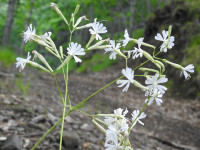
Perennial herbaceous plant, 30 to 60 cm tall, equipped with a taproot. The stem is erect, sticky to the touch, branched especially at the base and has erect flowering branches with dense hairs between 0.3 and 0.6 mm long. Generally, the stem is irregularly branched.
The leaves are mainly arranged in a basal rosette; the basal leaves are linear-spatulate, acute, with a blade 5-13 mm wide and 30-65 mm long, borne on a petiole 30-40 mm long, and usually disappear at flowering time. The cauline leaves are smaller: the lower ones linear, the upper ones tend to be sub-triangular. The leaf margin is entire, and the herbaceous texture is typical of perennial species.
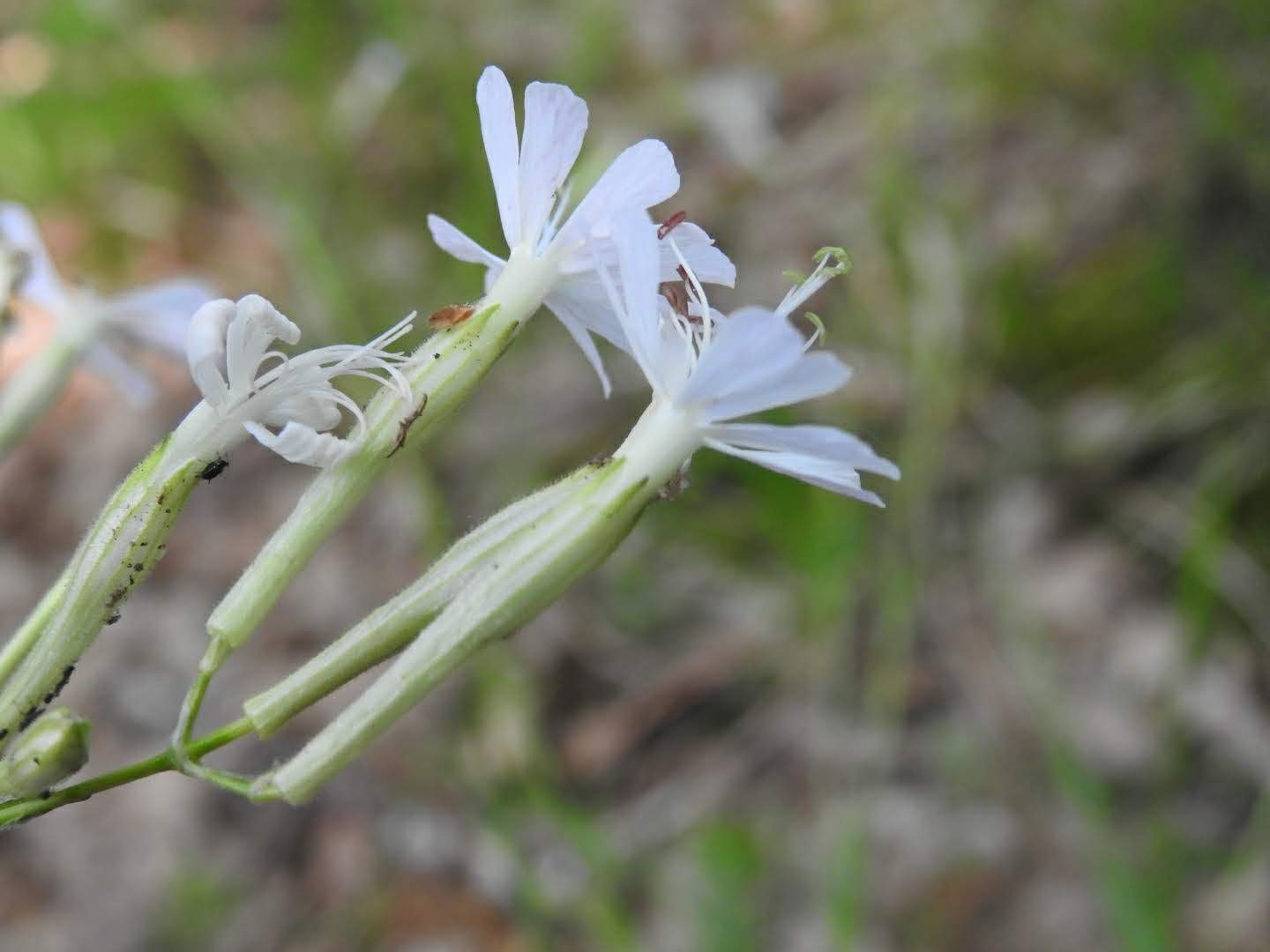
The inflorescence appears as a broad pyramidal dichasium with glabrous but sticky branches. The calyx is narrowly conical, 15 to 20 mm long (commonly around 18 mm) and 2-3 mm wide, with obtuse teeth about 1 mm long. The surface of the calyx is covered with simple and sometimes glandular hairs, and the upper part takes on a clavate shape.
The corolla has five free petals, milky white with reddish lower veins, about 15 mm long. The petals are glabrous, deeply bifid and ciliate at the throat, lacking scales, but with two well-evident gibbosities. There are 10 stamens and 3 styles.
The fruit is an ovoid, denticidal capsule, 4-6 mm wide by 9-12 mm long. The carpophore (style) is about as long as the capsule or slightly longer. The seeds measure about 0.9 x 1.2 mm, are reticulated, tuberculate and have a canaliculate back.
The plant is generally sticky-glandular and may present slight pubescence.
Habitat and distribution
The species is widely distributed in the Mediterranean basin with a range mainly affecting Mediterranean coasts, but it also extends northwards and eastwards, in areas historically linked to vine cultivation. In Italy it is very common and frequent, even in anthropized environments.
It prefers habitats of dry meadows, scrublands and forest edges. It grows well on well-drained soils, often calcareous, and tolerates sunny exposures. The altitude range varies from plains up to hilly and submontane elevations, typically up to about 800-1000 meters.
Flowering period
Flowering mainly extends from April to July. No substantial variations in the flowering period are known between different regions, although in milder climatic conditions flowering may start earlier or last slightly longer.
Ecology and pollination
The Italian Catchfly relies mainly on pollinating insects, including butterflies and bees, attracted by the white color of the corolla and the presence of red veins that guide to the nectar. The ciliate corolla and petal gibbosities are adaptations that facilitate pollination.
Seed dispersal occurs through the denticidal capsule which, once mature, opens releasing the seeds, which, thanks to their tuberculate and reticulated structure, can adhere to the soil or small debris.
Curiosities and traditional uses
The genus name refers to Silenus, a mythological deity linked to Bacchus, often depicted with humanoid features but also with equine ears, tail or hooves. This mythological reference could be due to the sticky secretion present on many species of the genus, or to the swollen and turgid appearance of the calyx, which recalls the prominent and constantly drunk belly of Silenus.
No specific data are available on traditional, medicinal or food uses for this species, nor on any folkloric meanings. However, the specific name “italica” indicates its strong association with Italy and the Mediterranean.
Etymology
The genus name, Silene, derives from the Latin Silenus, a mythological character of Greco-Roman tradition, known for his perpetual drunkenness and peculiar physical characteristics, which are reflected in the sticky habit and swollen calyx of plants of this genus.
The specific name “italica” derives from the geographic area of origin or greatest distribution, Italy, and can therefore be translated as “Italian” or “of Italy”.
The Italian common name, Italian Catchfly, simply reflects the scientific denomination, emphasizing its presence and distribution in the national territory.
Sources
- Prof. S. Pignatti, "Flora d'Italia"
- Acta Plantarum - Flora delle regioni italiane (scheda di Roberta Alberti)
- World Flora Online (WFO)
Characteristics
Scheda botanica
| Famiglia | Caryophyllaceae |
|---|---|
| Fioritura | aprile – luglio |
| Forma biologica | Rosulate |
| Habitat | with white flowers, Perennial plant |
Domande frequenti
- Quando fiorisce Italian Catchfly?
- Italian Catchfly fiorisce aprile – luglio.
- Che tipo di pianta è Italian Catchfly?
- Italian Catchfly è una Hemicryptophytes (Rosulate) secondo la classificazione di Raunkiaer.
- A quale famiglia appartiene Italian Catchfly?
- Italian Catchfly appartiene alla famiglia botanica Caryophyllaceae.
Where I found it (7 sightings)
Classification
- Kingdom
- Plantae
- Family
- Caryophyllaceae
- Full name
- Silene italica (L.) Pers.
- Synonyms
- Cucubalus italicus L.
- Life form
- Hemicryptophytes rosulate
Similar species
Search for species with similar characteristicsFurther reading
Noticed an error in the identification? Write to me
Other species of the same family
Caryophyllaceae
Explore
Other species of Caryophyllaceae