Botanical species
Carlina corymbosa
L.
Carlina raggio d'oro
Description
Morphological description
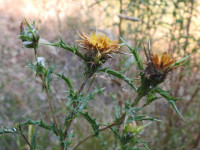
Perennial herbaceous plant, Carlina raggio d'oro has an erect or ascending habit with stems generally between 20 and 80 cm tall. The stem is simple, sparingly branched or even unbranched, woody at the base and almost glabrous. The plant develops from a branched, thickened and lignified rhizome, superficial in the soil, from which one or more aerial stems arise.
The leaves are leathery, spiny and toothed along the margins. The lower leaves are generally lanceolate, narrowed into a petiole and often disappear at flowering. The median leaves, up to about 9 cm long, are lanceolate-triangular, 4 to 4.5 times longer than wide, deeply pinnatifid with about five pairs of lobes per side, all patent and arcuate. The apical spines of the leaves are 1 to 2 cm long, more robust on the central part, and the lateral ones shorter (1-3 mm). The upper leaves are narrower, arcuate-patent and often bracteal, i.e. modified to protect the flower heads.
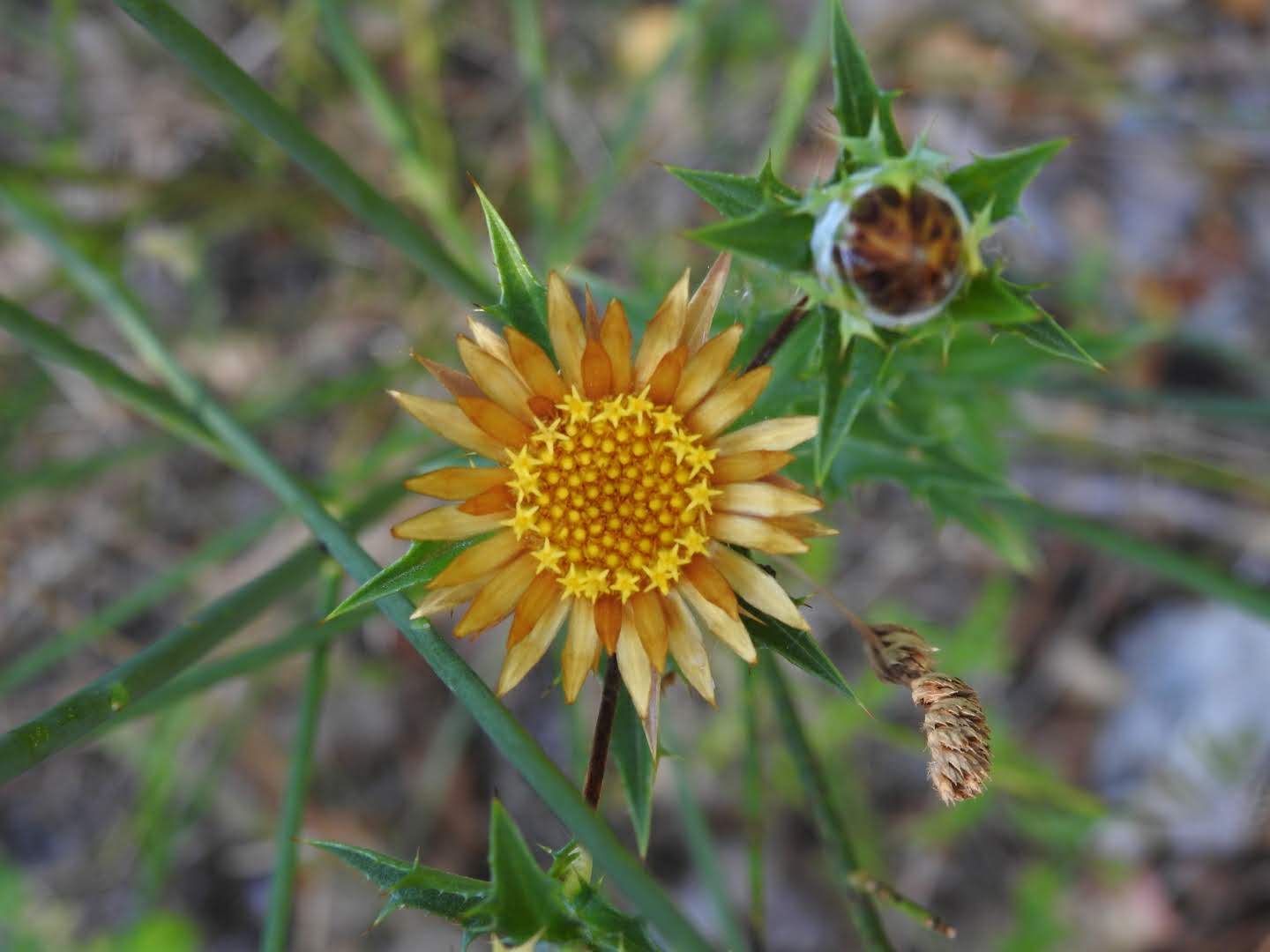
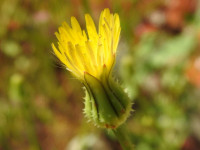
The flower heads, solitary or grouped in small corymbs at the tips of the branches, have a diameter of 1.5-4 cm (with the bracts up to 4 cm). The outer involucral bracts are linear-lanceolate, up to 4-5 cm long, clearly longer than the inner scales, and end with an apical spine of 7-25 mm. The inner scales are radiate, spatulate-subspatulate in shape, about 2 mm wide and 16-18 mm long, golden yellow on the upper side and yellow or purplish on the lower side, often brownish when dry.
The flowers are hermaphroditic, with a tubular corolla with 5 lobes of straw yellow color, up to 8 mm long. The androecium consists of 5 epipetalous stamens forming a tube around the style, while the gynoecium has an inferior unilocular ovary with a solitary style with two stigmas.
The fruit is an oblong cypsela about 2.5 mm long, equipped with a ringed feathery pappus, 2-3 times the length of the achene, which facilitates anemochorous dispersal.
Habitat and distribution
This species is mainly widespread in the Mediterranean area, with a range extending along the coasts and continuing northwards and eastwards. In Italy it is mainly present in the southern and insular regions, with reports in Calabria, northeastern Sicily and Puglia (Tremiti Islands). It is not present in Sicily in areas occupied by Carlina sicula.
A typical plant of dry and sunny environments, it grows in dry pastures, uncultivated fields, roadsides and sparse woods. It prefers stony or clayey soils, alkaline and poorly nitrified. The species adapts to a wide altitudinal range, from sea level up to about 1200 meters.
Flowering period
Flowering mainly occurs from July to October, with local variations related to climate and altitude. In warmer Mediterranean climates flowering can begin as early as July, while in more northern or mountainous areas it extends until October.
Ecology and pollination
The bright yellow flower heads, with tubular corollas shaped like small stars, are suitable to attract various pollinating insects, particularly bees and other hymenopterans, which promote pollination. The flower structure, with epipetalous stamens forming a tube around the style, represents a common strategy in Asteraceae to optimize contact with pollinators.
Seed dispersal occurs via the feathery pappus, which allows the wind to carry the cypselae over moderate distances, facilitating colonization of new open and sunny habitats.
Curiosities and traditional uses
Carlina raggio d'oro is a medicinal and edible plant, although the presence of spines and prickles makes its consumption rather laborious. In Sicily, however, young spring stems are collected, carefully cleaned of prickles and boiled, then consumed as a vegetable with a taste similar to artichoke.
The roots, rich in active principles, have traditionally been used in popular phytotherapy as diaphoretics, stomachics and antidotes against poisons. Furthermore, they were used to soothe toothache and to treat some skin diseases.
The genus name Carlina may derive from the Italian name "Cardellina" or "Cardina", diminutives of "cardo", or more anecdotally from Charlemagne, to whom a legend attributes the use of this plant against the plague, although this origin is probably apocryphal. The specific epithet "corymbosa" refers to the corymb arrangement of the flower heads, that is an inflorescence with flowers borne on peduncles of different lengths but with the top aligned.
Etymology
The name Carlina seems to derive from the Italian term "Cardina" or "Cardellina", meaning "little thistle". The hypothesis of a derivation from Charlemagne is a popular legend without scientific basis.
The specific name "corymbosa" indicates the characteristic arrangement of the flower heads in corymbs, i.e. inflorescences with flowers arranged so as to form a more or less flat surface, similar to an umbrella.
The common name "Carlina raggio d'oro" derives from the bright golden yellow color of the flowers, which resemble sun rays.
Sources
- Prof. S. Pignatti, "Flora d'Italia"
- Acta Plantarum - Flora delle regioni italiane (sheet by Giuliano Salvai)
- Tela Botanica / H. Coste, "Flore descriptive et illustrée de la France"
Characteristics
Scheda botanica
| Famiglia | Asteraceae |
|---|---|
| Fioritura | luglio – ottobre |
| Forma biologica | Scapose |
| Habitat | with yellow flowers, spiny plant, biennial plant |
Domande frequenti
- Quando fiorisce Carlina raggio d'oro?
- Carlina raggio d'oro fiorisce luglio – ottobre.
- Che tipo di pianta è Carlina raggio d'oro?
- Carlina raggio d'oro è una Hemicryptophytes (Scapose) secondo la classificazione di Raunkiaer.
- A quale famiglia appartiene Carlina raggio d'oro?
- Carlina raggio d'oro appartiene alla famiglia botanica Asteraceae.
Where I found it (12 sightings)
Classification
- Kingdom
- Plantae
- Family
- Asteraceae
- Full name
- Carlina corymbosa L.
- Synonyms
- Carlina corymbosa L. subsp. graeca auct. Fl. Ital.
- Life form
- Hemicryptophytes scapose
Similar species
Search for species with similar characteristicsFurther reading
Noticed an error in the identification? Write to me
Other species of the same family
Asteraceae
Explore
Other species of Asteraceae