Botanical species
Cirsium palustre
(L.) Scop.
Marsh Thistle
Description
Morphological description
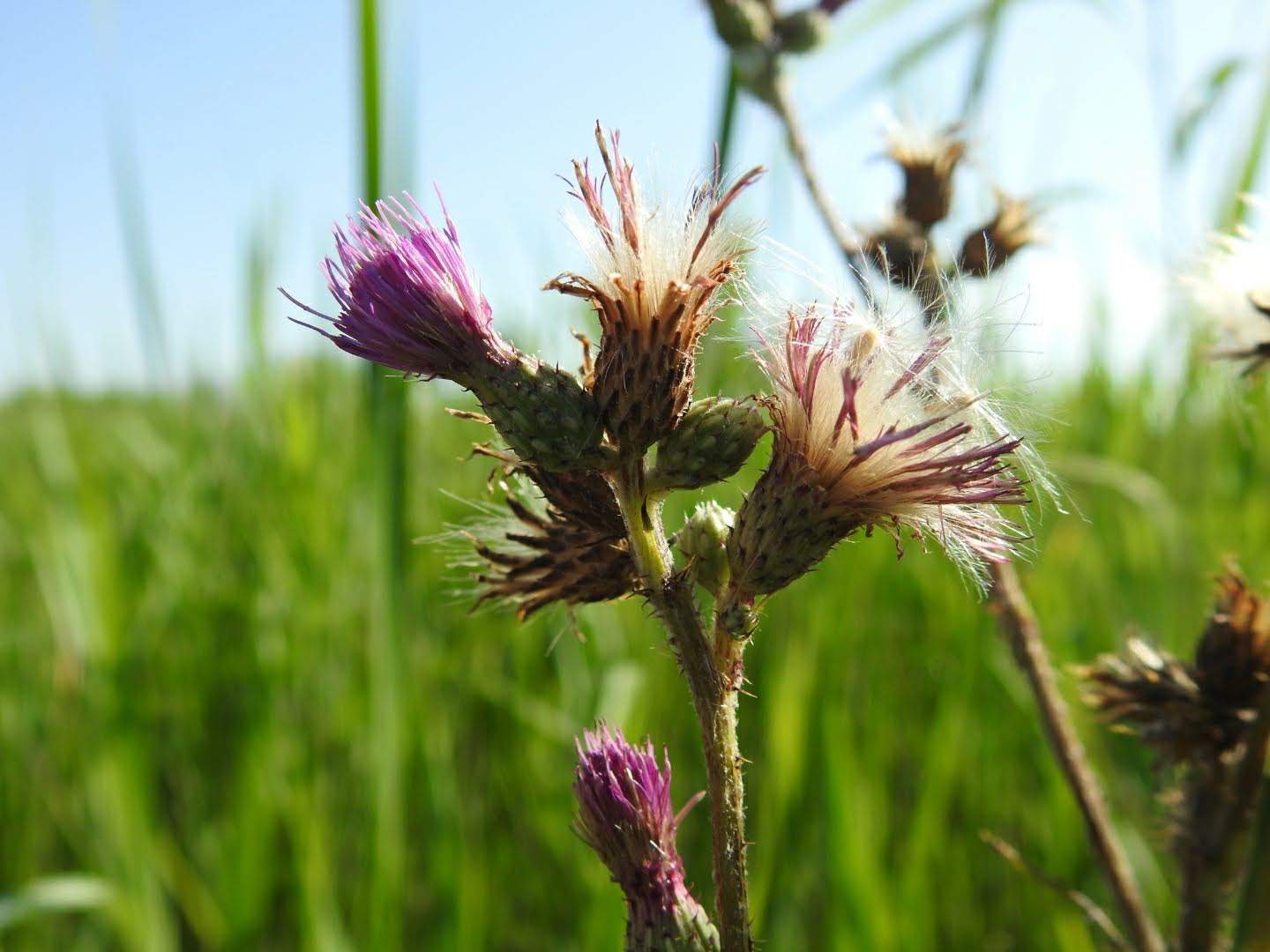
The Marsh Thistle is a biennial herbaceous plant that generally reaches a height between 40 and 150 centimeters, but can exceptionally grow up to 2 meters or more. The stem is erect, slender, simple or slightly branched in the upper part, where it sometimes curves slightly due to the weight of the flowers. The surface of the stem is provided with spiny wings, formed by the bases of the leaves that extend along the stem, often reduced to groups of spreading spines, making it particularly spiny and defensive.
The basal leaves are gathered in a rosette, have a lanceolate shape and vary in size between 12 and 20 centimeters in length. They are deeply divided into sharp and spiny triangular segments, with strongly serrated margins equipped with spines 2-4 mm long. The upper surface of the leaves is rough and somewhat coarse, while the lower surface is covered with dense white cobwebby hairs, giving a velvety appearance. The intermediate leaves, located along the stem, are similar but smaller and decurrent, while in the upper part of the stem they are often reduced or absent, giving an almost leafless appearance to this area.
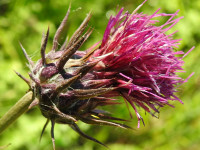
The inflorescence consists of numerous flower heads gathered in dense apical clusters. The flower heads have a cup-shaped involucre (diameter 7-11 mm), with imbricated, woolly and brownish scales, with a blackish spiny apex. The lower scales are shorter (about 1.2x4 mm), while the upper ones are longer (1x10-12 mm). The tubular flowers, very numerous inside each flower head, have a corolla of bright reddish-purple color, with a length between 13 and 18 mm, although varieties with lighter or faded corollas may exist. The stamens have pubescent filaments. The fruit is a cylindrical achene about 3 mm long, equipped with a feathery pappus of 7–13 mm formed by numerous barbed hairs at the base, which favor wind dispersal.
The root system, typical of biennial plants, is taprooted, allowing the plant to anchor firmly in moist and often unstable soils such as those of marshes.
Habitat and distribution
The Marsh Thistle is a species typical of wet environments, particularly marshes, peat bogs, wet meadows, swamps and edges of springs or water stagnations. It prefers substrates rich in constant moisture, often acidic or subacid, and is common in lowland and mid-mountain environments, generally between 600 and 1900 meters of altitude. It is rarely found in the plains, while it is frequent in the paleo-temperate zones of the Alps and northern Apennines. Its distribution in Italy is therefore concentrated mainly in the alpine and northern Apennine regions, while it is rarer or very rare in southern areas, for example in southern Italy up to the Sila and Serra San Bruno.
In the Mediterranean basin, the species is present in temperate Eurasian areas and has been introduced in North America, where in some areas it has become invasive, forming very dense and impenetrable colonies especially along roads, ditches and communication routes.
Flowering period
The flowering of the Marsh Thistle generally extends from June to September, although in some mountainous areas it may start later or end earlier depending on climatic conditions. The flowers, of bright reddish-purple color, can sometimes show color variations with lighter or almost white forms, although these are less common.
Ecology and pollination
The Marsh Thistle is an entomogamous species, i.e. pollinated by pollinating insects. Its tubular and colorful flowers attract numerous insects, including bees, bumblebees and butterflies, which play a fundamental role in fertilization. The feathery pappus facilitates wind dispersal, allowing the fruits to be carried by the wind over variable distances.
This species is also characterized by a marked ability to colonize marginal and wet environments, exploiting its spiny structure as a defense against herbivores and its robustness to compete with other plant species. In North America, where it has been introduced, this ability to adapt and compete has made it a very invasive weed species.
Curiosities and traditional uses
The genus name derives from the Greek “kirsós” meaning “varicose vein,” recalling the ancient popular belief that plants of this genus were effective in treating varicose veins, although there is no scientific evidence supporting these properties. The specific name “palustre” clearly indicates the typical habitat of this species: marshy and wet areas.
In some cultures, related thistle species have been used for food purposes (for example young shoots or cultivated thistles), but Cirsium palustre is not known for widespread food uses nor for significant medicinal use outside popular traditions. In North America it is considered an environmental problem due to its invasiveness and impenetrability.
Etymology
The scientific name "Cirsium" derives from the Greek “kirsós,” a word indicating a varicose vein or venous swelling, related to the traditional use of these plants in the treatment of varicose veins. The specific name “palustre” refers to the typical habitat of the species, i.e. the marshy and wet areas where it grows spontaneously. The Italian common name “cardo di palude” summarizes these characteristics, recalling both the similarity to other thistles for the spiny shape and the growth environment.
Sources
- Prof. S. Pignatti, "Flora d'Italia"
- Acta Plantarum - Flora delle regioni italiane (scheda di Marinella Zepigi)
- World Flora Online (WFO)
Characteristics
Scheda botanica
| Famiglia | Asteraceae |
|---|---|
| Fioritura | giugno – settembre |
| Forma biologica | Biennials |
| Habitat | with fuchsia flowers |
Domande frequenti
- Quando fiorisce Marsh Thistle?
- Marsh Thistle fiorisce giugno – settembre.
- Che tipo di pianta è Marsh Thistle?
- Marsh Thistle è una Hemicryptophytes (Biennials) secondo la classificazione di Raunkiaer.
- A quale famiglia appartiene Marsh Thistle?
- Marsh Thistle appartiene alla famiglia botanica Asteraceae.
Where I found it (2 sightings)
Classification
- Kingdom
- Plantae
- Family
- Asteraceae
- Full name
- Cirsium palustre (L.) Scop.
- Synonyms
- Carduus palustris L.; Cnicus palustris (L.) Willd.
- Life form
- Hemicryptophytes biennials
Similar species
Search for species with similar characteristicsFurther reading
Noticed an error in the identification? Write to me
Other species of the same family
Asteraceae
Explore
Other species of Asteraceae