Botanical species
Artemisia verlotiorum
Lamotte
Chinese Mugwort
Description
Morphological description
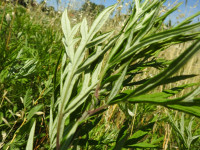
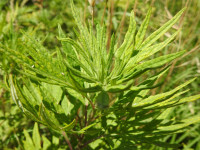
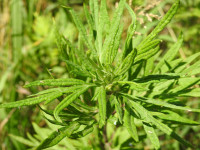
Perennial herbaceous plant belonging to the family Asteraceae, characterized by an erect and very branched habit. The height generally varies between 40 and 150-200 cm. The stem is striated reddish in color, with a rough surface and ascending-branching, equipped with numerous branches. The root system is tuberous and deep, with horizontal rhizomes or stolons that can extend for about 1 meter, allowing the plant a remarkable capacity for expansion and perennation.
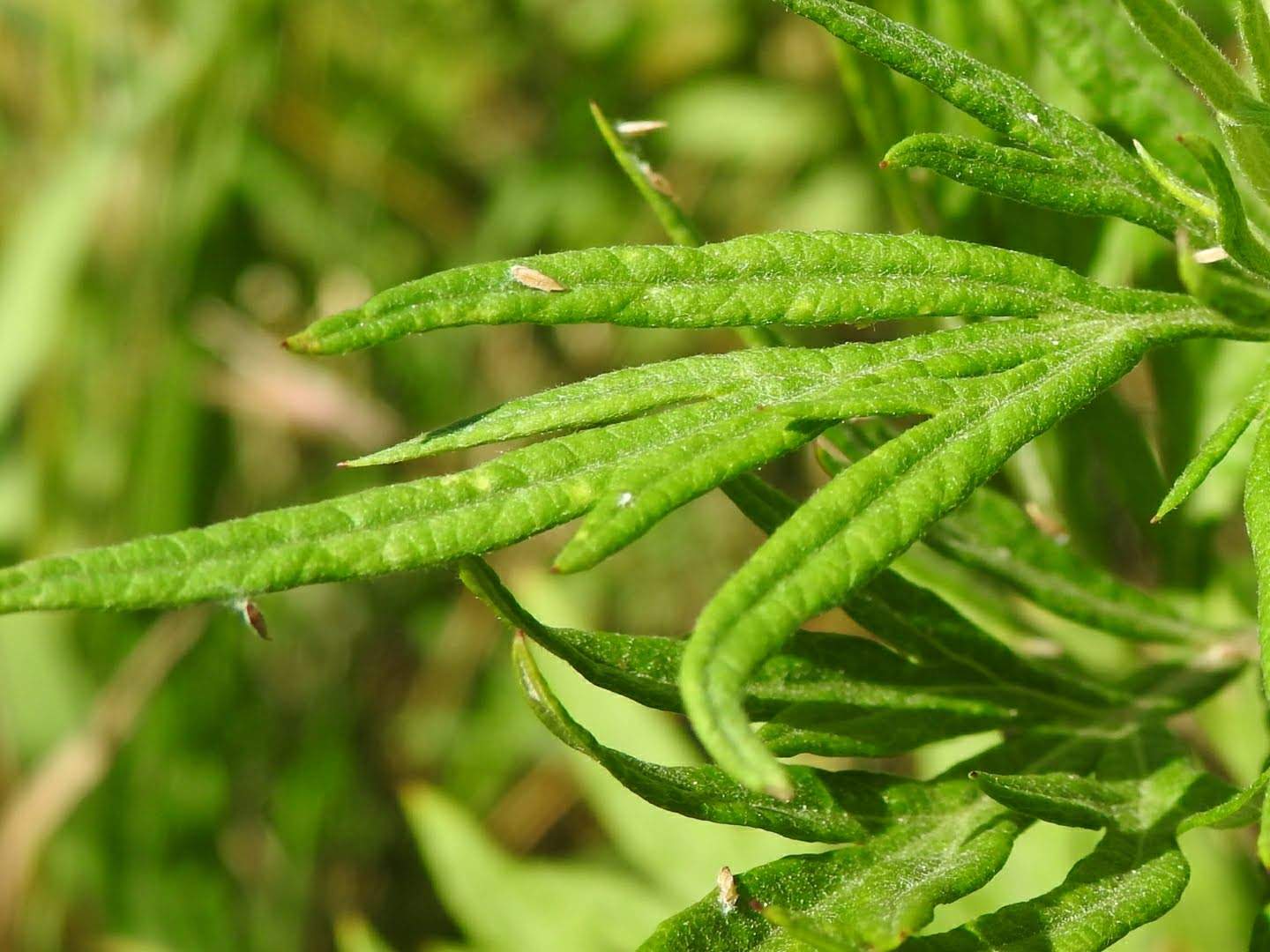
The leaves are alternate, lanceolate in shape and with entire margins. They have a glabrous and intense green upper surface, while the lower surface is tomentose and glandular. The upper leaves are divided into elongated lanceolate lobes, all of similar size (5-10 x 3-8 cm), with entire margins and slightly glandular texture. The lower leaves are smaller, semi-clasping the stem, with 3-5 pairs of lanceolate or lanceolate-linear lobes.
The inflorescence consists of dense pyramidal panicles of capitula (calathidia), tomentose and often arranged unilaterally. The capitula are small, spherical or ovoid, about 3 mm in diameter, grouped in clusters of 1-3 and with two orders of bracts, elongated oval, glabrous and with scarious margins. The flowers are tubular, with a filamentous corolla 2-3 mm long and reddish-brown in color, giving the plant a characteristic appearance compared to other Artemisia. The fruits are oblong-ovate achenes, without pappus, brown in color and 0.5-0.8 mm in size.
Habitat and distribution
Native to East Asia, naturalized species in Europe, it grows in humid environments disturbed by human activity, such as embankments, abandoned industrial areas, edges of rural roads, riparian woods, riverbeds. In Italy it is mainly found at low altitudes, from 0 up to about 600 meters above sea level.
It prefers nitrogen-rich and moist soils, exposed to full sun, typical of low-altitude hilly and mountainous environments. It is a strongly invasive species, capable of competing with local herbaceous flora thanks to its extensive rhizomes and stolons.
Flowering period
Flowering occurs mainly between October and November, later than Artemisia vulgaris with which it can be confused. The difference in flowering period is one of the useful criteria to distinguish it from similar species.
Ecology and pollination
The aromatic scent, particularly camphoraceous, is a distinctive characteristic. The plant produces tubular flowers that favor pollination by pollinating insects, mainly small hymenopterans and dipterans attracted by the aroma and nectar. Seed dispersal occurs through small achenes without pappus, so colonization of new areas mainly occurs through vegetative propagation via rhizomes and stolons, which confer a high capacity for expansion and invasiveness.
Curiosities and traditional uses
Verlot's wormwood is known for its officinal and medicinal properties. The flowering tops and roots contain essential oils, camphor, borneol, vulgarol, flavonoids, lactones, inulin and moderate amounts of thujone. Traditionally it has been used as a eupeptic, antispasmodic and bitter-tonic to improve digestion and rebalance menstrual disorders, particularly in popular female medicine.
Historically, the plant was appreciated since antiquity, with references by Dioscorides, Pliny and Hippocrates, especially for its role in rebalancing the menstrual and female sphere.
From a folkloric point of view, a bouquet of Artemisia gathered on St. John's Day was considered an amulet against the evil eye. It was also used to stuff pillows which, according to tradition, favored spiritual insights and the ability to foresee the future.
From an ecological point of view, it is considered an invasive and weedy species. Its presence can limit the growth of other local herbaceous plants, and its eradication is difficult due to the ability to regenerate from underground stolons. In several Italian regions it is therefore included in the weed blacklists. It is also used as a natural insecticide, often associated with pyrethrum.
Etymology
The genus name Artemisia derives from the Greek Ἄρτεμις (Artemis), the Greek goddess of hunting and nature, also associated with the female cycle, and could also refer to Artemisia II of Caria, queen and botanist of antiquity. The specific epithet “verlotiorum” is a tribute to the Verlot brothers, botanists from Grenoble, who studied and classified the species in Europe.
The Italian common name "Chinese Mugwort" directly recalls this botanical dedication, distinguishing it from common wormwood (Artemisia vulgaris).
Sources
- Acta Plantarum - Flora delle regioni italiane (scheda di Antonino Messina)
- World Flora Online (WFO)
Characteristics
Where I found it (2 sightings)
Classification
- Kingdom
- Plantae
- Family
- Asteraceae
- Full name
- Artemisia verlotiorum Lamotte
- Synonyms
- Artemisia selengensis, Artemisia umbrosa, Artemisia vestita
- Life form
- Emicriptofite scapose
Similar species
Search for species with similar characteristicsNoticed an error in the identification? Write to me
Other species of the same family
Asteraceae
Explore
Other species of Asteraceae