Botanical species
Senecio vulgaris
L.
Groundsel
Description
Morphological description
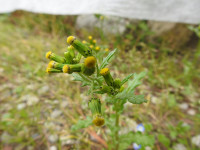
Annual herbaceous plant, sometimes biennial in colder areas, 10 to 40 cm tall, with an erect or ascending stem, often simple or branched especially in the upper part, with a scapose habit and corymbose inflorescence. The stem is fragile, fleshy in texture, herbaceous and may have a pubescent surface with fine hairs.
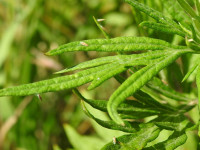
The leaves are alternate, arranged along the entire stem, with variable shapes from spatulate to pinnatifid or pinnatipartite, with obtuse, spaced and toothed lobes. The basal leaves are larger, up to 7 cm long and 2 cm wide, spatulate in shape and often lobed or parted, while the cauline leaves are sessile, widely imbricated to the stem with auriculate base. The leaf surface can be more or less glabrous or slightly pubescent, with fleshy texture especially in varieties adapted to drier habitats.
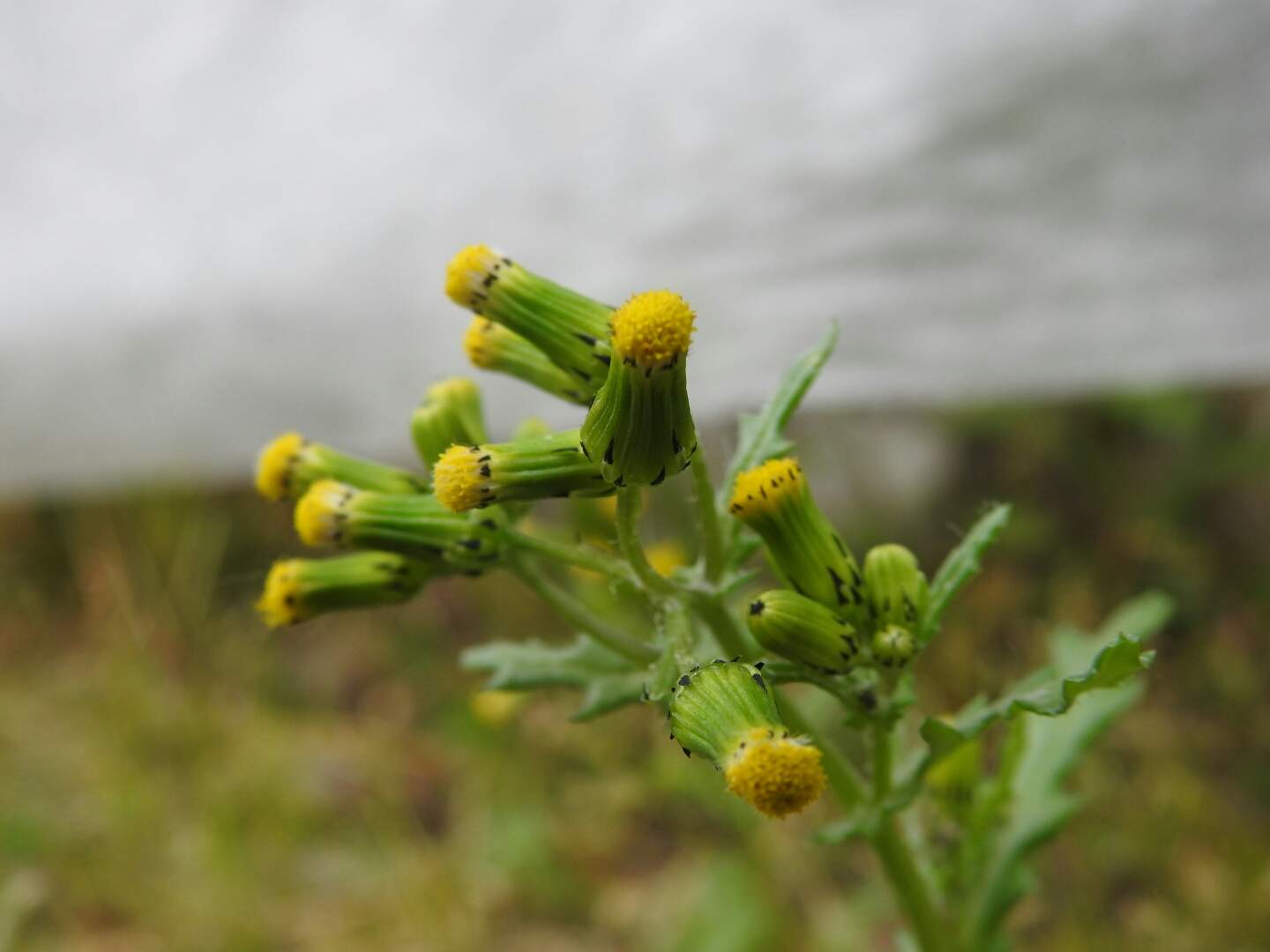
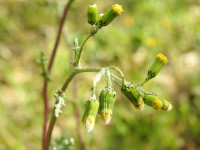
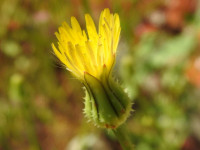
The flowers, arranged in numerous small capitula (about 10 mm long and 5 mm wide), are all tubular, hermaphroditic, bright yellow in color, with a five-toothed corolla that slightly protrudes from the involucre. The involucre is cylindrical or cylindrical-pyriform, 6-7 mm long and 3-4 mm wide, formed by 16-24 bracts arranged in two series: the outer ones, short and triangular, often with a black apex or entirely blackish, and the inner ones longer, linear. The outer bracts can be 10-12 in total, with 5-6 per side, and have a characteristic black tip. After flowering, the inner scales fold downward.
The fruit is a cylindrical cypsela 1-2 mm long, slightly pubescent especially along the edges, equipped with a pappus made up of numerous simple white bristles, persistent and more or less as long as or longer than the fruit itself. The root system consists of a rather evident main root (taproot), with poorly developed fibrous secondary roots.
The plant has a rapid biological cycle, with sexual maturity occurring 2-3 months after seed germination, and can produce several generations during the year. Its stature and branching vary greatly, with smaller and simpler individuals that can be confused with related species.
Habitat and distribution
Native to the temperate regions of Mediterranean Europe, North Africa and some temperate areas of Asia, the species is currently cosmopolitan and naturalized in many parts of the world. In Italy it is present in all regions, from the plains up to about 1800 meters of altitude.
It prefers disturbed habitats such as cultivated lands, uncultivated areas, pastures, roadsides and coastal dunes, where it grows on soils generally rich in nitrogen and mineral salts. It thrives in open and sunny environments, tolerating both high temperatures and intense frosts, being able to withstand temperature fluctuations of up to 50°C. It is considered a weed, typical of crops and anthropized environments, but poorly tolerates competition from other herbaceous species.
In some Mediterranean regions, such as Sardinia and Sicily, local variants with different characteristics are observed, such as a higher density of pubescence or modifications in the scales of the involucre.
Flowering period
Flowering is continuous or almost so, extending from January to December in areas with mild climate, while in colder zones it is mainly concentrated in the summer months. The species is able to produce multiple generations throughout the year thanks to its short cycle.
Ecology and pollination
The plant is autogamous, with a marked tendency to self-pollination, and the flowers are rarely visited by pollinating insects. This characteristic favors the formation of numerous local ecotypes and the genetic stability of populations. Seed dispersal occurs mainly through the feathery pappus which allows anemochory (wind dispersal).
Thanks to its high reproductive capacity and resistance to herbicides, Senecio vulgaris is often the first species to colonize disturbed soils and crops, becoming an important weed. The only known natural enemy is a parasitic fungus, Puccinia lagenophorae, which however does not survive winter frosts, leaving new generations unaffected.
Curiosities and traditional uses
The genus name derives from the Latin senex, meaning “old man”, referring to the white hairs of the pappus that resemble the hair of an elderly person.
Historically, the plant was used in folk medicine for its antiscorbutic, anthelmintic, diaphoretic, emmenagogue, purgative and diuretic properties. It was also used to treat inflammations of the skin, mouth and hemorrhoids. However, the presence of toxic pyrrolizidine alkaloids, such as senecionine, today makes its medicinal use dangerous, as it can cause severe liver damage, genotoxicity and potential carcinogenicity. For this reason, therapeutic use has been abandoned and discouraged.
The species is also known for its ability to withstand extreme climatic conditions and for being a pioneer plant in disturbed habitats, but its weedy nature limits its use in agricultural crops.
Etymology
The scientific name Senecio vulgaris derives from senex, which in Latin means “old man”, referring to the white hairs of the pappus that resemble the hair of an elderly person. The specific epithet vulgaris indicates its wide distribution and frequency. The common Italian name “senecione comune” reflects precisely its widespread presence and its belonging to the genus Senecio.
Sources
- Prof. S. Pignatti, "Flora d'Italia"
- Acta Plantarum - Flora delle regioni italiane (scheda di Giuliano Salvai)
- Tela Botanica / H. Coste, "Flore descriptive et illustrée de la France"
- World Flora Online (WFO)
Characteristics
Where I found it (3 sightings)
Classification
- Kingdom
- Plantae
- Family
- Asteraceae
- Full name
- Senecio vulgaris L.
- Life form
- Terofite scapose
Similar species
Search for species with similar characteristicsFurther reading
Noticed an error in the identification? Write to me
Other species of the same family
Asteraceae
Explore
Other species of Asteraceae