Botanical species
Orchis anthropophora
(L.) All.
Man Orchid
Description
Morphological description
Perennial herbaceous plant belonging to the family Orchidaceae, characterized by an erect and simple habit, with a height ranging between 20 and 40 cm. The root system consists of two deep ellipsoid tubers, brown in color, 11 to 28 mm wide and 12 to 36 mm long, which act as perennial organs from which stem, leaves, and flowers develop each year.
The stem is glabrous, rigid, erect, and shows longitudinal striations particularly evident in the lower part, below the inflorescence.
The basal leaves are numerous (7-10), arranged in a rosette and have a lanceolate or ovate-lanceolate shape, with entire margins and obtuse apex. They generally measure between 1 and 1.5 cm in width and between 6 and 10 cm in length, showing well-marked parallel veins. The cauline leaves are smaller, sheathing, and tightly wrap the stem.
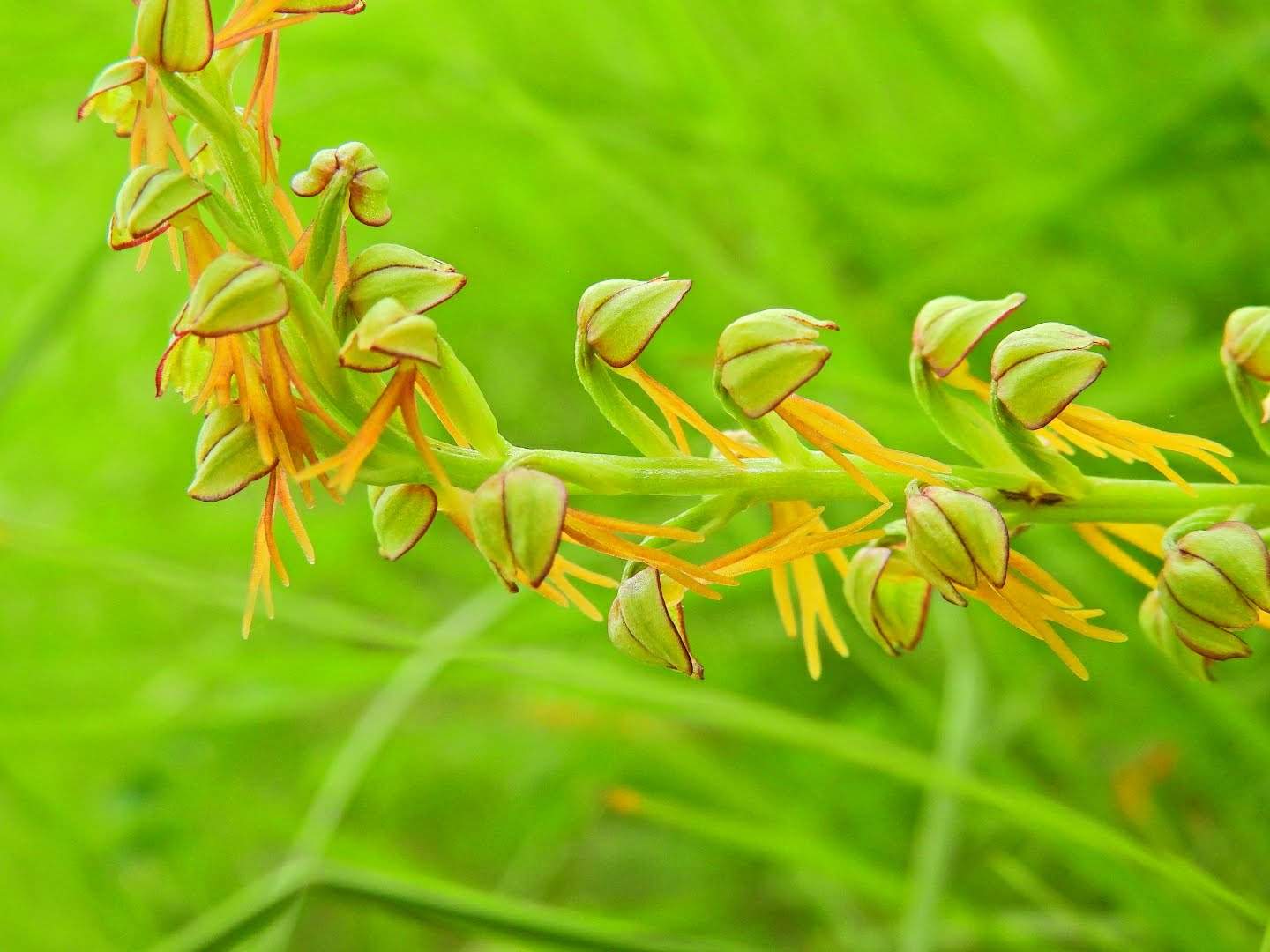
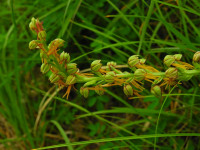
The inflorescence is a cylindrical, elongated, and dense spike, composed of 25-50 zygomorphic and sessile flowers about 14-16 mm long. The bracts of the inflorescence are shorter than the ovary. The outer tepals are oval, greenish with a violet margin, fused to form a helmet enclosing the two inner tepals, small and linear, pale green in color.
The labellum, which gives the plant its common name, is trilobed, pendulous, and without a spur. It is 10-15 mm long and is yellow-greenish or reddish-brown in color, with darker edges. The lateral lobes are linear, while the median lobe is bifid with linear laciniae, often bearing a small central tooth. This particular morphology gives the flower a humanoid appearance, from which the associated common names derive.
The fruit is an erect capsule, fissuricidal with three prominent ribs, containing numerous very small and light seeds, suitable for anemochorous dispersal (wind transport).
Habitat and distribution
The species is widespread along the Atlantic and Mediterranean coasts, with a distribution covering much of the Mediterranean area and some parts of Atlantic Europe. In Italy, it is present from sea level up to about 1500 meters in altitude.
It prefers habitats of open scrub, light woods, dry meadows, and rocky pastures, showing a preference for calcareous substrates. It typically grows in bright or semi-shaded woodland environments, generally with sunny or partially shaded exposure.
Flowering period
Flowering generally occurs in the months of April, May, and June, with possible geographical variations related to altitude and local climate. Further south or in mild climate areas, flowering may start earlier, while in mountainous or more northern zones it tends to last longer.
Ecology and pollination
Orchis anthropophora employs a reproductive strategy mediated by entomogamous pollination, mainly by pollinating insects, including various species of hymenopterans. The flower, with its particular shape and yellow-greenish or reddish-brown colors, attracts pollinating insects, favoring cross-fertilization.
Seed dispersal occurs through the wind, facilitated by the light structure and minuteness of the seeds contained in the capsules. This mode of dispersal allows the occupation of new microhabitats suitable for the species.
The plant can hybridize with other species of the genus Orchis, such as O. italica, O. militaris, O. purpurea, and O. simia. In hybrids, the presence of a small spur on the labellum is often observed, absent in the pure species.
Curiosities and traditional uses
The common name "Dancing orchid" derives from the particular shape of the flower, which resembles a human figure dancing, with the labellum taking the shape of a small stylized man. In several European languages, such as French and Spanish, the plant is called “hanged man” due to the pendulous silhouette of the flower, which seems to represent a hanging human figure.
From an ethnobotanical point of view, there are no significant or documented medicinal or food uses for this species, which instead is protected and safeguarded throughout the national territory due to its status as a wild orchid.
Etymology
The genus name “Orchis” derives from the Greek “órchis,” meaning “testicle,” referring to the shape of the plant’s tubers, which indeed resemble this anatomical part. This denomination dates back to Pliny the Elder, who observed this characteristic in many species of the genus.
The specific epithet “anthropophora” derives from the Greek “ánthropos” (man) and “phoros” (bearing), translatable as “bearing the man,” referring to the shape of the labellum that resembles a human figure.
The Italian common name “Man Orchid” emphasizes the dancing and composed aspect of the flower, evoking the silhouette of a stylized ballerina.
Sources
- Acta Plantarum - Flora delle regioni italiane (scheda di Anja Michelucci)
Characteristics
Where I found it
The sighting locations of this species are not public for conservation reasons.
Classification
- Kingdom
- Plantae
- Family
- Orchidaceae
- Full name
- Orchis anthropophora (L.) All.
- Synonyms
- Aceras anthropophorum (L.) R.Br.
- Life form
- Geofite bulbose
Similar species
Search for species with similar characteristicsNoticed an error in the identification? Write to me
Other species of the same family
Orchidaceae
Explore
Other species of Orchidaceae