Botanical species
Serapias lingua
L.
Tongue-orchid
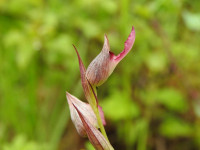
Description
Morphological description
The plant is a terrestrial perennial belonging to the Orchidaceae family, characterized by an erect habit and a variable height generally between 15 and 40 cm. The root system consists of light, subspherical bulbs, arranged at the base of the stem and connected by short rhizomes, which allow vegetative propagation.
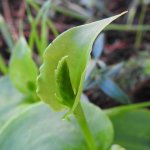
The stem is erect and leafy in the lower half, bearing lanceolate to lanceolate-linear leaves, usually measuring from 0.5-1 cm in width and 4-9 cm in length. The leaves are acuminate and grooved, with parallel veins typical of monocots; the upper ones progressively decrease in size.
The inflorescence, usually few-flowered, includes from 2 to 5 flowers, although in rare cases specimens with a single flower or up to 8 can be found. The bracts accompanying the flowers are linear-lanceolate, about 2-3 cm long, leaf-like in appearance but often tinged with purplish pink, giving an additional decorative effect to the inflorescence.
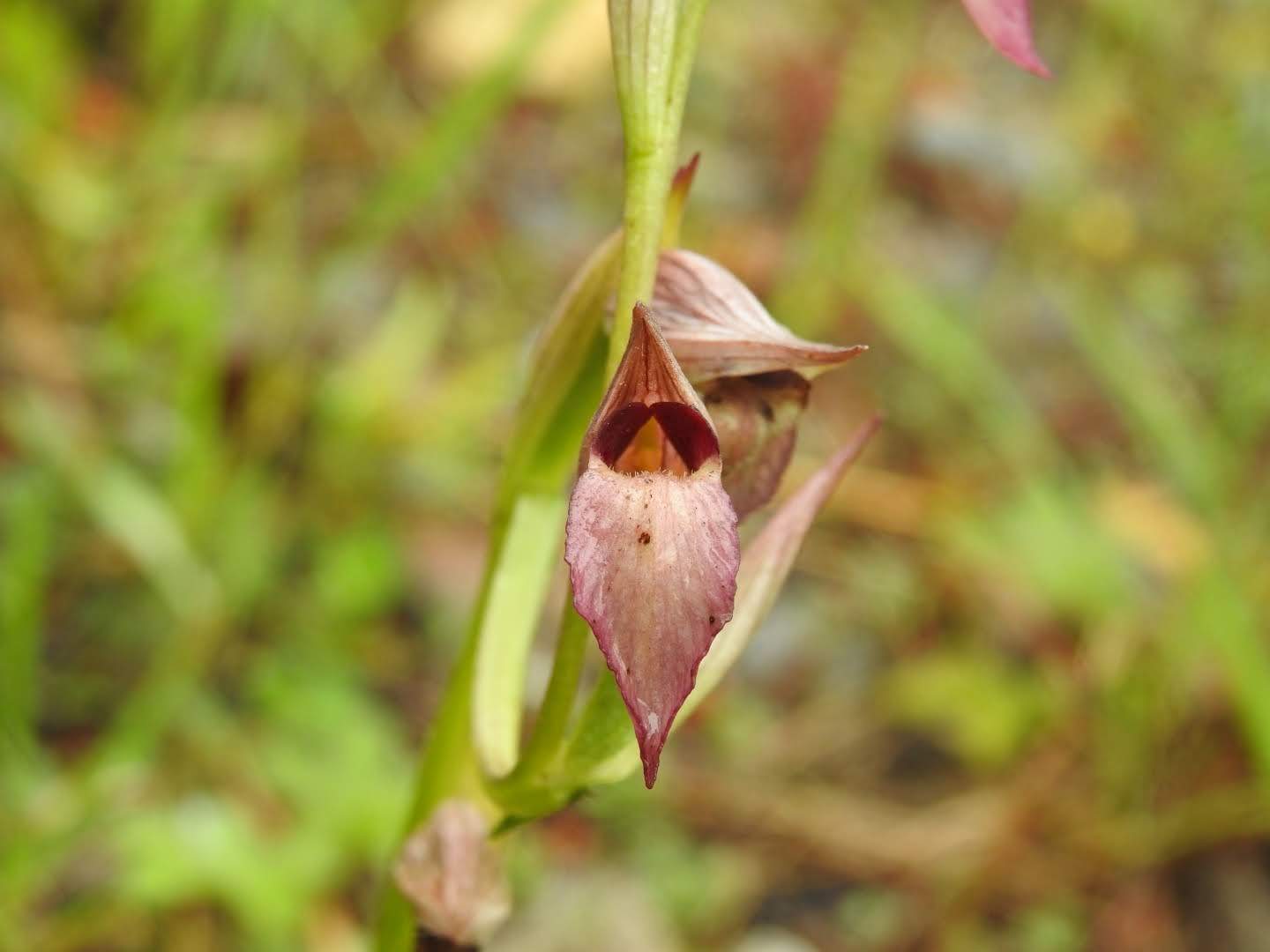
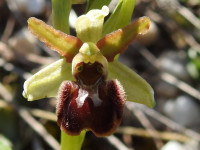
The flowers present a variegated coloration ranging from pinkish to purple, with violet shades. The helmet formed by the upper tepals is gray-violet in color, while the hypochile has a purple edge, enclosed within the helmet itself. The epichile, directed forward and downward, varies from lanceolate to cordate shape, with dimensions between 9 and 18 mm; the color is predominantly pink veined with purple, sometimes almost completely purple or even with yellowish shades. The flower as a whole is structured to facilitate pollination by specific insects.
The fruit is a typical orchid capsule, containing numerous tiny and light seeds, suitable for wind dispersal.
Habitat and distribution
This species is widely distributed in the Mediterranean area, with a consolidated presence in Italy, especially in the central-southern regions and the major islands. It prefers open and sunny environments, such as dry meadows, garrigues, clearings, and forest edges. It grows on well-drained soils, generally calcareous or slightly acidic, often on substrates poor in organic matter.
The growth altitude typically ranges from sea level up to about 800-900 meters, but can occasionally extend beyond, depending on local conditions. The preferred exposure is usually sunny or lightly shaded, with good ventilation.
Flowering period
Flowering mainly occurs between April and June, with possible geographic variations determined by altitude and microclimate. In the warmer areas of the Mediterranean, flowering can begin as early as April, while in cooler and mountainous areas it tends to shift towards May and June.
Ecology and pollination
Serapias lingua is characterized by a specialized reproductive strategy, with flowers structured to attract specific pollinating insects, mainly hymenopterans such as solitary bees. The shape and coloration of the flower, together with the presence of the helmet and the labellum (epichile), facilitate mechanical pollination, ensuring contact of the insects with the reproductive structures.
Seed dispersal occurs through the wind, thanks to the extremely small and light seeds, a characteristic common to all terrestrial orchids.
Curiosities and traditional uses
No significant traditional food or medicinal uses are known for this species, nor are there documented particular ethnobotanical applications or associations with relevant popular folklore. The beauty and uniqueness of the flowers make Serapias lingua one of the most appreciated orchids by enthusiasts of Mediterranean wild flora and scholars.
Etymology
The generic name "Serapias" probably derives from the name of the Egyptian god Serapis, but the exact connection is uncertain and likely related to the ancient tradition of attributing mythological names to particular plants. The specific name "lingua" refers to the shape of the labellum (epichile), which resembles a tongue due to its protruding position and elongated shape.
The Italian common name "Tongue-orchid" directly reflects the scientific denomination, emphasizing the distinctive aspect of the flower.
Sources
- Prof. S. Pignatti, Flora d'Italia
Characteristics
Where I found it
The sighting locations of this species are not public for conservation reasons.
Classification
- Kingdom
- Plantae
- Family
- Orchidaceae
- Full name
- Serapias lingua L.
- Synonyms
- Serapias olbia Verg.
- Life form
- Geofite bulbose
Similar species
Search for species with similar characteristicsFurther reading
Noticed an error in the identification? Write to me
Other species of the same family
Orchidaceae
Explore
Other species of Orchidaceae