Botanical species
Cephalanthera damasonium
(Mill.) Druce
White Helleborine
Description
Morphological description
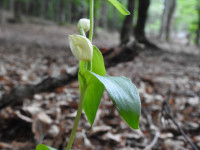
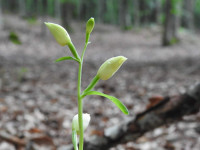
Perennial herbaceous plant belonging to the Orchidaceae family, it has an erect and robust habit, with a height generally ranging between 20 and 60 cm. The stem is glabrous, thin but solid, slightly striated and covered with leaves up to the apex. At the base it appears scaly and has some leaf sheaths.
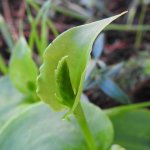
The leaves are arranged alternately along the stem, ovate or ovate-lanceolate, with entire margins and well-defined parallel veins (5-7 main veins). The basal leaves are reduced to amplexicaul sheaths, while the cauline leaves are broader, 2-3 times longer than their width, and progressively decrease in size towards the apex, gradually transforming into lanceolate or elliptical bracts, which often exceed the length of the ovary of the flowers.
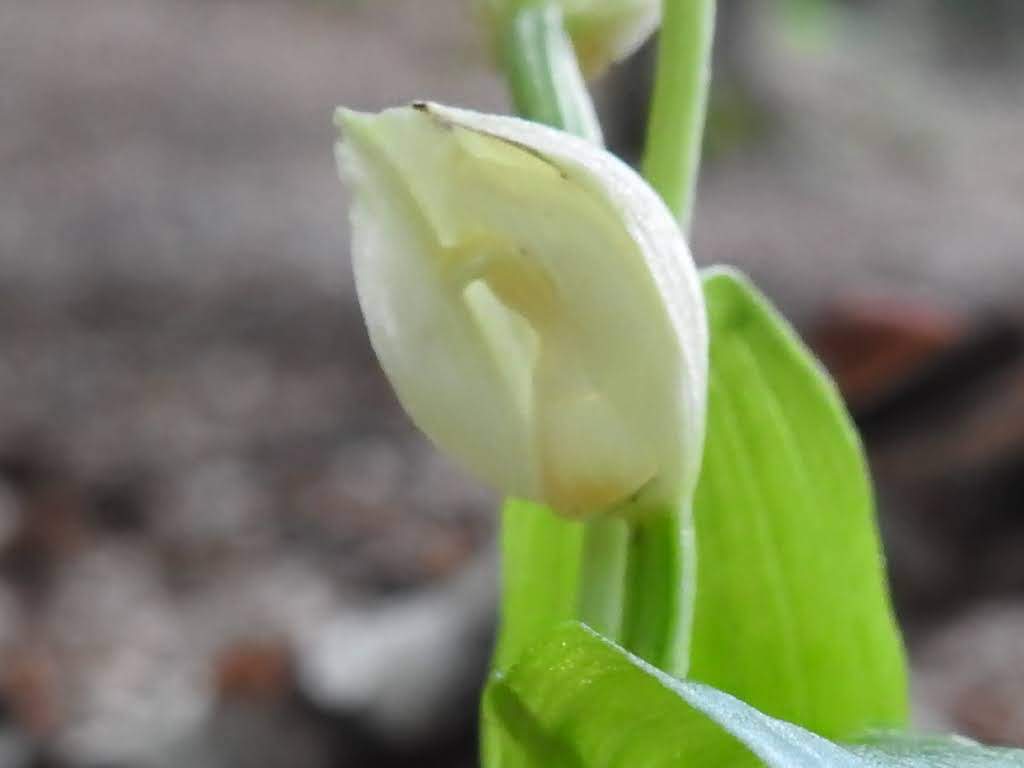
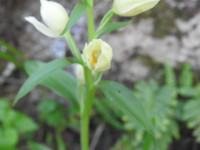
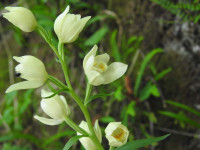
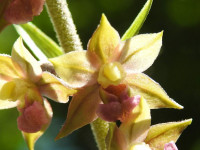
The flowers are white, with a white-yellowish hue, and are arranged in loose spikes, containing from 2 up to 12 elements. Each flower is suberect and rarely opens completely; the outer tepals are acute, slightly longer than the inner ones, while the labellum is concave, shorter than the tepals, with a yellow-orange base, barely visible because enclosed by the hypochile. The labellum is composed of two parts: the hypochile, saccate and gibbous, with three longitudinal orange lamellae in the basal half, and the epichile, transversely elliptical and densely papillose towards the apex. The column, 9-11 mm long, has two narrow oblong wings, and the anther is ovoidal, about 2.5 mm.
The fruit is a three-valved capsule that opens for seed dispersal.
The root system is characterized by deep tubers, typical of rhizomatous geophytes, which allow the plant to survive during unfavorable seasons.
Habitat and distribution
The species is widespread throughout the Italian territory, being more common in the Alps and pre-Alpine reliefs, while elsewhere it is considered rarer. Its distribution extends in the Mediterranean area with extensions towards the north and east, configuring as a eurymediterranean species.
It prefers woodland environments, particularly thermophilous beech forests, coppice woods and conifers. It grows on calcareous, fresh, shady but well-aerated soils, often in dry areas. It is a species that adapts well to woods after cutting interventions, taking advantage of increased light. It is found up to 1900 meters altitude, from the hill to the mountain level.
Flowering period
Flowering mainly extends between May and June, with slight variations related to altitude and latitude. In higher or northern areas flowering can be later.
Ecology and pollination
This orchid has a peculiar reproductive strategy: its flowers lack nectar and rarely open completely. They are pollinated almost exclusively by wasps, which are deceived by the yellow crests on the labellum, mistaking them for pollen sources to feed their larvae.
The plant can reproduce both sexually, through pollination (both allogamy and self-pollination, the latter important for the species), and vegetatively via rhizomes. Germination is very slow: it is estimated that about 8 years are needed from seed to the first basal leaves and a further 2-3 years before the first flowering, provided that light conditions are optimal.
Seed dispersal occurs through the capsule which opens releasing the numerous minute seeds, typical of orchids, which are carried by the wind.
Curiosities and traditional uses
No ethnobotanical traditions or specific medicinal uses are known for this species. However, its long development phase and particular pollination strategy make it an interesting example of evolutionary adaptation among spontaneous Italian orchids.
Etymology
The genus name derives from the Greek κεφαλή (kephalé), meaning "head", and the botanical Latin anthera, indicating the anther, probably referring to the globose shape or the apical position of the anther in the floral column.
The specific name damasonium could derive from the Latin "damasonium" or "alisma", perhaps due to the similarity of the leaves with those of the aquatic plant Alisma, or from "damascenus", meaning "of Damascus".
The Italian common name "Cefalantera maggiore" refers to the relatively large size of its flowers compared to other species of the genus Cephalanthera.
Sources
- Prof. S. Pignatti, "Flora d'Italia"
- Acta Plantarum - Flora delle regioni italiane (scheda di Marinella Zepigi)
- World Flora Online (WFO)
Characteristics
Scheda botanica
| Famiglia | Orchidaceae |
|---|---|
| Fioritura | maggio – luglio |
| Forma biologica | Rhizomatous |
| Habitat | with white flowers |
Domande frequenti
- Quando fiorisce White Helleborine?
- White Helleborine fiorisce maggio – luglio.
- Che tipo di pianta è White Helleborine?
- White Helleborine è una Geophytes (Rhizomatous) secondo la classificazione di Raunkiaer.
- A quale famiglia appartiene White Helleborine?
- White Helleborine appartiene alla famiglia botanica Orchidaceae.
Where I found it
The sighting locations of this species are not public for conservation reasons.
Classification
- Kingdom
- Plantae
- Family
- Orchidaceae
- Full name
- Cephalanthera damasonium (Mill.) Druce
- Synonyms
- Cephalanthera alba (Crantz) Simonk.; Cephalanthera pallens Rich.; Serapias damasonium Mill.
- Life form
- Geophytes rhizomatous
Similar species
Search for species with similar characteristicsFurther reading
Noticed an error in the identification? Write to me
Other species of the same family
Orchidaceae
Explore
Other species of Orchidaceae