Botanical species
Orchis mascula
(L.) L.
Early-Purple Orchid
Description
Morphological description
Perennial herbaceous plant belonging to the Orchidaceae family, characterized by an erect and slender habit, with a height generally ranging between 20 and 60 cm, although in some varieties it can also reach 25 cm. The root system consists of two ovoid rhizotubers, rich in mucilage and starch, which serve as perennial and storage organs.
The stem is simple, tubular and robust, often showing a reddish coloration with purplish spots especially in the lower part, while the apex tends to a dark brown color. The leaves are mainly arranged at the base of the stem, forming a rosette, with some smaller leaves arranged spirally along the stem. The leaf shape is oblanceolate or oblong-lanceolate, with entire margins, smooth and glossy surface, 5 to 20 cm long, sometimes with purplish spots on the lower half of the upper surface.
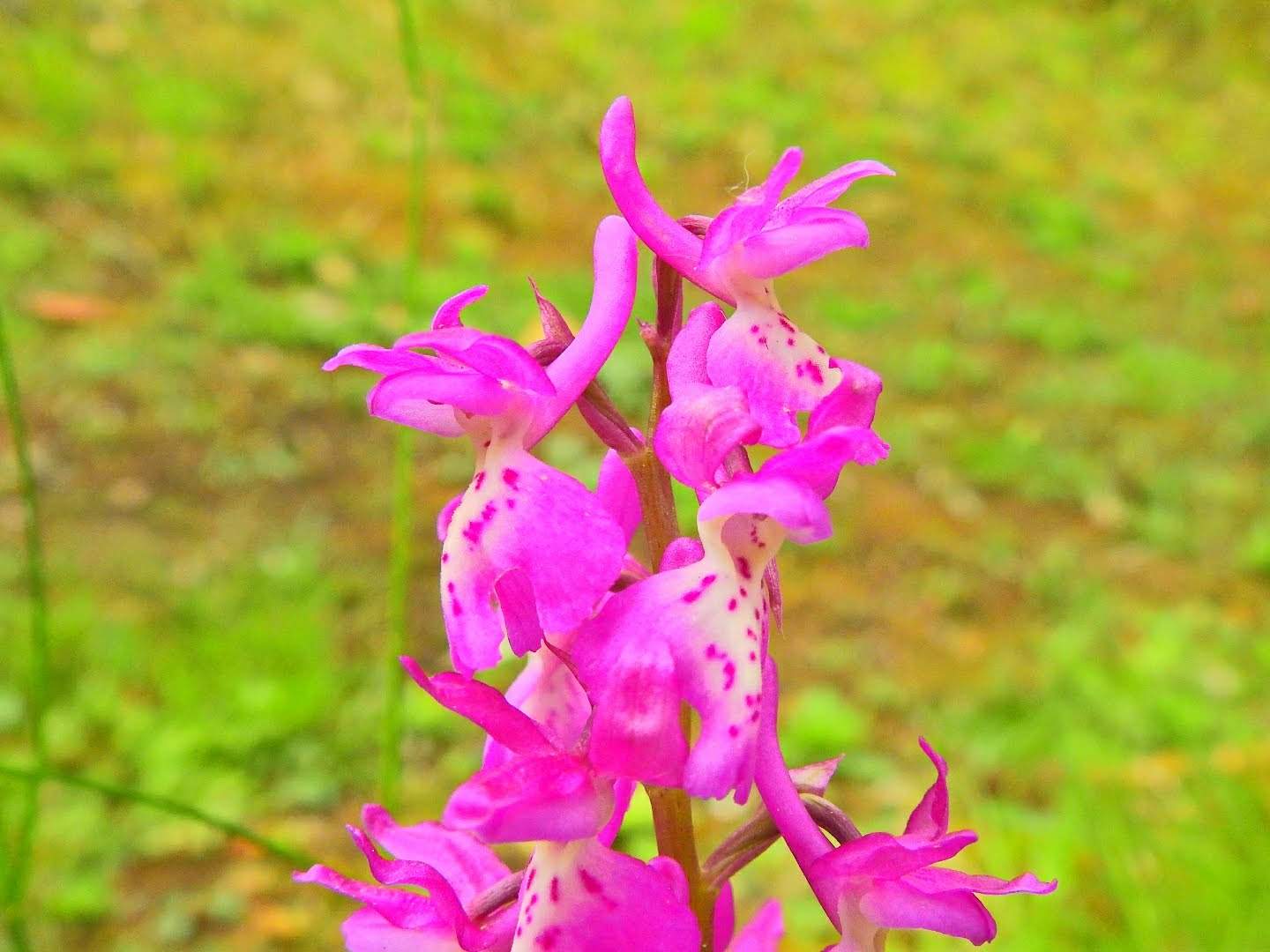
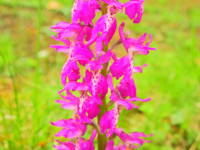
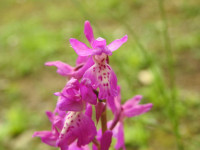
The inflorescence is a subcylindrical spike, quite dense, 8 to 25 cm long, bearing from 15 up to 50 flowers, although in some more slender varieties the inflorescence can be more sparse with 5-10 flowers. The flowers show a color range from purple-violet to light pink, rarely they can be white or paler shades. The flower structure is composed of six tepals: three outer ovate-lanceolate with acute apex (the central one slightly bent forward) and three inner, of which two lateral ones are shorter and fused, while the labellum is trilobed, with the median lobe longer and often divided into two secondary lobules. The lateral lobes are rounded or rhomboid and curved downwards, with dentate-crenulate margins. At the base the labellum is generally whitish, spotted with red-violet.
The spur is cylindrical, about 10-12 mm long, with an obtuse apex, and can be arranged horizontally or directed upwards; its length is slightly greater than that of the ovary. The spur color varies from pink to violet.
The fruit is a six-ribbed dehiscent capsule, containing numerous minute seeds, typical of orchids.
Habitat and distribution
A typical species of European regions and the Caucasus, it is widespread in Italy and the Mediterranean area, preferring woodland habitats, forest edges, rocky pastures and mountain meadows. It mainly occurs on calcareous substrates and can be found up to 2400 m altitude, with sporadic occurrences even higher, especially in southern regions.
In Italy it is present in several subspecies, including some endemics (for example in Sardinia), and is found in almost all regions, with a particular presence in fresh, bright environments but not too directly exposed to the sun. The species appears ubiquitous but tends to become rare in many areas of its natural range due to habitat loss.
Flowering period
Flowering mainly occurs between April and June, with small local variations due to altitude and latitude. In colder climates and higher elevations flowering may start later, while in milder areas it can anticipate the appearance of flowers.
Ecology and pollination
Orchis mascula is mainly pollinated by pollinating insects, such as bees and bumblebees, attracted by the vivid colors of the flowers and the particular shape of the labellum which facilitates access to the nectar contained in the spur. The trilobed structure of the labellum and the position of the spur promote effective contact between insects and the reproductive structures of the plant, thus ensuring cross-pollination.
Seed dispersal occurs by wind, thanks to the lightness and very small size of the seeds contained in the dehiscent capsule. These very fine seeds can be carried over considerable distances, facilitating colonization of new suitable habitats.
Curiosities and traditional uses
The genus name derives from the Greek “orchis”, meaning testicle, referring to the shape of the underground tubers which indeed resemble this organ; this characteristic inspired in the past medicinal uses linked to the theory of “correspondences” between form and function (doctrine of signatures).
In Italian and Mediterranean folk tradition, some species of Orchis, including mascula, were used to prepare a beverage called “salep” (from Turkish “sahlep”), obtained by grinding dried tubers, used as a nutritional and energizing remedy, especially in winter. Salep was also considered a remedy for gastrointestinal and respiratory ailments.
Today, due to the rarity and protection of many wild orchids, these uses are strongly discouraged and plant collection is prohibited in many regions to preserve natural populations.
Etymology
The scientific name “Orchis mascula” derives from the Greek word “orchis”, meaning “testicle”, alluding to the shape of the underground tubers, and from the Latin “masculus”, meaning “male”, probably referring to the erect, robust and slender habit of the plant, which appears vigorous and strong.
The Italian common name “orchide maschio” precisely reflects this characteristic of robustness and vigor, distinguishing it from other more delicate orchids or with different habits.
Sources
- Prof. S. Pignatti, "Flora d'Italia"
- Acta Plantarum - Flora delle regioni italiane (sheet by Giuliano Salvai)
Characteristics
Where I found it
The sighting locations of this species are not public for conservation reasons.
Classification
- Kingdom
- Plantae
- Family
- Orchidaceae
- Full name
- Orchis mascula (L.) L.
- Life form
- Geofite bulbose
Similar species
Search for species with similar characteristicsNoticed an error in the identification? Write to me
Other species of the same family
Orchidaceae
Explore
Other species of Orchidaceae