Botanical species
Serapias parviflora
Parl.
Small-flowered Tongue-orchid
Description
Morphological description
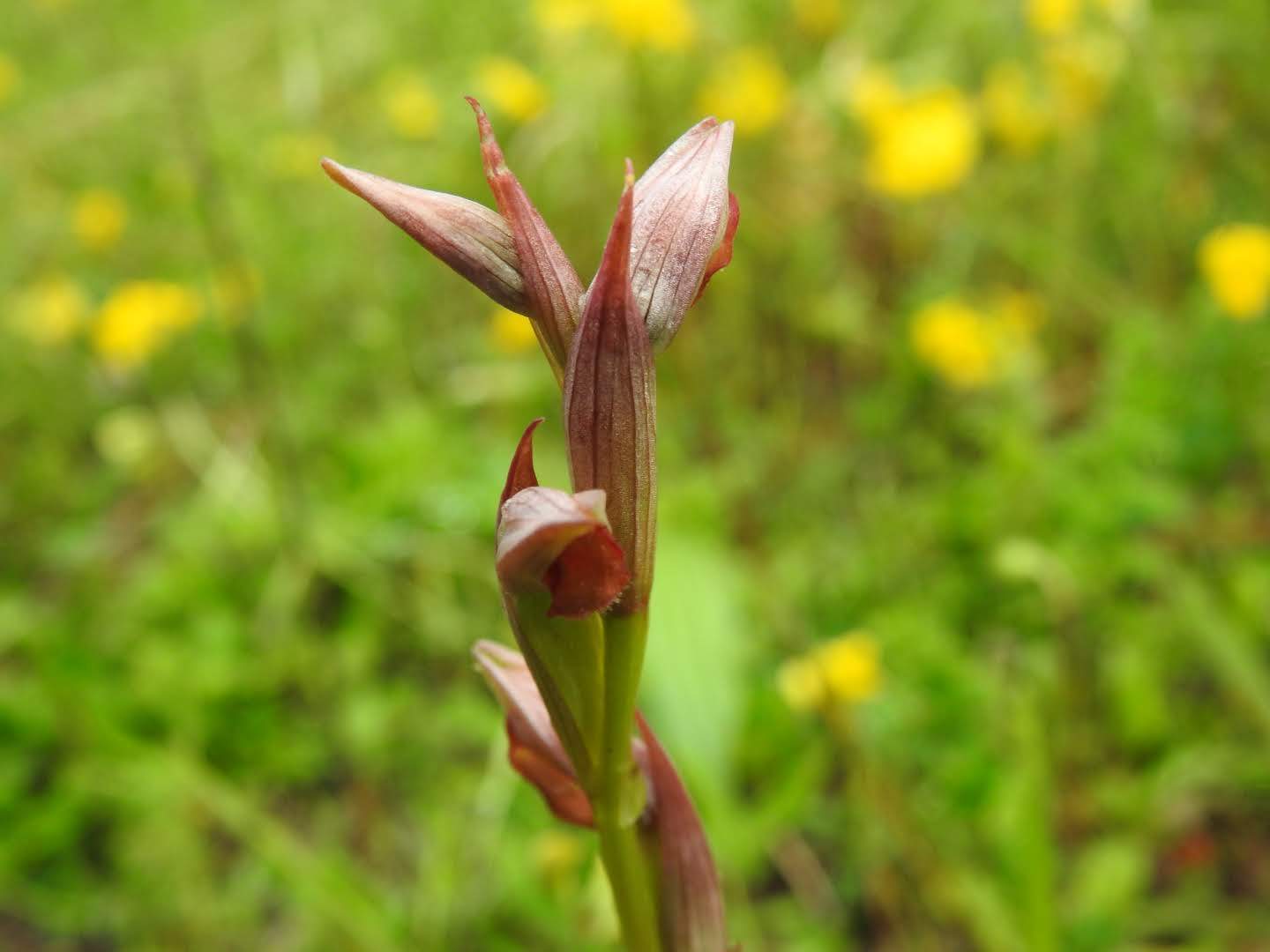
Perennial herbaceous plant of modest size, the Small-flowered Tongue-orchid generally reaches a height between 10 and 30 cm. The stem is erect, simple and cylindrical, green in color with reddish reflections especially at the base. The root system consists of globose rhizotubers, underground perennial organs that ensure the plant's survival during unfavorable seasons.
The leaves, typically 4-5, are arranged in two opposite rows along the stem. They are lanceolate or ovate-lanceolate in shape, herbaceous, narrow, grooved and slightly curved, measuring between 5 and 12 cm in length. The lower leaves often show reddish spots on the basal sheaths, while the upper ones are greener and reach up to the base of the inflorescence, partially sheathing the scape.
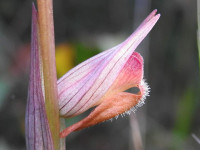
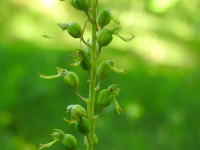
The inflorescence is a cylindrical, elongated and slightly loose spike, composed of 3 to 8 very small flowers (10-15 mm), often wrapped by ovate-lanceolate and acuminate bracts, which slightly exceed the tepals. These bracts vary in color from green to purple or violet with darker veins.
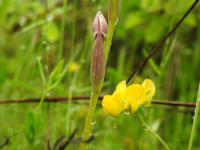
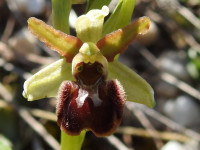
The flowers are characterized by lanceolate and pointed tepals, green-purple with darker longitudinal stripes, forming a pointed helmet at the apex. The hypochile is completely enclosed in the helmet, dark in color with violet or brownish edges. The epichile, narrower but longer than the hypochile, is fixed and hairy, colored from brick-red to yellowish, folded backward so as to be parallel and close to the ovary.
The labellum is trilobed and longer than the tepals, with two dark linear callosities at the base, and presents a short whitish hairiness in the center. The stamens are fused with the style forming a small and inconspicuous gynostemium; the spur is absent. The ovary is cylindrical.
The fruit is an erect, oblong and fissure-dehiscent capsule, brown-ochre in color, containing numerous very small seeds.
Habitat and distribution
This species has a steno-Mediterranean distribution, limited to the Mediterranean coasts, with a range mainly coinciding with the Olive area. In Italy it is considered rare and grows along dry pastures, garrigues, meadows, olive groves, dunes and roadside edges, up to an altitude of about 1200 meters. It prefers dry soils, especially calcareous or slightly acidic, usually with sunny exposure.
Flowering period
Flowering mainly occurs between March and May, with possible local variations linked to climatic and altitudinal conditions. The flowers, small and inconspicuous, can be observed during this period, often hidden by the colorful bracts.
Ecology and pollination
The Small-flowered Tongue-orchid presents a peculiar reproductive strategy: it practices self-pollination (cleistogamy) even before the flowers fully open. This mechanism ensures reproduction even in the absence of pollinating insects. However, the occurrence of hybrids with other species of the genus Serapias suggests that cross-pollination may occasionally occur.
The flowers are inconspicuous and do not produce nectar; the helmet structure of the tepals and the position of the labellum and pollinia are adapted to deceive pollinating insects, although in this species self-pollination is prevalent. Seed dispersal occurs through the capsule which, once mature, opens releasing countless minute seeds dispersed by the wind.
Curiosities and traditional uses
No particular ethnobotanical, medicinal or traditional food uses are known for this species. Its rarity and legal protection at national and regional levels discourage collection. From a naturalistic point of view, it is interesting for its self-pollination mechanism that distinguishes it from many other Mediterranean orchids.
Etymology
The genus name, Serapias, derives from the Egyptian deity Sérapis, perhaps referring to the "helmet" shape of the flowers which resemble a headdress. The specific name parviflora clearly indicates the small size of the flowers ("parvus" = small, "flora" = flower). The Italian common name “Serapide minore” also refers to the small size of the flowers compared to other species of the genus.
Sources
- Prof. S. Pignatti, Flora d'Italia
- Acta Plantarum - Flora delle regioni italiane (scheda di Giuliano Salvai)
Characteristics
Scheda botanica
| Famiglia | Orchidaceae |
|---|---|
| Fioritura | marzo – maggio |
| Forma biologica | Bulbous |
| Habitat | with green flowers, with small flowers, with purple flowers |
Domande frequenti
- Quando fiorisce Small-flowered Tongue-orchid?
- Small-flowered Tongue-orchid fiorisce marzo – maggio.
- Che tipo di pianta è Small-flowered Tongue-orchid?
- Small-flowered Tongue-orchid è una Geophytes (Bulbous) secondo la classificazione di Raunkiaer.
- A quale famiglia appartiene Small-flowered Tongue-orchid?
- Small-flowered Tongue-orchid appartiene alla famiglia botanica Orchidaceae.
Where I found it
The sighting locations of this species are not public for conservation reasons.
Classification
- Kingdom
- Plantae
- Family
- Orchidaceae
- Full name
- Serapias parviflora Parl.
- Life form
- Geophytes bulbous
Similar species
Search for species with similar characteristicsFurther reading
Noticed an error in the identification? Write to me
Other species of the same family
Orchidaceae
Explore
Other species of Orchidaceae