Botanical species
Gennaria diphylla
(Link) Parl.
Gennari’s Two-Leaved Orchid
Description
Morphological description
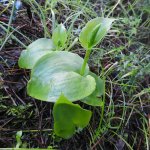
Perennial herbaceous plant belonging to the Orchidaceae family, characterized by an erect habit and a height generally ranging between 15 and 30 cm. The plant develops from a single ovoid bulb, which acts as a perennial organ, with a cylindrical and slender stem.
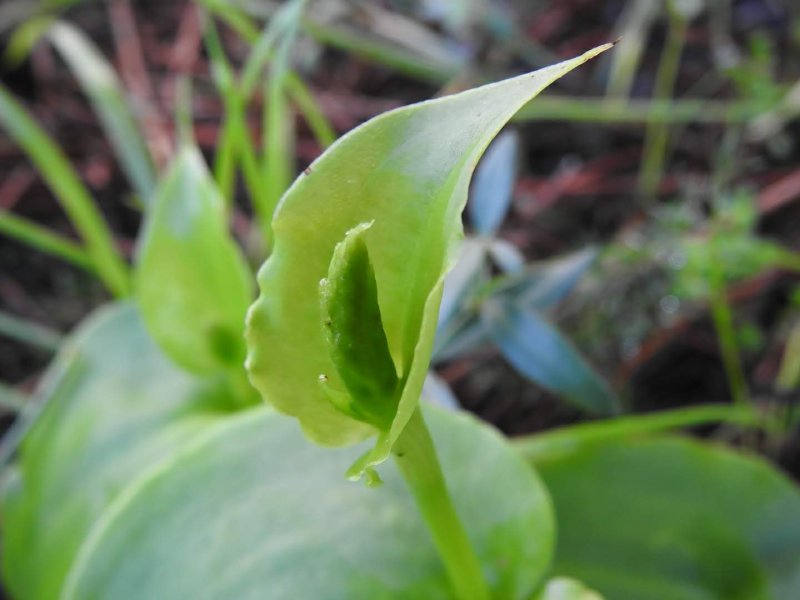
The leaves are only two, placed on the stem in alternate and spaced positions. Both are ovate-cordate in shape, sheathing at the base and with an acute apex, with variable dimensions: the lower leaf measures about 3-4 cm in width and 4-5.5 cm in length, while the upper one is smaller, about 2-3 cm. The leaves have from 9 to 15 main longitudinal veins, connected by a dense network of anastomosed transverse secondary veins, giving them a clearly reticulate structure.
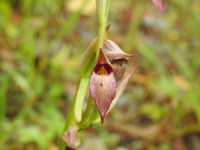
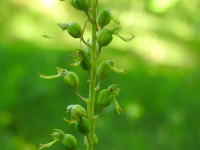
The inflorescence is elongated, dense and generally unilateral, 5 to 8 cm long, bearing from 10 to 30 small pedicellate flowers. The flowers are greenish-yellow in color, about 4 mm long, with oblong and convergent outer tepals, while the lateral inner tepals are wider and have an obtuse apex, facing upwards. The labellum is trilobed, with the median lobe subtriangular, wider and longer than the lateral lobes, and with an obtuse apex facing downwards. The spur, short and saccate in shape, is clearly visible beneath the labellum. The bracts accompanying the flowers are narrow and lanceolate, longer than the ovary, with the lower ones about 10 mm long and 2 mm wide.
Precise data on the fruit are not available, but as in many orchids, it is presumably a capsule containing numerous minute seeds. The root system is bulbous, consisting of a single ovoid bulb from which the plant regenerates annually.
Habitat and distribution
The species is present in some areas of Sardinia, especially in Gallura, along almost the entire western coast, in the upper Oristano area, in Medio Campidano, in Sulcis and in the Maddalena archipelago. It has also been reported on the island of Elba, in Tuscany. Its presence is rare and localized, with often isolated populations.
It preferably grows in typical Mediterranean maquis habitats, such as shrublands and garrigues, but is also found in humid woods, shady cliffs and pine forests, including artificial ones, especially on schistose and crystalline substrates. The growth altitude ranges from sea level up to about 400 meters. Coastal populations are particularly vulnerable due to the progressive alteration of natural habitats.
The distribution of the species extends throughout the Mediterranean basin and along the Atlantic coasts, with inland penetrations, but it is considered a plant with a limited and fragmented range.
Flowering period
Flowering generally occurs between February and April, with possible variations depending on the latitude and altitude of the growth sites. In more southern or low-altitude sites, flowering tends to start earlier, while in cooler or higher areas it can extend further into spring.
Ecology and pollination
Gennari’s Two-Leaved Orchid exhibits a reproductive strategy typical of orchids, with hermaphroditic flowers and a specialized pollination mechanism, probably mediated by pollinating insects. Although precise data on the specific pollinating insects of this species are not available, in many similar orchids small hymenopterans or dipterans attracted by the green color and flower shapes are involved.
Seed dispersal, typical of Orchidaceae, occurs through capsules that release extremely small and light seeds, easily transported by the wind. Germination success is however dependent on the presence of specific mycorrhizal fungi with which the plant establishes a symbiosis fundamental for germination and development.
Curiosities and traditional uses
No particular ethnobotanical properties, medicinal or traditional food uses related to this species are known, probably also due to its rarity and limited distribution. Like many wild orchids, it is a nationally protected plant and included in the list of species at risk with IUCN status Vulnerable (VU), which is why collection is prohibited and habitat conservation is essential.
Orchids, in general, are among the plant families richest in species worldwide, with an ancient origin dating back about 70-80 million years. Gennaria diphylla represents an example of these fascinating and often elusive plants, with unique characteristics that make it a species of botanical and conservation interest.
Etymology
The genus name, Gennaria, is a tribute to the botanist Patrizio Gennari (1820-1897), a scholar of Sardinian flora and promoter of the Botanical Garden of Cagliari, inaugurated between 1864 and 1866.
The specific name diphylla derives from Latin and literally means "two-leaved," referring to the distinctive characteristic of the plant having only two stem leaves.
In Italian the species is commonly called Gennaria a due foglie, reflecting precisely this peculiar and immediately recognizable morphological characteristic.
Sources
- Acta Plantarum - Flora delle regioni italiane (actaplantarum.org)
- Acta Plantarum - Flora delle regioni italiane (scheda di Marinella Zepigi)
Characteristics
Scheda botanica
| Famiglia | Orchidaceae |
|---|---|
| Fioritura | febbraio – aprile |
| Forma biologica | Bulbous |
| Habitat | with green flowers, Perennial plant, plant with dimorphic leaves |
Domande frequenti
- Quando fiorisce Gennari’s Two-Leaved Orchid?
- Gennari’s Two-Leaved Orchid fiorisce febbraio – aprile.
- Che tipo di pianta è Gennari’s Two-Leaved Orchid?
- Gennari’s Two-Leaved Orchid è una Geophytes (Bulbous) secondo la classificazione di Raunkiaer.
- A quale famiglia appartiene Gennari’s Two-Leaved Orchid?
- Gennari’s Two-Leaved Orchid appartiene alla famiglia botanica Orchidaceae.
Where I found it
The sighting locations of this species are not public for conservation reasons.
Classification
- Kingdom
- Plantae
- Family
- Orchidaceae
- Full name
- Gennaria diphylla (Link) Parl.
- Synonyms
- Coeloglossum diphyllum (Link) Fiori & Paol.
- Life form
- Geophytes bulbous
Similar species
Search for species with similar characteristicsFurther reading
Noticed an error in the identification? Write to me
Other species of the same family
Orchidaceae
Explore
Other species of Orchidaceae