Botanical species
Centaurea melitensis
L.
Maltese Star-thistle
Description
Morphological description
It is an annual herbaceous plant that can reach a height between 10 and 100 cm, with a more frequent average of 30-60 cm. The habit is erect or ascending, with angular stems, thinly winged (i.e., provided with narrow wings along the edges, 1-2 mm wide), covered by a woolly and hairy pubescence, with articulated multicellular hairs, sometimes slightly rough and with minute resinous glands. The stems, one to a few per plant, are more or less branched especially in the upper part, forming corymbs of flower heads.
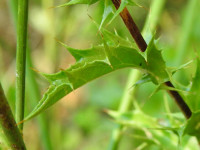
The basal leaves are pinnatisect, 5-8 cm long, with an undivided central portion about 3 mm wide and 4-5 deep lobes or teeth per side, while the cauline leaves are linear-spatulate, 20-30 mm long and 2-3 mm wide, generally entire or slightly toothed, semi-clasping and running down along the stem. The leaf surface is covered by hairs that give a grayish or whitish appearance, and sometimes they are spiny or rough to the touch.
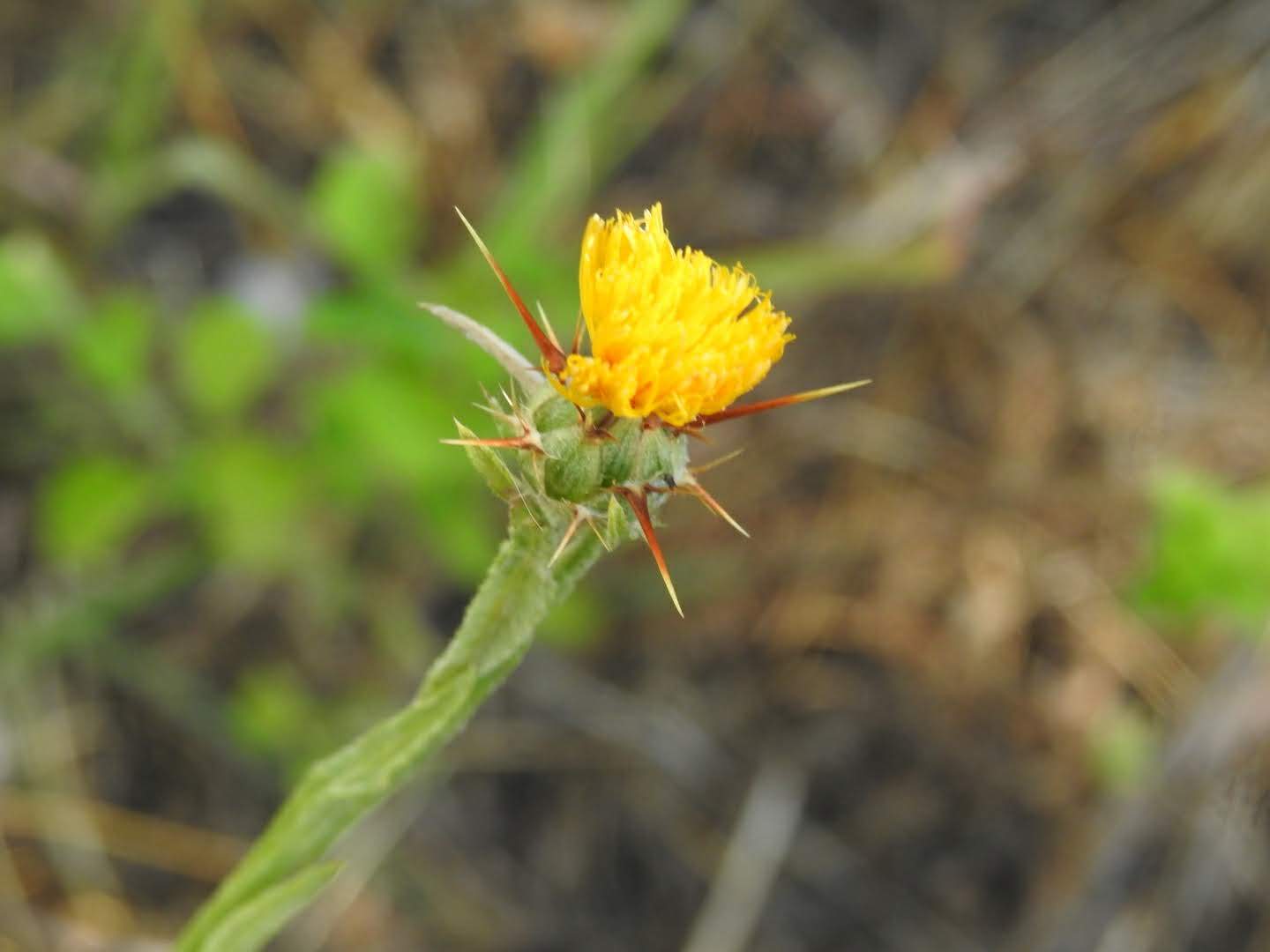
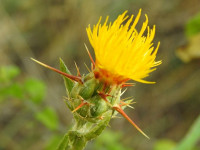
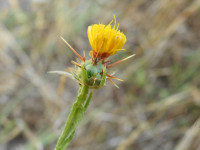
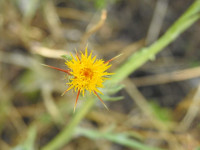
The flower heads are very numerous, pyriform in shape, with a diameter ranging from 7 to 12 mm. The involucre is composed of numerous scales arranged in several series, light in color, with an apex bearing a robust spine 8-12 mm long and from 2 to 6 lateral spines at the base; moreover, there are 2 or 3 pairs of shorter spines along the margins of the bracts. The flowers are exclusively tubular, bright yellow in color, with corollas 10 to 12 mm long. The number of flowers per head is high; sterile flowers are thinner and less conspicuous than fertile ones.
The fruit is an elongated achene about 2.5 mm long, opaque white or light brown in color, slightly laterally compressed and finely pubescent. The pappus consists of many white, stiff, and unequal bristles, 2.5-3 mm long, persistent and arranged in several series.
The root system is not described in detail in the sources, but being an annual species adapted to arid environments, it probably has fairly developed fibrous roots for rapid water absorption under dry soil conditions.
Habitat and distribution
This species is native to the southeastern Mediterranean area, particularly the Maltese Islands, from which the common name “Maltese Star-thistle” also derives. In Italy it is present in several central-southern regions and along the western coastal belt: it is found in Liguria, Tuscany (Maremma), Lazio (Circeo area), Apulia, Calabria, Sicily, Sardinia, as well as in smaller islands such as Giannutri and Corsica. The species is considered rare (R) in some of these areas.
It prefers habitats of dry grasslands, uncultivated lands, roadsides, abandoned crops, and ruderal environments, frequently occurring in areas with a typically arid or semi-arid Mediterranean climate. It grows on well-drained soils, often sandy or rocky, with sunny exposure, from near sea level up to about 1600 m altitude.
It behaves as a weed species of crops and disturbed soils, adapting to conditions of low water availability and poor soils.
Flowering period
Flowering generally extends from June to November, with variations linked to latitude and local climatic conditions. In some Mediterranean areas it can start already in late spring (May-June) and continue until autumn, while in warmer climates or more southern zones it may last longer.
Ecology and pollination
The Maltese Star-thistle presents tubular, yellow, and conspicuous flowers that attract a variety of insect pollinators. Among the main pollinators are bees, bumblebees, and other hymenopterans, but also butterflies and beetles, attracted by the bright color and the presence of nectar and pollen.
The structure of the flower head, with numerous fertile and sterile flowers, facilitates entomophilous pollination (by insects). The presence of spines on the bracts of the involucre protects the flowers and fruits from predators and facilitates seed dispersal.
Dissemination mainly occurs through the feathery pappus that allows the seeds (achenes) to be carried by the wind over short distances, contributing to the species’ expansion in open and disturbed habitats.
Curiosities and traditional uses
No particular or significant traditional uses in medicine or food are known for this species, nor specific references in local folklore. Its presence is more relevant from an ecological and naturalistic point of view, as a component of the spontaneous Mediterranean flora and as a weed species that can colonize arid soils and crops.
Etymology
The scientific name "Centaurea" derives from Greek mythology, where the centaur Chiron used a similar plant to heal wounds, hence the genus Centaurea is traditionally associated with medicinal plants. The specific epithet "melitensis" refers to the Maltese Islands (Melita in Latin), from which the species is native or where it was first described.
The Italian common name “fiordaliso maltese” precisely recalls the Maltese origin and is due to the bright color of the yellow flowers, which resemble cornflowers although belonging to a different genus than the true cornflowers (Centaurea cyanus).
Sources
- Acta Plantarum - Flora delle regioni italiane (actaplantarum.org)
- World Flora Online (WFO)
Characteristics
Scheda botanica
| Famiglia | Asteraceae |
|---|---|
| Fioritura | giugno – agosto |
| Forma biologica | Scapose |
| Habitat | with yellow flowers, spiny plant, with blue-purple flowers |
Domande frequenti
- Quando fiorisce Maltese Star-thistle?
- Maltese Star-thistle fiorisce giugno – agosto.
- Che tipo di pianta è Maltese Star-thistle?
- Maltese Star-thistle è una Therophytes (Scapose) secondo la classificazione di Raunkiaer.
- A quale famiglia appartiene Maltese Star-thistle?
- Maltese Star-thistle appartiene alla famiglia botanica Asteraceae.
Where I found it (9 sightings)
Classification
- Kingdom
- Plantae
- Family
- Asteraceae
- Full name
- Centaurea melitensis L.
- Synonyms
- Calcitrapa melitensis (L.) Soják
- Life form
- Therophytes scapose
Similar species
Search for species with similar characteristicsFurther reading
Noticed an error in the identification? Write to me
Other species of the same family
Asteraceae
Explore
Other species of Asteraceae