Botanical species
Centaurea jacea
L.
Brown Knapweed
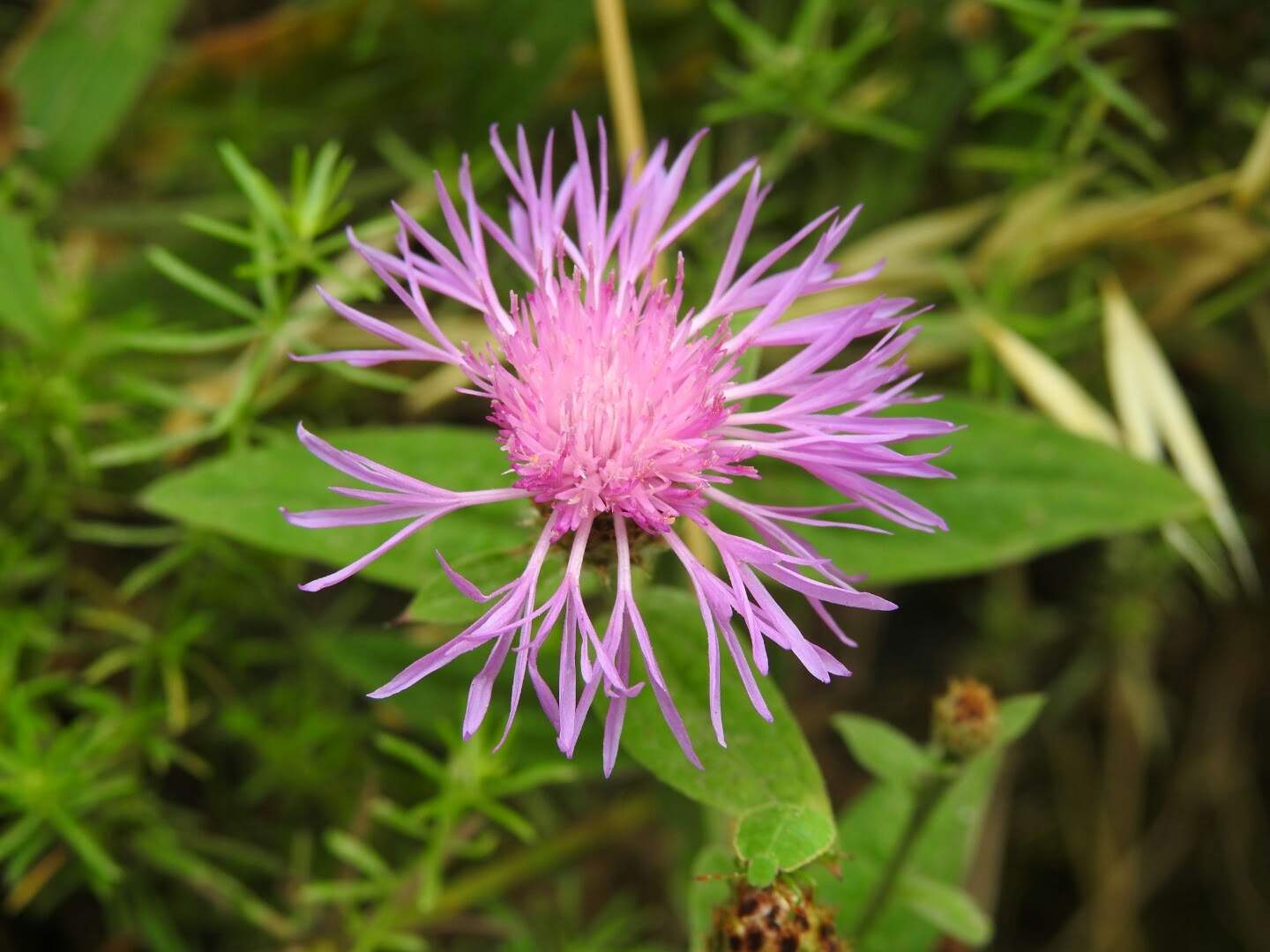
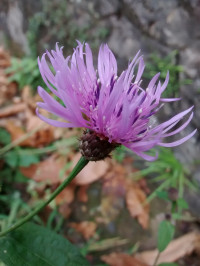
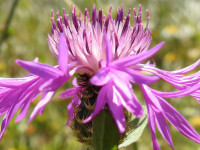
Description
Morphological description
Perennial scapose plant, with an erect habit, reaching a height between 30 and 60 cm. The stem is generally glabrous, sometimes slightly pubescent, robust and ascending. The basal leaves are larger, often ovate-lanceolate or lanceolate, with entire or slightly dentate margins; the cauline leaves are sessile, lanceolate with entire margins, narrower and smaller towards the apex of the stem. The lower leaves may sometimes present pinnatifid segmentations, while the upper ones are generally entire.
The flower heads, relatively large (2-4 cm in diameter), are borne singly or in small groups at the apex of the scapose flowering stems, i.e., with few or almost no leaves. The involucre, cylindrical or subglobose, has a diameter of about 7-15 mm and presents scales with well-developed, membranous, flat or slightly concave appendages, with irregularly laciniate, fringed or combed margins, ranging in color from light brown to dark brown, often completely hiding the green part beneath the scales. The flowers are tubular, actinomorphic, numerous, pink-purple or purplish in color, with the peripheral flowers often radiate. The pappus is absent or very rudimentary, composed of very small bristles.
The fruits are achenes about 2.5-3 mm long, slightly pubescent and united at the apex, lacking a well-developed pappus. The root system is typical of perennial herbaceous species, with buds at ground level allowing perennation.
Habitat and distribution
Typical species of mountainous and submontane environments, frequent in stable meadows, clearings and grassy edges, often in cool and well-sunny places. It grows on soils of various types, preferably well-drained, and usually in areas with sunny or partially shaded exposure. In Italy it is widespread especially in the alpine and Apennine regions, but its presence extends throughout temperate Europe, up to Siberia, and in vast Eurasian areas up to Japan.
The species has been favored by human intervention, particularly by the creation of stable meadows, which has increased its expansion. It is also present in rural environments such as roadside edges and uncultivated spaces.
Flowering period
Flowering extends from June to September, with some variations related to altitude and latitude. In cooler and mountainous climates flowering may start later, while in temperate climate areas it can begin as early as June.
Ecology and pollination
The species is pollinated by pollinating insects, particularly bees, butterflies and other hymenopterans attracted by the tubular flowers and vivid colors (pink-purple). The presence of radiate peripheral flowers favors the visual attraction of pollinating insects. The reproductive strategy may also include phenomena of apomixis (reproduction without fertilization) and polyploidization, which contribute to the genetic variability and adaptability of the species.
Seed dispersal occurs through achenes lacking a developed pappus, therefore dissemination is probably limited to short distances, facilitated by light wind or animals.
Curiosities and traditional uses
No specific food or medicinal uses are documented for this species in the available literature. However, Brown Knapweed is often appreciated in naturalistic and botanical contexts for its beauty and the ecological role it plays in mountain meadows, where it contributes to the maintenance of biodiversity.
The common name “fiordaliso stoppione” probably refers to the resemblance to the common cornflower, with the addition of “stoppione” which could refer to the appendages of the involucre scales that resemble wicks or fringes.
Etymology
The generic name Centaurea derives from the mythological figure of the centaur Chiron, known for his knowledge in herbalism and medicine. The specific name jacea is of uncertain origin, but traditionally could derive from Latin or Greek terms related to the shape of the plant or its habitat.
The Italian common name “fiordaliso stoppione” describes the plant as a flower similar to the cornflower, with the characteristic “stoppione” meaning the lamellar and fringed appendages of the involucre which indeed resemble wicks or fringes.
Sources
- Prof. S. Pignatti, "Flora d'Italia"
- Acta Plantarum - Flora delle regioni italiane (scheda di Marinella Zepigi)
- Tela Botanica / H. Coste, "Flore descriptive et illustrée de la France"
- World Flora Online (WFO)
Characteristics
Scheda botanica
| Famiglia | Asteraceae |
|---|---|
| Fioritura | giugno – luglio |
| Forma biologica | Scapose |
| Habitat | with purple flowers, Perennial plant, plant with leaves with irregularly toothed margin |
Domande frequenti
- Quando fiorisce Brown Knapweed?
- Brown Knapweed fiorisce giugno – luglio.
- Che tipo di pianta è Brown Knapweed?
- Brown Knapweed è una Hemicryptophytes (Scapose) secondo la classificazione di Raunkiaer.
- A quale famiglia appartiene Brown Knapweed?
- Brown Knapweed appartiene alla famiglia botanica Asteraceae.
Where I found it (3 sightings)
Classification
- Kingdom
- Plantae
- Family
- Asteraceae
- Full name
- Centaurea jacea L.
- Synonyms
- Centaurea timbalii Martrin-Donos
- Life form
- Hemicryptophytes scapose
Similar species
Search for species with similar characteristicsFurther reading
Noticed an error in the identification? Write to me
Other species of the same family
Asteraceae
Explore
Other species of Asteraceae