Botanical species
Scorzonera rosea
Waldst. & Kit.
Scorzonera rosea
Description
Morphological description
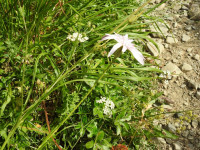
It is a perennial plant belonging to the family Asteraceae, with a scapose habit and height varying between 25 and 40 cm, sometimes up to 60 cm. The aerial part of the stem is erect, simple, glabrous and striated, with leaves arranged along 2/3 - 3/4 of the axis. The underground part consists of an oblique rhizome, wrapped in brown fibers, from which secondary roots arise.
The leaves are herbaceous in texture, lanceolate or ovate-lanceolate in shape, with a linear blade and flat surface. They are semi-clasping the stem and arranged alternately. The lower leaves reach lengths of 20-30 cm, while the upper ones are smaller, from 4 to 8 cm, with a width around 8-9 mm.
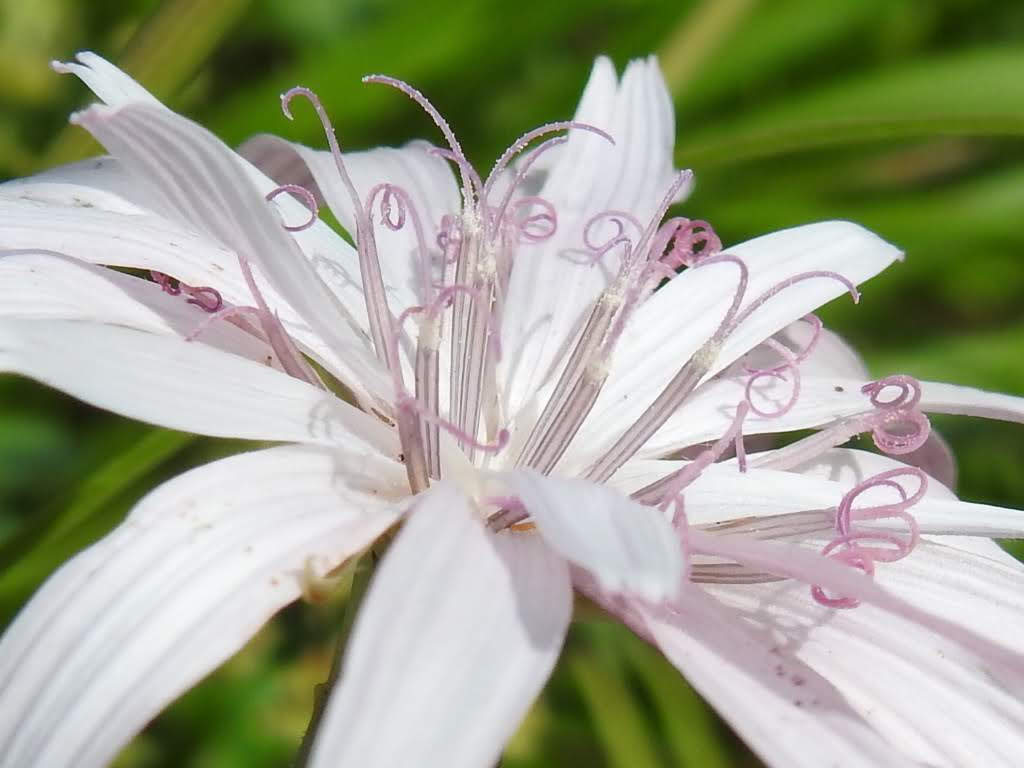
The inflorescence consists of single capitula, of medium size (3-5 cm in diameter), supported by a pyriform-elongated involucre formed by several series of lanceolate-acuminate bracts. The lower bracts are sharper, covering about one third of the upper bracts, which measure up to 15-18 mm in length. The receptacle is naked, that is, without chaff scales.
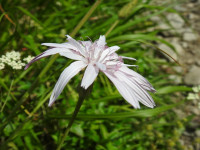
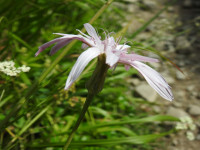
The flowers are all ligulate, pink in color, hermaphroditic and actinomorphic. The corolla includes five petals fused to form a ligule, while the calyx is reduced to a crown of scales. The androecium consists of five stamens, while the gynoecium is bicarpellate with an inferior ovary. The floral formula is * K 0/5, C (5), A (5), G (2), inferior, with pentamerous and tetracyclic flowers. The fruit is an achene.
Habitat and distribution
This species is typical of mountain environments. It grows in mountainous areas of the Mediterranean basin, including Italy, preferring well-drained soils and sunny or semi-shaded exposure conditions. Its presence is documented at medium-high altitudes, where the cool temperate climate favors its development.
Flowering period
Flowering mainly occurs in the summer months, from July to August. Depending on altitude and latitude, the flowering period may undergo slight variations, but it generally concentrates in midsummer.
Ecology and pollination
The pink ligulate flowers are adapted to attract pollinating insects, particularly bees and butterflies, which play a fundamental role in pollination. The plant is a scapose hemicryptophyte: the buds overwinter at ground level, protected by litter or snow, and the floral axis rises during the growing season. Seed dispersal occurs through achenes, which can be transported by wind or animals, although no specific dispersal strategy is documented.
Curiosities and traditional uses
The genus name, Scorzonera, has an uncertain etymological origin: it could derive from ancient terms such as "scorzon" in French, "scorsone" in Italian or "escorzonera" in Spanish, with meanings associated with "black bark". Another possible origin is linked to the word "viper" and the traditional use of the plant's roots as a remedy against snake bites.
The specific epithet "rosea" refers to the pink color of the corolla, a distinctive characteristic of the species. Although specific medicinal or food uses of this species are not widely documented, related plants of the genus Scorzonera are known for the edible and therapeutic properties of their roots and leaves.
Etymology
The scientific name was proposed in 1805 by Austrian and Hungarian botanists and is composed of the genus Scorzonera, probably meaning "black bark" or "viper", and the epithet "rosea", which describes the pink color of the flowers. In Italian, the plant is simply known as "Scorzonera rosea", with the common name directly deriving from the scientific denomination.
Sources
Wikipedia
Characteristics
Scheda botanica
| Famiglia | Asteraceae |
|---|---|
| Fioritura | luglio – agosto |
| Forma biologica | Scapose |
| Habitat | with pink flowers, Perennial plant, plant with a scapose habit |
Domande frequenti
- Quando fiorisce Scorzonera rosea?
- Scorzonera rosea fiorisce luglio – agosto.
- Che tipo di pianta è Scorzonera rosea?
- Scorzonera rosea è una Hemicryptophytes (Scapose) secondo la classificazione di Raunkiaer.
- A quale famiglia appartiene Scorzonera rosea?
- Scorzonera rosea appartiene alla famiglia botanica Asteraceae.
Where I found it (4 sightings)
Classification
- Kingdom
- Plantae
- Family
- Asteraceae
- Full name
- Scorzonera rosea Waldst. & Kit.
- Synonyms
- Podospermum roseum (Waldst. & Kit.) Gemeinholzer & Greuter; Scorzonera purpurea L. subsp. rosea (Waldst. & Kit.) Nyman
- Life form
- Hemicryptophytes scapose
Similar species
Search for species with similar characteristicsFurther reading
Noticed an error in the identification? Write to me
Other species of the same family
Asteraceae
Explore
Other species of Asteraceae