Botanical species
Arctium lappa
L.
Greater Burdock
Description
Morphological description
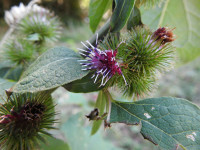
A large biennial herbaceous plant, Greater Burdock has an erect and robust habit, with a height ranging between 80 and 200 cm. The stem is grooved, often reddish, and branches at the apical part, sometimes covered by a slight coating of silky tomentum. The base of the stem and the petioles of the basal leaves are filled with pith (not tubular), a distinctive feature compared to other similar species.
The leaves are large, alternate, with a blade that can reach considerable sizes, up to 50 cm long and 40 cm wide. They are ovate or heart-shaped, especially the basal ones, while the cauline leaves tend to be sessile and smaller, with decreasing size towards the apex. The upper surface of the leaves is bright green, glabrous, while the lower surface appears whitish and cobwebby, with a dense tomentose hairiness giving a grayish appearance. The petioles are grooved and filled with pith.
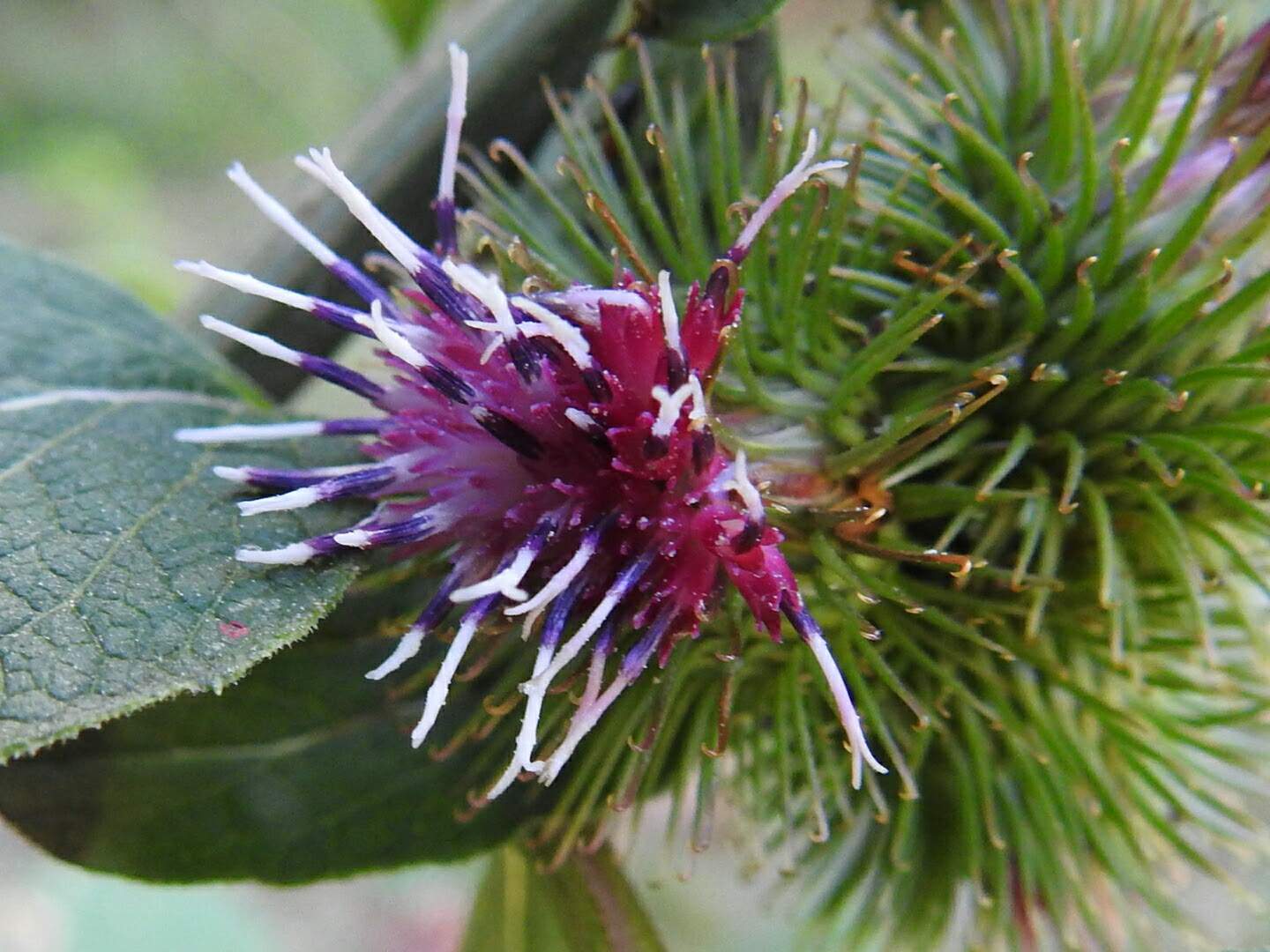
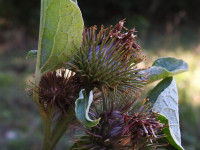
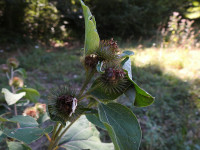
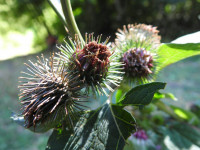
The inflorescence consists of spherical capitula, 3-4 cm in diameter, gathered in terminal corymbs and borne on peduncles at least 2.5 cm long. Each capitulum is surrounded by acuminate, glabrous, entirely green bracts, with a hooked apex, which give the plant its characteristic ability to cling to animals and clothing. The flowers are tubular, hermaphroditic, violet or purplish in color, with a corolla about 1.4 cm long and a tube about 8 mm. The stamens and stigmas are glabrous, but with a tuft of hairs at the apex of the style.
The fruit is an oblong-elliptic achene, about 6-7 mm long, reddish-brown with black spots, wrinkled at the apex, topped by a pappus of yellowish ciliate bristles at the base and by a disc with a wavy and pleated edge.
The root system is characterized by a large taproot, fleshy, brown on the outside and white inside, which allows the plant to store nutrients during the first year of life, when the basal rosette develops.
Habitat and distribution
Greater Burdock is widespread almost everywhere in Italy and is present throughout Europe and temperate Asia, with a Eurasian range extending from the European continent to Japan. In Italy, it commonly grows in ruderal environments, along roadsides, fallow lands, forest clearings, and paths, from the plains up to about 1,800 meters altitude. It prefers well-drained soils, often disturbed or nutrient-rich, and adapts to sunny or partially shaded exposures.
In the Mediterranean, it is mainly found in the more temperate regions, where anthropized environments and open woods offer favorable conditions for its growth.
Flowering period
Flowering occurs in the second year of the plant's life, generally between July and September, with a higher concentration in July and August. In some geographic areas, especially at altitude or in cooler climates, flowering may vary slightly but remains concentrated in the summer season.
Ecology and pollination
Greater Burdock is an entomophilous species, mainly pollinated by pollinating insects such as bees and other hymenopterans that visit the numerous tubular flowers to collect nectar and pollen. The corymbose structure of the capitula favors the attraction of many insects simultaneously.
Seed dispersal occurs thanks to the pappus formed by hooked bracts, which easily attach to animal fur or clothing fabrics, facilitating the spread of the species over large distances and in diverse environments.
Curiosities and traditional uses
Greater Burdock has played an important role in traditional medicine and popular culture of many civilizations. Its roots and leaves are known for their medicinal properties: they contain polyphenolic compounds, polysaccharides such as inulin, essential oils, tannins, lignans, and B vitamins.
It is traditionally used as a depurative, anti-inflammatory, antibacterial, diuretic, and hypoglycemic herb. In particular, the root is employed to treat dermatitis, eczema, psoriasis, acne, boils, and other skin conditions. Burdock extract is used both internally and externally, for example to stimulate hair growth.
In cooking, the petioles of young leaves are consumed boiled or fried, while the large fleshy root can be eaten raw in salads or cooked like carrots, also in frying.
Historically, Greater Burdock has been used both in European folk medicine and Asian medicine. For example, ancient Chinese physicians used it for colds and respiratory infections; in medieval Europe, it was included in herbals and recommended for various diseases, although its therapeutic efficacy was later questioned by modern experts.
The plant also plays a role in beekeeping, being a good source of nectar for honey bees.
Etymology
The genus name derives from the Greek “arktos” meaning “bear,” probably referring to the spiny infructescences and the rough appearance of plants of this genus, which resemble the coarseness of bear fur. The specific epithet “lappa” derives from the Latin “lappare,” meaning “to grasp,” referring to the ability of the infructescences to easily adhere to animals or clothing.
In Italian, the common name “Bardana” is traditional and widespread, while “Greater Burdock” distinguishes it from other species of the genus present in the territory.
Sources
- Prof. S. Pignatti, "Flora d'Italia"
- Acta Plantarum - Flora delle regioni italiane (scheda di Marinella Zepigi)
- Tela Botanica / H. Coste, "Flore descriptive et illustrée de la France"
- World Flora Online (WFO)
Characteristics
Scheda botanica
| Famiglia | Asteraceae |
|---|---|
| Fioritura | luglio – settembre |
| Forma biologica | Biennials |
| Habitat | with purple flowers |
| Uso officinale | Pianta officinale |
Domande frequenti
- Quando fiorisce Greater Burdock?
- Greater Burdock fiorisce luglio – settembre.
- Che tipo di pianta è Greater Burdock?
- Greater Burdock è una Hemicryptophytes (Biennials) secondo la classificazione di Raunkiaer.
- A quale famiglia appartiene Greater Burdock?
- Greater Burdock appartiene alla famiglia botanica Asteraceae.
Where I found it (5 sightings)
Classification
- Kingdom
- Plantae
- Family
- Asteraceae
- Full name
- Arctium lappa L.
- Synonyms
- Arctium majus Bernh., nom. illeg.; Arctium vulgare (Hill) Druce; Lappa glabra Lam., nom. illeg.; Lappa major Gaertn., nom. illeg.; Lappa officinalis All., nom. illeg.; Lappa vulgaris Hill
- Life form
- Hemicryptophytes biennials
Similar species
Search for species with similar characteristicsFurther reading
Noticed an error in the identification? Write to me
Other species of the same family
Asteraceae
Explore
Other species of Asteraceae