Botanical species
Aquilegia atrata
W.D.J.Koch
Dark Columbine
Description
Morphological description
Perennial scapose herbaceous plant, with a height that can reach up to 70 cm. The stem is erect, cylindrical, branched and often presents a reddish coloration, especially in the upper part, where it is also covered by a fine glandular pubescence. The base of the plant has a large vertical or oblique rhizome from which secondary roots and basal leaves develop.
The basal leaves are arranged in a basal rosette, with long petioles of 10-30 cm and a blade finely divided into three tripartite segments, each with fan-shaped and deeply lobed forms, measuring up to 3 x 3 cm. The lower surface of these leaves is glaucous. The cauline leaves, smaller and more numerous, become progressively simpler towards the top of the stem, ranging from tripartite with lobed segments to linear and entire, often sessile.
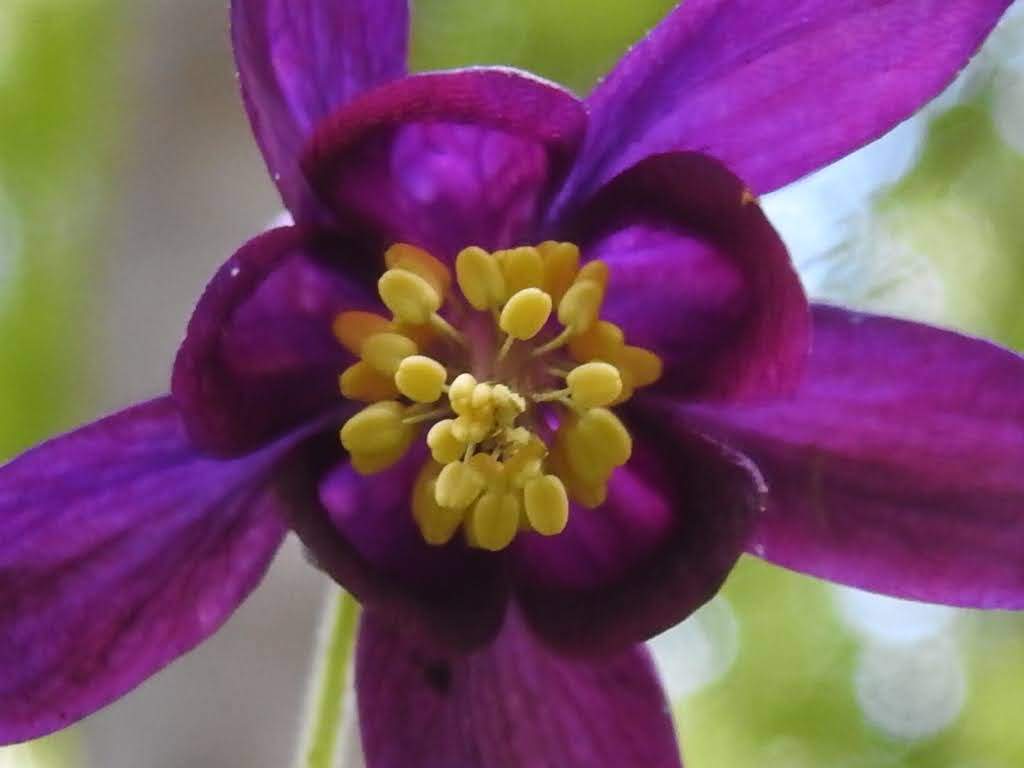
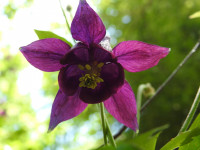
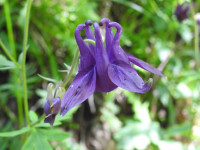
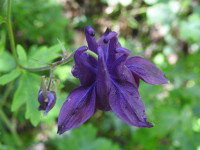
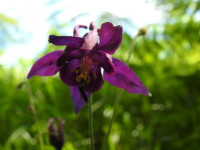
The flowers, hermaphroditic and pendulous, are borne on long, curved and glandular peduncles. The inflorescence is a loose panicle composed of 2-7 flowers. Each flower measures between 3 and 5 cm in diameter and is characterized by five outer tepals of dark violet or brownish color, ovate-lanceolate or spatulate in shape and about 8 x 17-20 mm in size. The inner whorl includes five nectaries (inner tepals) of the same color, hood-shaped, with a curved spur at the tip, 10-15 mm long, bending towards the floral axis. The stamens, numerous and yellow, protrude clearly beyond the tepals, forming a column 5 to 10 mm long.
The fruit is a follicle, consisting of five glandular-pubescent follicles, briefly fused at the base.
Habitat and distribution
This species is typically montane and is mainly found in orophilous environments of Southwestern Europe, with a distribution in Italy including the Alps, the Langhe, the Ligurian Apennines, the Tuscan-Emilian Apennines, the Apuan Alps, Abruzzo, Campania and the Pollino Massif. In these areas it can locally replace Aquilegia vulgaris.
It prefers mountain woods, particularly spruce forests, shrubby gorges, semi-shaded areas, pastures and meadows on humus-rich, calcareous or neutral soils, with exposure from hilly to subalpine, between 400 and 2000 meters of altitude.
Flowering period
Flowering generally occurs between May and July (months 5-7), with possible variations related to altitude and local climate.
Ecology and pollination
The pendulous flowers, dark violet and fragrant, attract various pollinating insect species, including bumblebees and butterflies, which facilitate pollination. The protrusion of the stamens beyond the petals favors contact with pollinating insects. Seed dispersal occurs through follicles that open to release seeds equipped with glandular structures that may facilitate dispersal by small animals or abiotic agents, although specific details of this phase are not widely documented.
Curiosities and traditional uses
Dark Columbine is a medicinal species known for its antiseptic, calming, astringent, purifying, diuretic, diaphoretic and parasiticidal properties. Historically it has been used to combat skin conditions such as scabies and ringworm, and to promote urinary secretion through its seeds. The alcoholic tincture obtained from the plant was used to relieve headaches, dyspnea crises and dysmenorrhea. The leaves were used to prepare poultices against boils, ulcers, sores and scurvy.
It is important to emphasize that the entire plant, especially the seeds, is toxic due to the presence of cardioactive glycosides that release hydrocyanic acid and alkaloids such as aquilegin. Poisoning from this species can cause burning in the mouth and on the skin, agitation, weakening of the heartbeat, vomiting, diarrhea, convulsions and can be fatal.
For these reasons, any therapeutic or food use must be avoided or carried out only under strict medical supervision.
Etymology
The genus name probably derives from the Latin aquilegium, which can mean “cistern” or “to collect water,” referring to the shape of the leaves that collect rainwater. Another interpretation links the name to the resemblance of the flower spurs to the beaks of an eagle, interpreting Aquilegia as “like an eagle.”
The specific epithet atrata refers to the dark, almost blackish color of the petals. In Italian the species is called “Aquilegia scura” or “Aquilegia nerastra” precisely because of this distinctive chromatic characteristic.
Sources
- Prof. S. Pignatti, Flora d’Italia
- Acta Plantarum – Flora delle regioni italiane (scheda di Giuliano Salvai)
- World Flora Online (WFO)
Characteristics
Scheda botanica
| Famiglia | Ranunculaceae |
|---|---|
| Fioritura | maggio – luglio |
| Forma biologica | Scapose |
| Habitat | with purple flowers, Perennial plant, plant with a scapose habit |
Domande frequenti
- Quando fiorisce Dark Columbine?
- Dark Columbine fiorisce maggio – luglio.
- Che tipo di pianta è Dark Columbine?
- Dark Columbine è una Hemicryptophytes (Scapose) secondo la classificazione di Raunkiaer.
- A quale famiglia appartiene Dark Columbine?
- Dark Columbine appartiene alla famiglia botanica Ranunculaceae.
Where I found it (13 sightings)
Classification
- Kingdom
- Plantae
- Family
- Ranunculaceae
- Full name
- Aquilegia atrata W.D.J.Koch
- Life form
- Hemicryptophytes scapose
Similar species
Search for species with similar characteristicsFurther reading
Noticed an error in the identification? Write to me
Other species of the same family
Ranunculaceae
Explore
Other species of Ranunculaceae