Botanical species
Anemonoides nemorosa
(L.) Holub
Wood Anemone
Description
Morphological description
Perennial herbaceous plant belonging to the family Ranunculaceae, the wood anemone is distinguished by its erect and compact habit, with a height generally ranging between 10 and 15 cm, but it can reach 30 cm under favorable conditions. The stem is simple, lacking axillary buds, and shows a characteristic reddish coloration in the lower part.
The root system consists of horizontal rhizomes, briefly creeping, with a diameter between 2 and 6 mm, covered by scales that fall off quickly. These rhizomes allow the plant to regenerate every year and slowly expand in its woodland environment.
The leaves are differentiated into basal and cauline. Basal leaves appear after flowering and are pinnately lobed, generally trilobed with 3-5 irregularly incised segments and toothed margins. They are herbaceous, with a slightly pubescent surface due to silvery hairs. The cauline leaves, instead, are arranged in whorls of three around the middle of the stem and have a simpler shape, with leaf-like bracts provided with petioles 2-5 cm long.
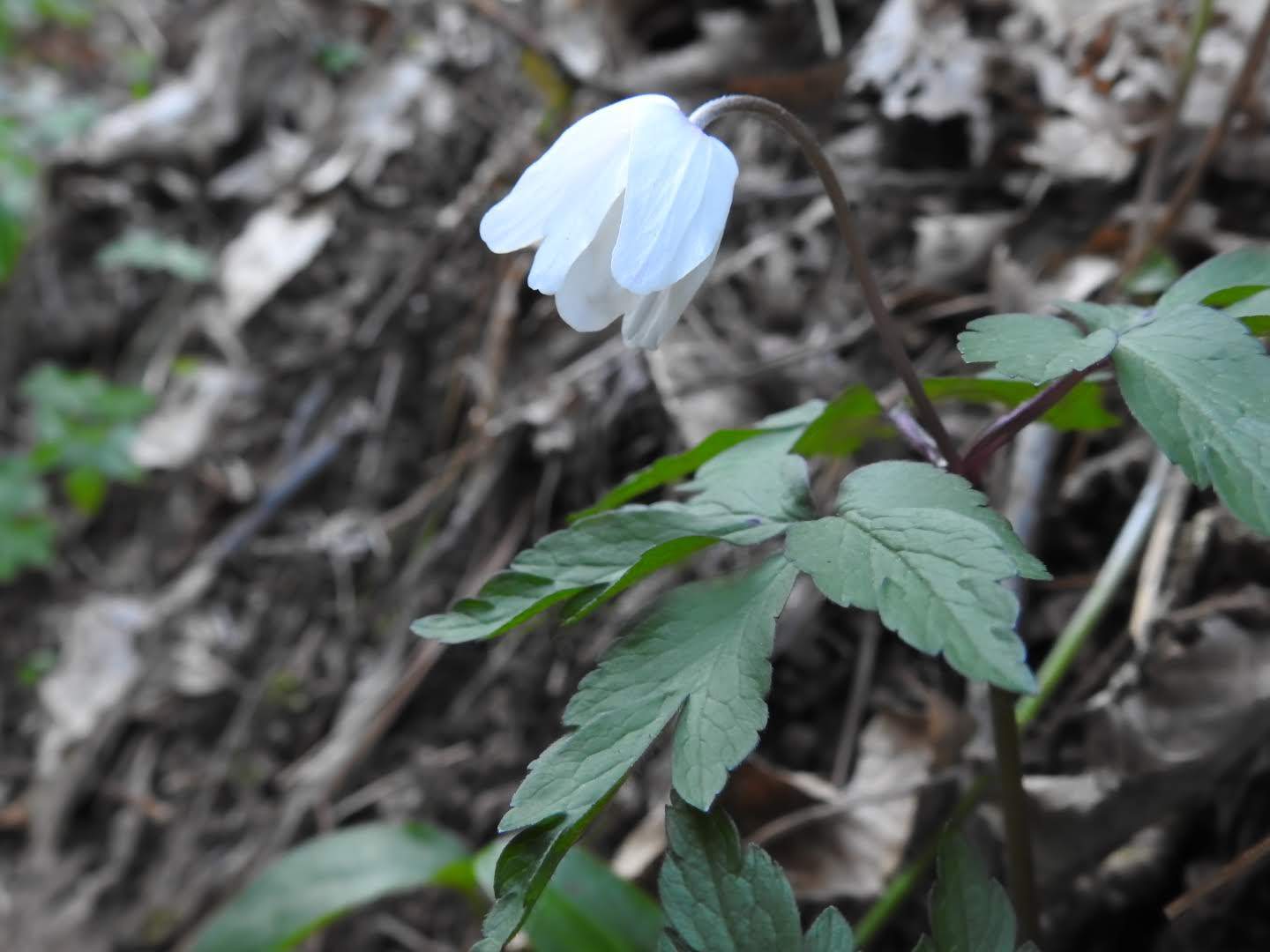
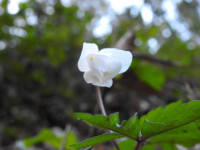
The flower is solitary, with a diameter of 2-4 cm and a peduncle 2-3 cm long. It does not have true petals, but petaloid sepals (6-9) of white color, sometimes with pinkish shades and light pink veins at the base. These sepals are elliptical, glabrous, 6-12 mm long, and give the flower a delicate and bright appearance. The anthers are white, while the carpels are numerous and lack nectaries.
The fruit is a spherical polyachene, pubescent and of variable size from 15 up to 25-50 mm, with a persistent style that facilitates its dispersion.
Habitat and distribution
The wood anemone is a typically nemoral species, i.e., linked to broadleaf woodland environments, where it preferably grows in shaded and humid areas. It is widespread throughout Italy, from the plains up to 1600 meters altitude, adapting to different soil types, provided they are well-drained and rich in organic matter.
Its distribution also extends to Europe and the temperate-cold regions of Asia and North America, configuring it as a circumboreal plant. In the Mediterranean basin it is mainly present in mountain and submontane areas, where it manages to exploit the early spring season before the woodland foliage fully develops, thus allowing better light availability.
Flowering period
The flowering of the wood anemone generally occurs between March and May, with variations related to altitude and latitude. In the plains and milder areas, flowers can appear already at the end of winter, while in mountainous regions flowering shifts towards late spring.
The precocity of flowering is an adaptive strategy that allows the plant to complete the reproductive cycle before the understory is covered by summer foliage, which shades the light.
Ecology and pollination
The wood anemone is mainly pollinated by pollinating insects, including solitary bees and bumblebees, attracted by the white flowers and their early visibility. It does not possess nectaries, but pollen is the main reward for pollinators.
The species also reproduces vegetatively through rhizomes, which favor the formation of extensive and stable colonies over time. Seed dispersal occurs thanks to the polyachenous fruits, which, equipped with a persistent style and pubescence, can be transported by animals or wind.
Curiosities and traditional uses
In Greek mythology the anemone is linked to several legends: one of these tells that the flower was born from the tears of the goddess Venus for the death of Adonis, while another narrates that Anemone was a nymph loved by Zephyr, the west wind, who was transformed into a flower out of jealousy by the goddess Flora. This symbolism has made the anemone represent sorrow for disappointed loves or abandonments.
Historically the wood anemone has been used in folk medicine, but it is important to underline that its pharmacological applications are to be considered only for informational purposes and do not replace medical therapies. The plant contains potentially toxic principles and its use for food or medicinal purposes is not advisable without adequate knowledge.
Etymology
The scientific name reflects the similarity of the plant to those of the genus Anemone (hence "anemonoides", meaning "similar to anemone"). The specific epithet "nemorosa" derives from Latin nemus, nemoris, meaning "wood", emphasizing the species' preferred habitat.
The Italian common name, "anemone dei boschi", exactly recalls this ecological characteristic, referring to its typical presence in shady and cool understories.
Sources
- Acta Plantarum - Flora delle regioni italiane (scheda di Antonino Messina)
Characteristics
Where I found it (9 sightings)
Classification
- Kingdom
- Plantae
- Family
- Ranunculaceae
- Full name
- Anemonoides nemorosa (L.) Holub
- Synonyms
- Anemone nemorosa L.
- Life form
- Geofite rizomatose
Similar species
Search for species with similar characteristicsFurther reading
Noticed an error in the identification? Write to me
Other species of the same family
Ranunculaceae
Explore
Other species of Ranunculaceae