Botanical species
Thalictrum aquilegiifolium
L. subsp. aquilegiifolium
French Meadow-rue
Description
Morphological description
Perennial herbaceous plant belonging to the family Ranunculaceae, with an erect habit and a height ranging from 40 to 140 cm. The stem is glabrous, slightly striated, violet-colored, cylindrical and hollow, completely provided with leaves along its entire length. The roots are thin, fusiform and reddish in color, of the taproot type.
The leaves, arranged alternately on the stem, are bi- or tripinnate, that is divided into ovate or suborbicular segments, with incised or toothed margins. The basal leaves are larger and divided into ovate or lobed segments, cordate at the base, with the lower surface glaucous and glabrous. Those on the stem are similar but progressively smaller. At the base of the leaf petioles there are rudimentary, membranous and whitish stipules, similar to small ears.
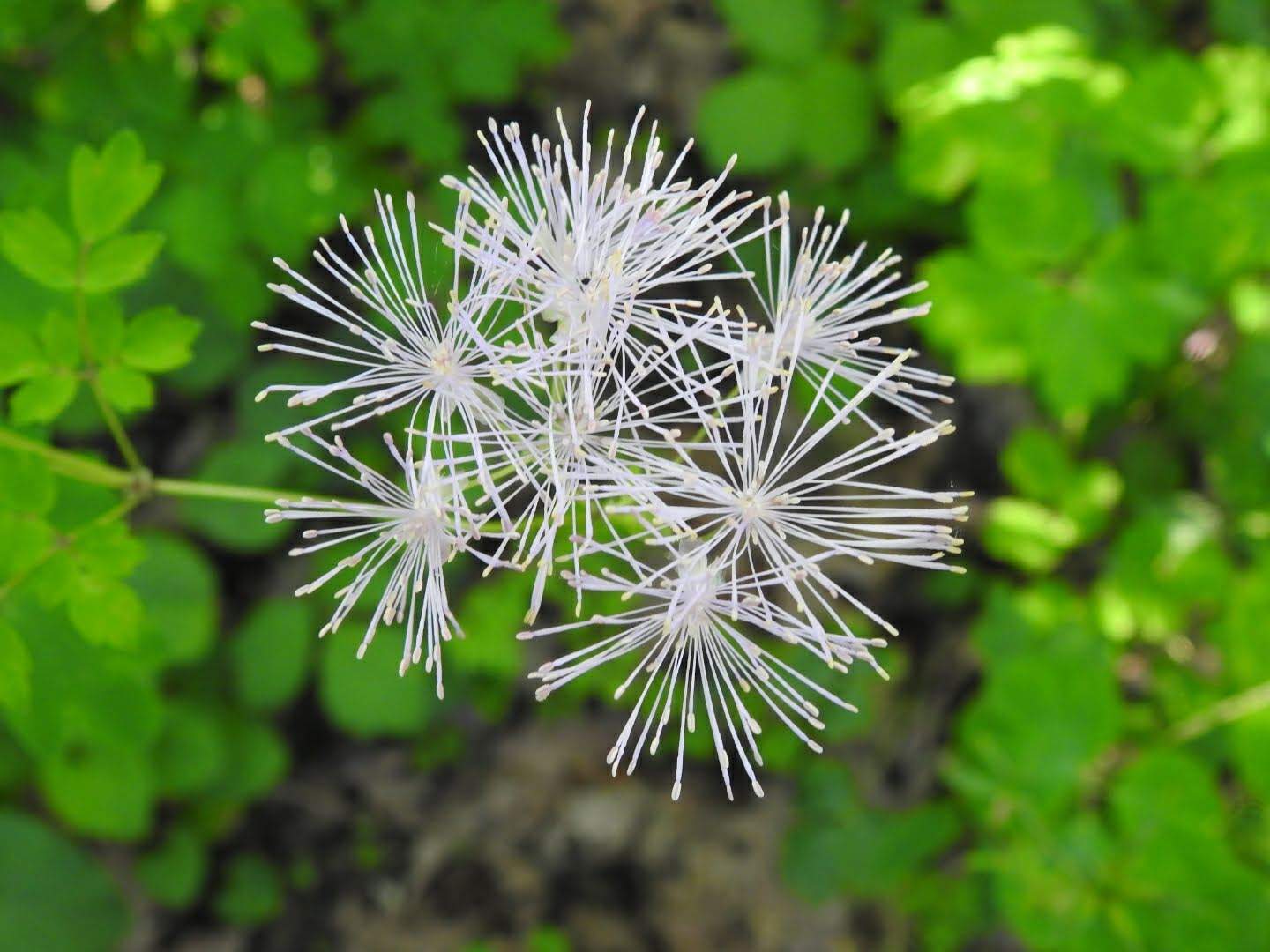
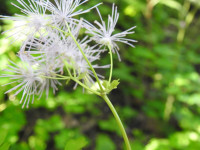
The flowers, petal-less, are small and gathered in highly branched corymbose inflorescences, often panicle-shaped. Each flower has 4-5 small deciduous tepals and numerous erect stamens with filaments 8-10 mm long, pink, light lilac, more rarely white, thickened at the tip and ending with yellow anthers about 1.5 mm long. The style is deciduous and the carpels numerous. The corolla is actinomorphic, that is radially symmetrical.
The fruits are pendulous achenes, 7-10 mm long, trigonal with pronounced winged angles; each achene is monospermous and borne on long and thin pedicels.
Habitat and distribution
The species is widespread in mountainous areas, both in the Alps and the Apennines, from 50 up to about 2400 meters altitude. It prefers cool and humid environments such as broadleaf woods (especially beech forests), stream banks, mountain meadows and pastures. It grows on well-drained but moist soils, often in wooded environments or at the edge of wet areas.
Its distribution is typically eurosiberian, present in the cold and temperate-cold regions of Eurasia. In the Mediterranean basin it is limited to the cooler mountainous areas.
Flowering period
Flowering generally occurs between May and July (months 5-7), with slight variations depending on altitude and latitude. In colder climates or at higher elevations, flowering may start later and last for a shorter time.
Ecology and pollination
The flowers, petal-less but with long colorful and conspicuous stamens, are adapted to attract pollinating insects, particularly bees and other pollinators that land on the filaments to collect pollen. The plant produces numerous achenes which, thanks to the long and thin pedicels and winged shape, facilitate dispersal by wind or contact with animals.
The reproductive strategy is therefore based on entomogamous pollination and anemochorous seed dispersal.
Curiosities and traditional uses
This species is known for its toxicity, due to the presence of a cyanogenic glycoside. Livestock avoid feeding on it, although in the past free-ranging pigs were poisoned by ingesting the roots, which they were fond of.
In the past, the plant was used in folk medicine for its presumed medicinal properties, although today it is considered toxic and not recommended for therapeutic or food uses. Yellow pigments can be extracted from the roots and used for dyeing wool.
In ornamental horticulture, French Meadow-rue is appreciated for its showy flowers and elegant form, finding use in rock and alpine gardens.
Etymology
The genus name "Thalictrum" derives from the Latin "thalia," an ancient name attributed to this plant, probably connected to the verb "thallein" meaning "to flourish, to prosper," referring to the rapid and vigorous vegetative growth of the species. The specific epithet "aquilegiifolium" indicates the similarity of the leaves to those of columbines (genus Aquilegia).
The Italian common name "pigamo colombino con foglie di aquilegia" precisely reflects this leaf characteristic similar to that of columbines and the typical habit of the species.
Sources
- Acta Plantarum - Flora delle regioni italiane (scheda di Marinella Zepigi)
- World Flora Online (WFO)
Characteristics
Scheda botanica
| Famiglia | Ranunculaceae |
|---|---|
| Fioritura | maggio – luglio |
| Forma biologica | Scapose |
| Habitat | with white flowers, toxic plant |
| Tossicità | Tossica — non consumare |
Domande frequenti
- Quando fiorisce French Meadow-rue?
- French Meadow-rue fiorisce maggio – luglio.
- È tossica French Meadow-rue?
- French Meadow-rue è una pianta tossica o velenosa. Non consumare nessuna sua parte senza aver consultato un esperto.
- Che tipo di pianta è French Meadow-rue?
- French Meadow-rue è una Hemicryptophytes (Scapose) secondo la classificazione di Raunkiaer.
- A quale famiglia appartiene French Meadow-rue?
- French Meadow-rue appartiene alla famiglia botanica Ranunculaceae.
Where I found it (5 sightings)
Classification
- Kingdom
- Plantae
- Family
- Ranunculaceae
- Full name
- Thalictrum aquilegiifolium L. subsp. aquilegiifolium
- Life form
- Hemicryptophytes scapose
Similar species
Search for species with similar characteristicsFurther reading
Noticed an error in the identification? Write to me
Other species of the same family
Ranunculaceae
Explore
Other species of Ranunculaceae