Botanical species
Anemone hortensis
L.
Broad-leaved anemone
Description
Morphological description
Perennial herbaceous plant belonging to the family Ranunculaceae, it has a small woody tuber of blackish color, deep and ovoid in shape, with variable dimensions from 1 to 1.5 cm. The stem is slender, initially curved during the development phase, then becoming erect and elongated during flowering, reaching a height between 10 and 30 cm. The surface of the stem is pubescent, with fine and bristly hairs, giving a slight fuzziness.
The basal leaves have a long petiole, ranging between 5 and 10 cm, and present a palmatoset leaf blade 3-4 cm long, divided into 3-5 lobed, parted, or completely divided linear segments. These segments are glabrous, with the underside glaucescent in color. The cauline leaves, which form a whorl just below the flower, are simpler or trifurcated, with a less complex shape compared to the basal ones.
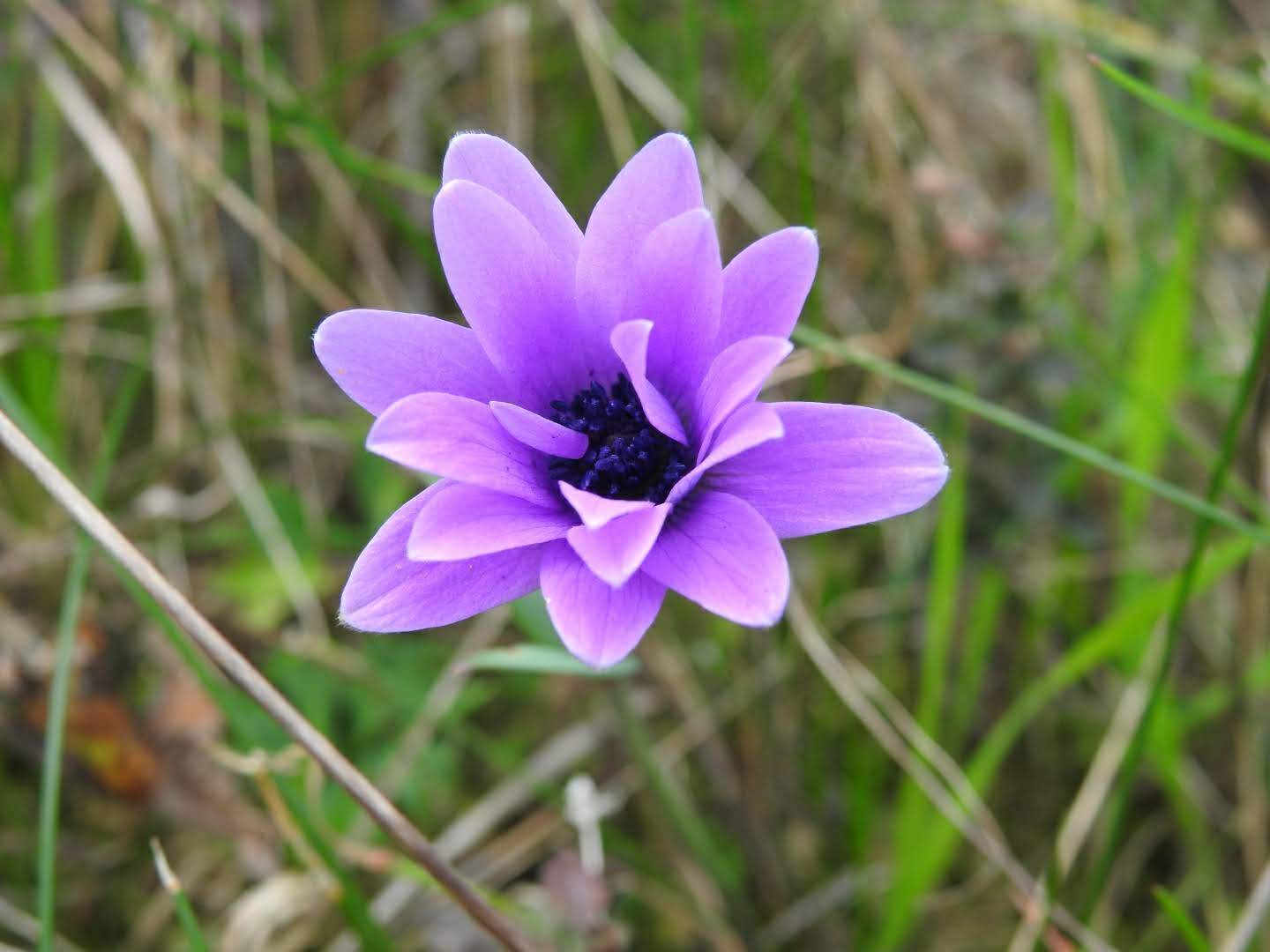
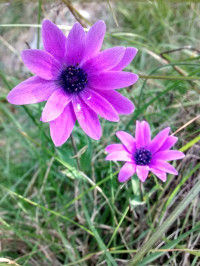
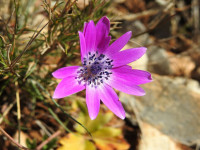
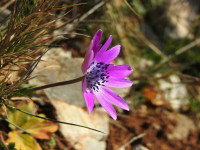
The flower is solitary, terminal, broad in shape and fragrant, with a diameter between 3 and 6 cm. It is characterized by numerous petaloid sepals (8-20, generally 12-13), narrowly elliptical, 15 to 30 mm long and 4-7 mm wide, with colors ranging from pink to violet, with shades that can reach carmine or almost white. The underside of the sepals is lighter, with evident violet-blue veins. The stamens are blue-violet in color, while the pistils are numerous and centrally positioned.
The fruit is a multiple achene, formed by numerous achenes derived from free and independent carpels, covered by a woolly pubescence. This characteristic favors seed dispersal.
Habitat and distribution
This species has a typically Mediterranean distribution, widespread in the northern Mediterranean basin, including much of Italy, Corsica, and some areas of Asia Minor. In Italy, it grows mainly in dry and sunny environments: dry meadows, clearings, olive groves, and cultivated fields, often in well-drained soils poor in organic matter.
It prefers sunny exposures and light soils, often calcareous or stony, and can be found from low altitudes up to about 1500 meters above sea level, although its presence is more common in hilly and Mediterranean areas.
Flowering period
Flowering mainly extends between March and April, with slight variations depending on location and altitude. In warmer climates and coastal areas, flower appearance can anticipate to late winter, while in higher zones it can extend until May.
Ecology and pollination
Broad-leaved anemone is a bulbous geophyte plant, which renews itself every year thanks to the underground tuber. Early spring flowering is associated with a strategy to exploit the first available pollinating insects, including bumblebees, solitary bees, and other pollinating insects attracted by the bright colors and scent of the flowers.
The flower structure, with numerous blue-violet stamens and multiple pistils, facilitates entomogamous pollination. Seed dispersal occurs through wind and potentially with the help of small animals, thanks to the presence of woolly achenes that can be more easily transported in the environment.
Curiosities and traditional uses
The species is known for its toxicity due to the presence of protoanemonins, irritating and toxic substances common to all anemones. For this reason, it is not used for food or medicinal purposes, while its handling requires caution.
In popular folklore, Broad-leaved anemone was considered a plant full of symbolic meanings and superstitions: it was believed to grow in places marked by sacred or tragic events, such as under the cross of Jesus, and was associated with diseases or ominous omens. Conversely, some popular traditions tell that the Magi advised collecting the first anemone of the year, wrapping it in a red cloth and wearing it as an amulet to ward off evil and negativity.
The flower, with a short and ephemeral life, is a symbol of fragility and abandonment, as expressed in poetic verses celebrating its fleeting nature and purple color.
Etymology
The scientific name derives from the Greek ἀνεμώνη (anemóne), meaning “daughter of the wind,” referring to the ease with which the petals are dispersed by the wind. The Latin term hortensis, translatable as “of the gardens,” probably alludes to the type of habitat or places where the plant frequently grew, such as gardens and vegetable patches.
The Italian common name "Broad-leaved anemone" refers to the shape of the petals which, arranged around the center of the flower, resemble a star.
Sources
- Prof. S. Pignatti, "Flora d'Italia"
- Acta Plantarum - Flora delle regioni italiane (scheda di Giuliano Salvai)
- Tela Botanica / H. Coste, "Flore descriptive et illustrée de la France"
Characteristics
Scheda botanica
| Famiglia | Ranunculaceae |
|---|---|
| Fioritura | gennaio – aprile |
| Forma biologica | Bulbous |
| Habitat | toxic plant, with pink flowers |
| Tossicità | Tossica — non consumare |
Domande frequenti
- Quando fiorisce Broad-leaved anemone?
- Broad-leaved anemone fiorisce gennaio – aprile.
- È tossica Broad-leaved anemone?
- Broad-leaved anemone è una pianta tossica o velenosa. Non consumare nessuna sua parte senza aver consultato un esperto.
- Che tipo di pianta è Broad-leaved anemone?
- Broad-leaved anemone è una Geophytes (Bulbous) secondo la classificazione di Raunkiaer.
- A quale famiglia appartiene Broad-leaved anemone?
- Broad-leaved anemone appartiene alla famiglia botanica Ranunculaceae.
Where I found it (5 sightings)
Classification
- Kingdom
- Plantae
- Family
- Ranunculaceae
- Full name
- Anemone hortensis L.
- Synonyms
- Anemone stellata Lam., nom. illeg.
- Life form
- Geophytes bulbous
Similar species
Search for species with similar characteristicsFurther reading
Noticed an error in the identification? Write to me
Other species of the same family
Ranunculaceae

Explore
Other species of Ranunculaceae