Botanical species
Clematis vitalba
Evergreen clematis
Description
Morphological description
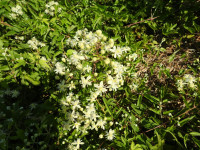
Perennial climbing and vigorous plant, the Evergreen clematis can reach lengths up to 12-15 meters thanks to its woody and trailing stems, characterized by an angular section and a fibrous bark that detaches easily. Young branches are herbaceous, twining, and angular, with a solid pith.
The leaves are opposite, imparipinnate, usually divided into 3 or 5 lanceolate or oval segments, 2 to 6 cm long and 4-6 cm wide. The margins are entire, toothed, or coarsely crenate; sometimes some leaves have deep lobes. The leaves are borne on spreading petioles thickened at the base. They are deciduous during winter.
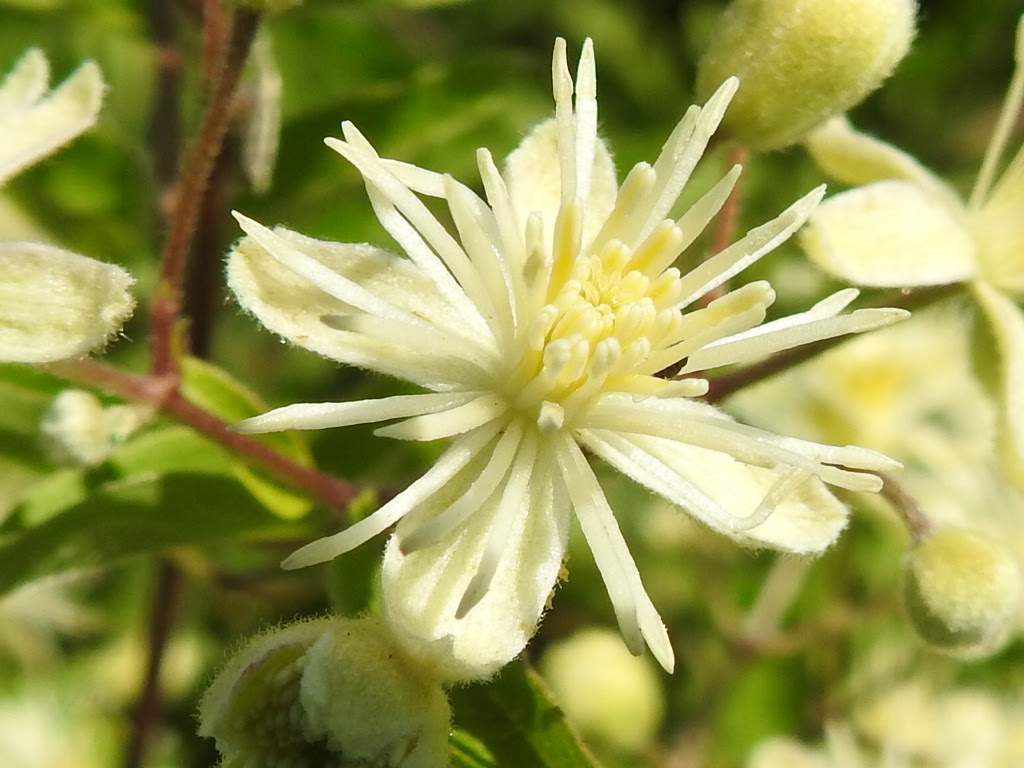
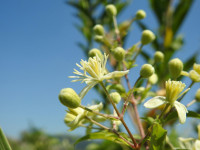
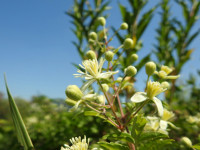
The inflorescence consists of multiflorous panicles, both terminal and axillary, with flowers about 2.5 cm in diameter. The flowers lack true petals but have 4 or 5 petaloid sepals, white or white-greenish in color, elliptic in shape, 10-12 mm long and about 3-4 mm wide, velvety on both sides. They are hermaphroditic, fragrant flowers with numerous stamens and carpels. Flowering is accompanied by an intense scent.
The fruits are small ovoid achenes, about 2-3 mm long, grouped compactly at the end of the floral peduncle. Each achene extends into a long, silvery, feathery tail, 2-3.5 cm long, which facilitates wind dispersal.
The root system is typical of liana plants, with taproots anchoring the plant to the soil, but its climbing growth is favored by the woody and twining habit of the stems.
Habitat and distribution
The Evergreen clematis is widely distributed in Europe and the Caucasus regions, with occurrences also in North Africa. In Italy, it grows spontaneously in typical temperate and Mediterranean environments, preferring hedges, edges of deciduous woods, thickets, abandoned walls, margins of watercourses and canals. It adapts to a wide variety of soils, from calcareous to more clayey, and prefers sunny or slightly shaded exposures.
The species is found up to about 1300 meters in altitude, from plains to hilly and sub-mountainous mountain reliefs. In some areas, its presence can be invasive, especially where hedges and shrubs have been cut down, thanks to its ability to quickly recolonize the territory.
Flowering period
Flowering generally extends from May to July, with possible local variations depending on altitude and climate. In warmer climates and Mediterranean areas, flowering can begin as early as May, while in cooler or mountainous areas it lasts until August.
Ecology and pollination
The flowers, hermaphroditic and fragrant, attract numerous pollinating insects, particularly bees, bumblebees, and butterflies, which facilitate entomophilous pollination. The presence of numerous stamens and carpels ensures good seed production.
Seed dispersal occurs mainly by wind (anemochory), thanks to the long feathery tails that facilitate long-distance transport of the achenes. This mechanism contributes to the rapid expansion of the plant in favorable environments.
Curiosities and traditional uses
The Evergreen clematis has a long history of traditional uses, although today it is considered a toxic plant. Its main constituents, including saponins and alkaloids (anemonin, protoanemonin), limit its phytotherapeutic use due to their caustic and irritating action.
In the past, fresh leaves were used as poultices to treat arthritis, sciatica, and gout, but caused rubefacient and blistering effects with possible skin ulcers. Some beggars used the leaves to cause ulcerations and arouse pity, hence the popular name "ragweed herb".
Infusions of dried leaves were used as diuretics, while young shoots, after cooking, were used as purgatives. Oil obtained from macerating the leaves was traditionally used to treat scabies, a remedy already known to Pliny and Dioscorides. In some Anglo-Saxon regions, dry stems were used as cigars, a custom that caused mucous membrane inflammations.
From a dietary point of view, the habit of consuming cooked young shoots, used in soups or omelets, is passed down, but only in small quantities and with caution due to the presence of toxic substances.
In folklore, the Evergreen clematis was highly appreciated by the Romans, who cultivated it next to house walls to protect against storms. The shoots were used in basket and tie production, earning it the name "poor man's viburnum".
In the floral field, it is one of Bach's flowers, associated with those who have little attention to present reality and live in fantasies or dreams; it is a symbol of inspiration and artistic creativity. In the language of flowers, it represents clear and honest intelligence.
Etymology
The scientific name derives from the Greek “klema” meaning “vine”, “shoot” or “flexible branch”, referring to the characteristic climbing habit of the plant. The specific epithet “vitalba” derives from the Latin “vitis alba”, meaning “white vine”, recalling both the appearance of the branches and the resemblance to the vine, as well as the whitish color of the flowers and the feathery silvery infructescence.
The Italian common name “clematide vitalba” precisely recalls this combination of characteristics: the ability to climb like a vine and the light coloration of the inflorescences.
Sources
- Prof. S. Pignatti, "Flora d'Italia"
- Acta Plantarum - Flora delle regioni italiane (scheda di Mirna Medri)
- Tela Botanica / H. Coste, "Flore descriptive et illustrée de la France"
- World Flora Online (WFO)
Characteristics
Scheda botanica
| Famiglia | Ranunculaceae |
|---|---|
| Fioritura | maggio – luglio |
| Forma biologica | Lianescent |
| Habitat | with white flowers, Perennial plant |
Domande frequenti
- Quando fiorisce Evergreen clematis?
- Evergreen clematis fiorisce maggio – luglio.
- Che tipo di pianta è Evergreen clematis?
- Evergreen clematis è una Phanerophytes (Lianescent) secondo la classificazione di Raunkiaer.
- A quale famiglia appartiene Evergreen clematis?
- Evergreen clematis appartiene alla famiglia botanica Ranunculaceae.
Where I found it (8 sightings)
Classification
- Kingdom
- Plantae
- Family
- Ranunculaceae
- Life form
- Phanerophytes lianescent
Similar species
Search for species with similar characteristicsFurther reading
Noticed an error in the identification? Write to me
Other species of the same family
Ranunculaceae
Explore
Other species of Ranunculaceae