Botanical species
Helleborus viridis
L.
Green Hellebore
Description
Morphological description
Perennial herbaceous plant with a variable height between 20 and 50 cm, characterized by a compact habit with flowering stems emerging before the leaves. The stem is branched and has a longitudinally grooved and ribbed surface; leaves are present only on the branches. The root system consists of a brown, superficial rhizome that produces new roots and stems every year.
The basal leaves, generally 2 per plant, can reach up to 40 cm in length including the petiole, with a blade up to 40 cm wide; they are palmately or pedately divided into 5-7 lanceolate segments, with margins coarsely toothed with teeth 4-8 mm long. Some lateral segments are further divided into 2-4 smaller segments. The underside of the leaves has slightly pubescent veins. The bracteal leaves, smaller, are divided into about 3 segments with the central one often trifurcated.
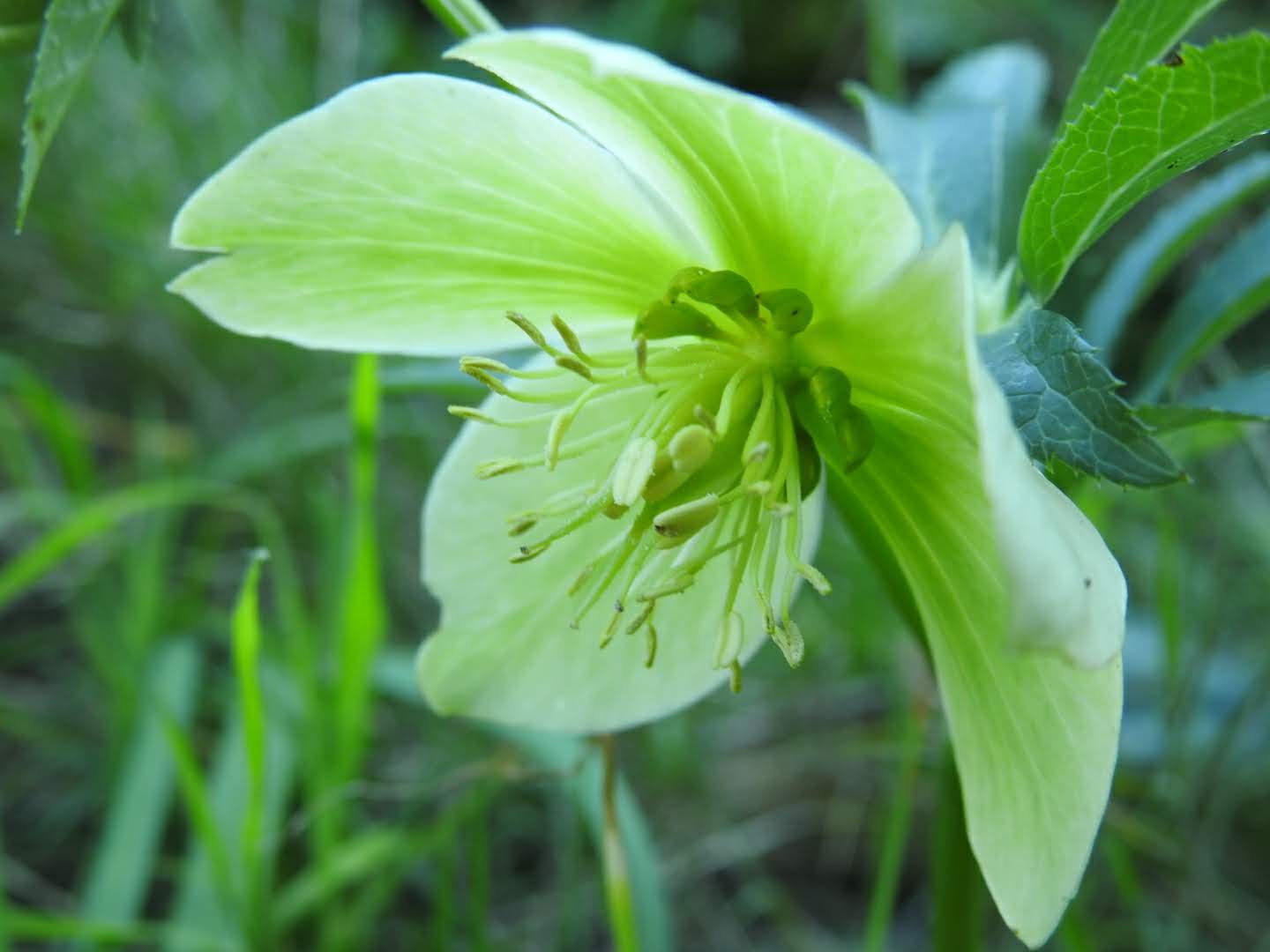
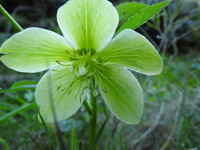
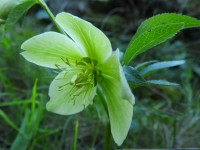
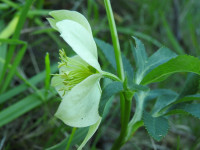
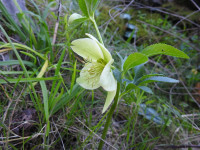
The flowers are pendulous, facing downward, with a diameter up to 6 cm. Initially, they appear whitish, then assume a light green color tending to yellow-green. They consist of 5 oval or subrounded tepals, arranged with slightly overlapping margins. Horn-shaped petals, curved upwards, 2.5-3 cm long, with involute margins. Numerous green stamens are present inside the flower, accompanied by about 10 nectaries arranged around the ovary. The fruit consists of 2-5 follicles with an appendage that constitutes less than half of their length; at maturity they open releasing small brownish seeds.
Habitat and distribution
The species is endemic to Italy, occurring spontaneously only within the national territory, particularly in the central-southern regions. It prefers deciduous broadleaf woodland environments, hedges, embankments, and forest edges in cool and shady places. It grows from the plains up to 1700 meters altitude, showing some altitudinal adaptability. The soil is generally well-drained, typical of Mediterranean and sub-Mediterranean forest soils, with preferably shaded or semi-shaded exposure.
Flowering period
Flowering extends from January to April, with some geographic variation linked to altitude and latitude. Flowers appear early, often already in late winter, and remain visible until spring. This early period allows the plant to exploit the available light before the complete closure of the tree canopy.
Ecology and pollination
The pendulous flowers and their structure, with light green colored tepals and numerous nectaries, attract specialized pollinating insects collecting nectar and pollen. The flower morphology, with horn-shaped petals and slightly overlapping tepals, facilitates access for pollinating insects such as bees and other hymenopterans. The plant uses a reproductive strategy based on entomophilous pollination and is able to develop follicular fruits containing small and light seeds, which are mainly dispersed by falling (barochory).
Curiosities and traditional uses
This species is known for its toxicity due to the presence of alkaloids such as elleborine, which discourage its use for food or medicinal purposes without proper preparation and control. Historically, in veterinary contexts, the plant was called "erba nocca" because it was used to treat infections in livestock (goats, pigs, canids, and cattle). The application of the root to the affected area stimulated a reaction in the organism, facilitating the maturation of buboes from skin infections, a process known as "annoccare". Treated animals were however penalized in sales, being recognizable as "annoccati".
Despite its toxicity, Green Hellebore has a long history as a medicinal species, formerly used in herbal medicine for its pharmacological properties, always with extreme caution. The name "elleboro" recurs in several species of the genus Helleborus, all characterized by toxic and medicinal effects.
Etymology
The scientific name derives from the Greco-Latin term "Helleborus", with two possible origins. One interprets the term as deriving from the Semitic "helebar", translated into Greek as the name of a plant used against madness. The other hypothesis links the name to “helein” (to cause death) and “boros” (voracious), alluding to the poisonous nature of the plant that "consumes life".
The Italian common name "elleboro verde" reflects the characteristic color of the flowers, which shift from white to light green, a distinctive feature compared to other hellebore species.
Sources
- Acta Plantarum - Flora delle regioni italiane (actaplantarum.org)
- Acta Plantarum - Scheda di Antonino Messina
- World Flora Online (WFO)
Characteristics
Scheda botanica
| Famiglia | Ranunculaceae |
|---|---|
| Fioritura | febbraio – aprile |
| Forma biologica | Rhizomatous |
| Habitat | toxic plant, with green flowers, endemic plant |
| Tossicità | Tossica — non consumare |
| Uso officinale | Pianta officinale |
Domande frequenti
- Quando fiorisce Green Hellebore?
- Green Hellebore fiorisce febbraio – aprile.
- È tossica Green Hellebore?
- Green Hellebore è una pianta tossica o velenosa. Non consumare nessuna sua parte senza aver consultato un esperto.
- Che tipo di pianta è Green Hellebore?
- Green Hellebore è una Geophytes (Rhizomatous) secondo la classificazione di Raunkiaer.
- A quale famiglia appartiene Green Hellebore?
- Green Hellebore appartiene alla famiglia botanica Ranunculaceae.
Where I found it (11 sightings)
Classification
- Kingdom
- Plantae
- Family
- Ranunculaceae
- Full name
- Helleborus viridis L.
- Life form
- Geophytes rhizomatous
Similar species
Search for species with similar characteristicsFurther reading
Noticed an error in the identification? Write to me
Other species of the same family
Ranunculaceae
Explore
Other species of Ranunculaceae