Botanical species
Ficaria verna
Huds.
Lesser Celandine
Description
Morphological description
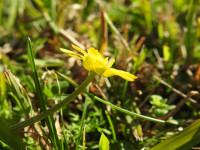
Perennial herbaceous plant belonging to the Ranunculaceae family, it has a prostrate-ascending habit with thin stems, often flaccid and tubular, hollow inside, with a diameter up to 5 mm. The height generally ranges from 5 to 30 cm. The root system is characterized by the presence of white underground tubers, fusiform or elongated, up to 3 cm long, which serve as storage organs.
The leaves are mainly basal, with petioles 7-11 cm long, and a cordate blade of variable size from 2 × 2.5 cm up to 5 × 6.5 cm. The leaf surface is glossy and slightly greasy, with a crenate margin and 5-9 main veins ending on the edge with a characteristic white dot. The upper side of the leaf may show light variegations and sometimes a dark spot in the center. The cauline leaves, present in limited number, are smaller than the basal ones.
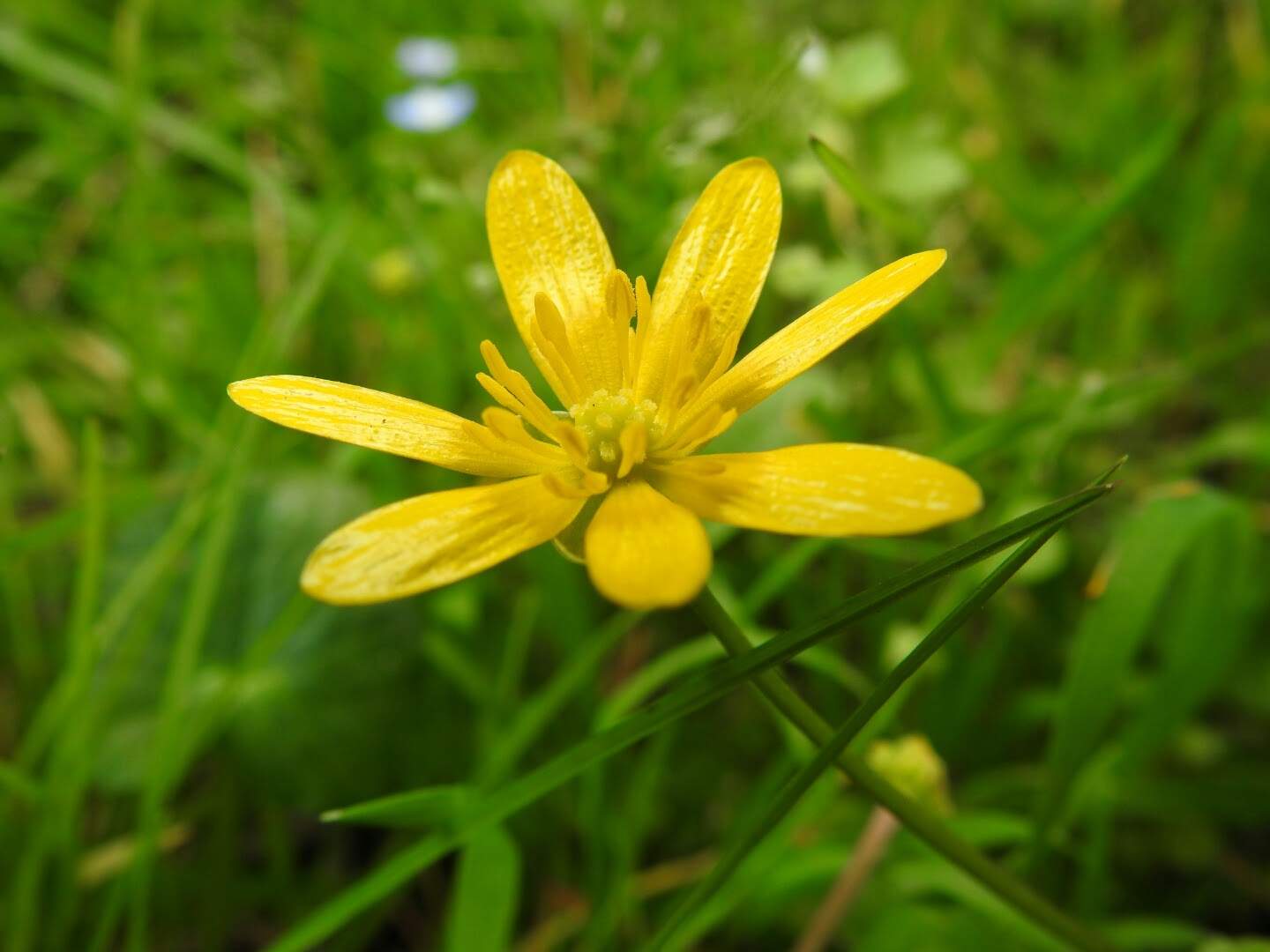
The flowers are solitary and develop on long peduncles in the leaf axils. The corolla is composed of 7-11 bright yellow petals, with the lower side slightly brownish. The calyx consists of 3-4 ovate and spreading whitish-green sepals. The stamens bear yellow anthers, while the nectary is bilobed and approximately equal in width. The fruit consists of a group of 4-8 spherical achenes, pubescent or hirsute, covered with spines or tubercles, each containing one seed.
Habitat and distribution
The species is widespread throughout much of Europe and Asia, with a strong presence in the Mediterranean basin and beyond up to Japan. In Italy it commonly grows in wet meadows, fields, along ditches, and in shady woods, often at the edges of paths or in areas with moisture. It adapts to different soil types, preferring fresh and well-drained soils, and is found from the plains up to altitudes of 1400 meters. Its prostrate habit allows it to root easily at stem nodes, promoting its spread.
Flowering period
Flowering mainly occurs from late winter to early spring, typically between February and April. In some areas and climatic conditions, flowering can start as early as late January or extend until March. This early development indicates its adaptability and the ecological role it plays as an early species in temperate plant communities.
Ecology and pollination
Despite the showy yellow corolla, the flowers are not particularly attractive to bees and are little visited by pollinating insects. It is presumed that pollination occurs mainly through less specialized insects or by self-pollination. The plant produces achenes that can be dispersed mechanically or through the intervention of small animals or water. The ability to root at nodes and the presence of underground tubers favor vegetative reproduction, contributing to the often invasive character of the species.
Curiosities and traditional uses
The genus name derives from the Latin "ficus" (fig), alluding to the underground tubers that resemble small figs. The specific epithet "verna" refers to spring, the period when the plant flowers early.
This species is known for its medicinal properties but also for its toxicity: it contains anemonin, an alkaloid that can be harmful to health if ingested in large quantities, especially during and after flowering. However, if harvested before flowering, the plant is edible and rich in vitamin C; young leaves can be consumed cooked, often combined with chard and spinach. The roots, if boiled and seasoned, are also usable in cooking. Historically, it has been included among alimurgic plants, i.e., those used in times of famine or war.
From an ethnobotanical point of view, the species was mentioned by ancient authors such as Dioscorides and Pliny, and has had a traditional role in folk medicine. Caution is recommended when using it for medicinal or food purposes, given the presence of toxic substances.
Etymology
The scientific name derives from Latin: "Ficaria" refers to the underground tubers resembling figs, while "verna" means "spring," referring to the early flowering period. The Italian common name "ficaria" directly recalls the genus, while "ranuncolo favagello" alludes to the Ranunculaceae family and the characteristic yellow color of the flowers.
Sources
- Prof. S. Pignatti, "Flora d'Italia"
- Acta Plantarum - Flora delle regioni italiane (scheda di Marinella Zepigi)
- Tela Botanica / H. Coste, "Flore descriptive et illustrée de la France"
Characteristics
Scheda botanica
| Famiglia | Ranunculaceae |
|---|---|
| Fioritura | gennaio, febbraio, marzo, settembre, ottobre, novembre, dicembre |
| Forma biologica | Bulbous |
| Habitat | with yellow flowers, Perennial plant, plant with a prostrate-ascending habit |
| Uso officinale | Pianta officinale |
Domande frequenti
- Quando fiorisce Lesser Celandine?
- Lesser Celandine fiorisce gennaio, febbraio, marzo, settembre, ottobre, novembre, dicembre.
- Che tipo di pianta è Lesser Celandine?
- Lesser Celandine è una Geophytes (Bulbous) secondo la classificazione di Raunkiaer.
- A quale famiglia appartiene Lesser Celandine?
- Lesser Celandine appartiene alla famiglia botanica Ranunculaceae.
Where I found it (15 sightings)
Classification
- Kingdom
- Plantae
- Family
- Ranunculaceae
- Full name
- Ficaria verna Huds.
- Synonyms
- Ranunculus ficaria L.
- Life form
- Geophytes bulbous
Similar species
Search for species with similar characteristicsFurther reading
Noticed an error in the identification? Write to me
Other species of the same family
Ranunculaceae
Explore
Other species of Ranunculaceae