Botanical species
Clematis flammula
L.
Virgin's-Bower
Description
Morphological description
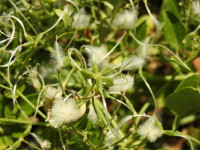
Virgin's-Bower is a perennial climbing shrub that can reach a height of about 5 meters. It develops from a woody rhizome that allows its perenniality. The stem is woody at the base, while at the top it is herbaceous, flexible, twining, and characterized by an angular cross-section. The stem's texture is robust but flexible, suitable for supporting itself by clinging to other plants or structures.
The leaves are deciduous, arranged oppositely along the stem. They are bipinnate, meaning composed of secondary leaflets distributed along a central axis. These leaf segments vary in shape: generally lanceolate, ovate-lanceolate, sometimes linear or subround, with entire or slightly lobed margins. The leaflets measure about 1 x 1.5 cm. Both leaf surfaces are glabrous and uniformly green. The leaf petioles are long and flexible, wrapping around supports, allowing the plant to climb effectively, often creating a dense tangle of leaves and branches.
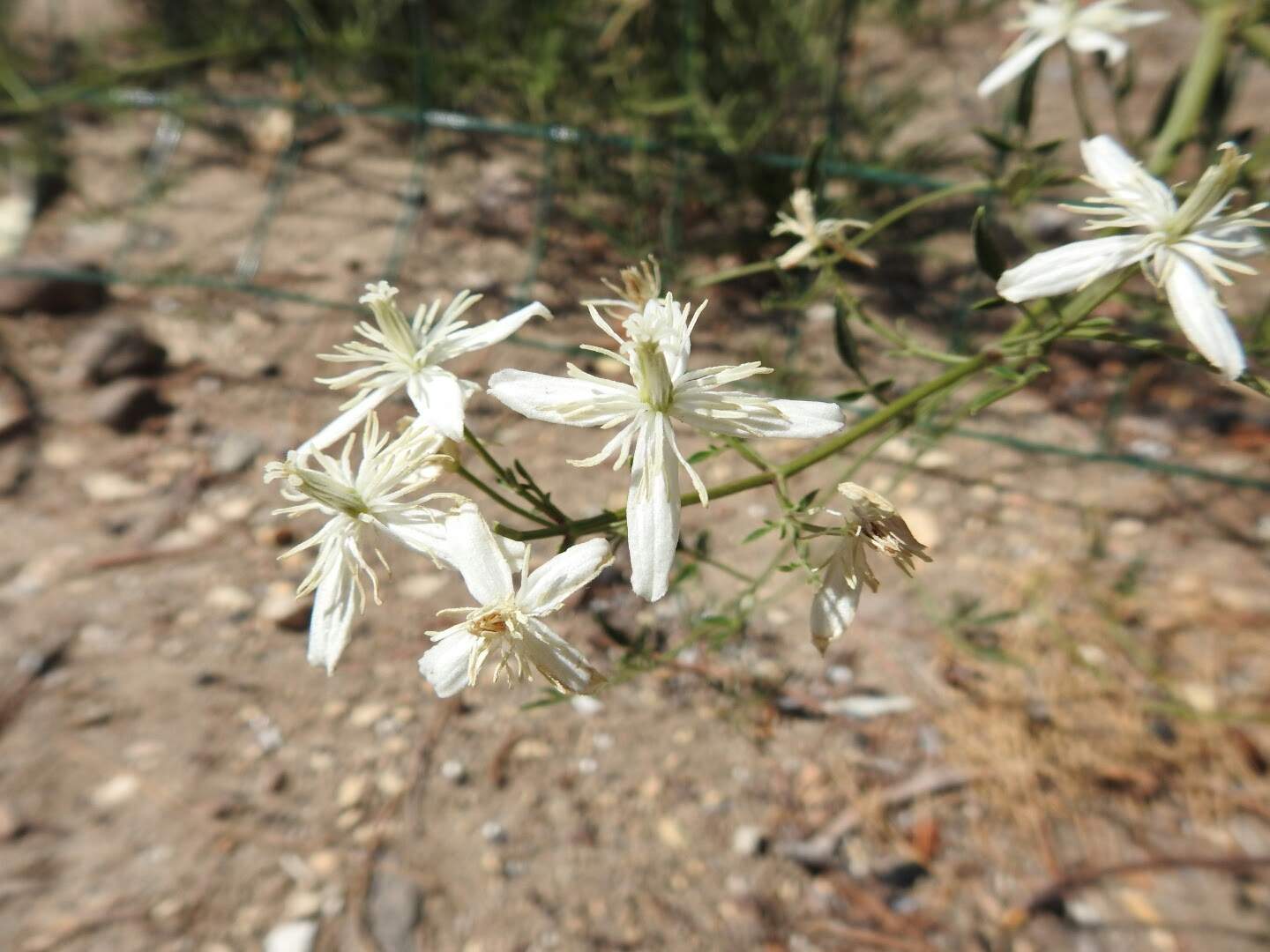
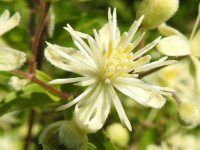
The flowering occurs in rich and well-supplied panicles, positioned both in the leaf axils and terminally. The flowers are actinomorphic, erect, and borne on long peduncles. The corolla consists of four (rarely five) white petaloid sepals, vaguely elliptical in shape, with an entire or slightly bilobed apex. The lower surface of the sepals is pubescent, while the upper surface is glabrous. True petals are absent. The stamens are numerous, with white filaments and yellow-green anthers, initially pressed together before opening and releasing pollen. The flowers are very fragrant, a feature that attracts pollinating insects.
The fruit consists of numerous discoid achenes, each equipped at the apex with a feathery plume 1-2 cm long, which facilitates anemochorous dispersal (wind transport). The achenes are laterally compressed and about 3 mm in diameter.
Habitat and distribution
Virgin's-Bower is typical of Mediterranean regions, widespread along coasts and in mild climate areas of the basin. In Italy, it mainly grows in woodland environments, thickets, holm oak woods, garrigues, shrubs, and hedges, often along roadsides and paths. It prefers sunny or partially shaded exposures, on well-drained soils rich in organic matter.
The altitude range varies from sea level up to about 600 meters. The species is present from the Iberian Peninsula to the Anatolia and Persia area, with a range that also includes more northern territories near the Mediterranean, such as Drôme and Aveyron in France.
Flowering period
Flowering generally occurs from May to August, with some local variation linked to climatic conditions and altitude. The flowers open gradually in the panicles, ensuring a prolonged and continuous bloom during the summer season.
Ecology and pollination
The fragrant flowers of Virgin's-Bower attract numerous pollinating insects, particularly bees and butterflies, which are the main pollinators. The erect and open structure of the flower facilitates access to pollen and nectar, while the presence of numerous stamens increases pollen production.
Seed dispersal mainly occurs via wind, thanks to the feathery plumes that act as parachutes, allowing the achenes to be carried away from the parent plant. This mechanism promotes colonization of new areas suitable for growth.
Curiosities and traditional uses
Virgin's-Bower is a medicinal plant known for its toxicity. The green parts, particularly the leaves collected between May and June, contain alkaloids (such as anemonin), camphor (clematidol), phytosterols, and saponins. These compounds give the plant rubefacient and vesicant properties, used in the past against rheumatism and gout. Camphor exerts a revulsive effect, and anemonin has a mild sedative action.
Despite traditional medicinal uses, the plant is considered toxic and its use is strongly discouraged without proper preparation and supervision.
In the food field, young shoots were once used in some regions, after preliminary boiling to eliminate bitter and toxic substances, as an ingredient for omelets and soups. The long woody branches are also used in basketry and weaving.
It is sometimes cultivated for its intense fragrance and white flowers, used to adorn pergolas and structures in Mediterranean gardens, where it is also known as "fragrant clematis".
Etymology
The genus name "Clematis" derives from the Greek "klematìs," meaning "vine branch" or "shoot," referring to the climbing habit of the plant. The specific name "flammula" comes from Latin and means "little flame," probably referring to the lively appearance and arrangement of the white flowers that look like small bright flames on a green background.
The Italian common name "clematide fiammella" precisely recalls this characteristic, evoking the image of bright and fragrant white flowers that illuminate the dense vegetation with their presence.
Sources
- Prof. S. Pignatti, "Flora d'Italia"
- Acta Plantarum - Flora delle regioni italiane (scheda di Daniela Longo)
- Tela Botanica / H. Coste, "Flore descriptive et illustrée de la France"
Characteristics
Scheda botanica
| Famiglia | Ranunculaceae |
|---|---|
| Fioritura | maggio – agosto |
| Forma biologica | Lianescent |
| Habitat | with white flowers, fragrant plant |
Domande frequenti
- Quando fiorisce Virgin's-Bower?
- Virgin's-Bower fiorisce maggio – agosto.
- Che tipo di pianta è Virgin's-Bower?
- Virgin's-Bower è una Phanerophytes (Lianescent) secondo la classificazione di Raunkiaer.
- A quale famiglia appartiene Virgin's-Bower?
- Virgin's-Bower appartiene alla famiglia botanica Ranunculaceae.
Where I found it (10 sightings)
Classification
- Kingdom
- Plantae
- Family
- Ranunculaceae
- Full name
- Clematis flammula L.
- Life form
- Phanerophytes lianescent
Similar species
Search for species with similar characteristicsFurther reading
Noticed an error in the identification? Write to me
Other species of the same family
Ranunculaceae
Explore
Other species of Ranunculaceae