Botanical species
Serapias vomeracea
(Burm. f.) Briq.
Long-lipped Tongue-orchid
Description
Morphological description
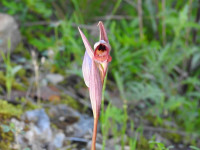
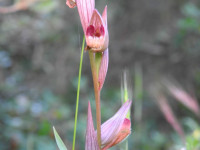
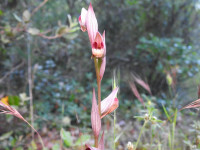
Perennial herbaceous plant belonging to the Orchidaceae family, equipped with a root system consisting of two small ovoid rhizotubers, of which the younger one has a short peduncle. The stem, light green with reddish hues especially in the upper part, reaches a height between 15 and 40 cm, with exceptional cases up to 60 cm. The base of the stem is sheathed by one or two membranous leaves, while higher up there are 6-8 linear-lanceolate leaves, initially reflexed, then progressively shorter, adhering to the axis and, finally, transformed into bracts.
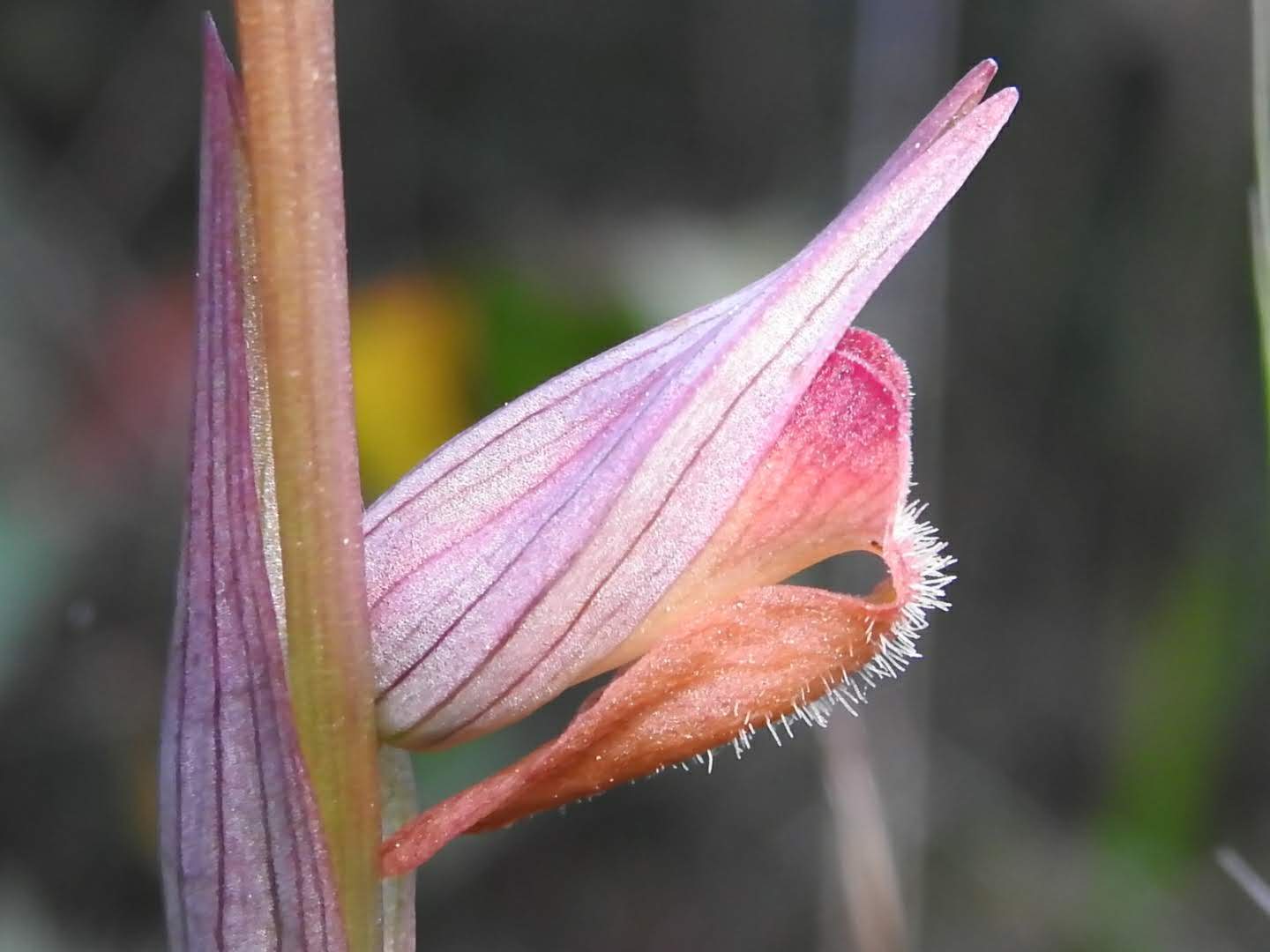
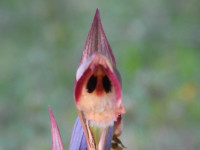
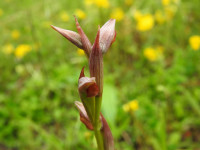
The inflorescence appears as a loose, narrow, and elongated spike, composed of 3-8 (up to 10) flowers. The bracts, lanceolate, acute, and glabrous, are longer than the tepals and red-violet in color with more intense veins. The outer tepals, six in total, are lanceolate, acute, erect, and gathered at the top to form a characteristic pointed helmet about 20-28 mm long, purplish red or pink in color with more marked veins. The lateral inner tepals, much shorter and brown-purple in color, are almost completely hidden inside the helmet.
The labellum, dark red and larger than the other tepals, is trilobed and divided into two distinct zones: the lower part, called hypochile, is concave, kidney-shaped, shorter, and about half the length of the upper part; this is enclosed inside the helmet together with the two raised lateral lobes, covered with numerous light hairs, and presents two parallel or divergent callosities in front. The upper part, called epichile, is narrower, triangular lanceolate or acute in shape, purplish red or rusty red (rarely yellow-ochre), lighter and with veins in the center; it is covered with long hairs and is pendulous or turned inward. No spur is present.
The ovary is cylindrical, long, green in color, with a triangular cross-section, not twisted. The fruit is an oblong, erect, and fissure-dehiscent capsule containing very small brown-ochre seeds.
Habitat and distribution
The species is typical of Mediterranean regions, with a range centered on the Mediterranean coasts and extensions towards the north and east. In Italy, it preferably grows in xerothermic habitats such as dry meadows, pastures, scrublands, and thickets, often on clayey soils. It is present up to an altitude of about 1300 meters above sea level, showing some adaptability to different exposures but preferring sunny and well-drained environments.
The range is defined as steno-Mediterranean, mainly limited to the coastal areas of the Mediterranean, with greater frequency in the area defined as “Olive” and “Vine” according to biogeographical classification.
Flowering period
Flowering mainly extends from April to June, with possible local variations linked to climatic and altitudinal conditions. The inflorescence appears during this period with its characteristic colorful flowers, visible and easily recognizable thanks to the shape of the labellum and the helmet formed by the tepals.
Ecology and pollination
The species is pollinated by insects (entomogamous), which are attracted and hosted inside the helmet formed by the outer tepals. Here they find a warm and dry refuge during the night, coming into contact with the pollen present in the gynostemium and on the hypochile, which they then carry to other flowers, ensuring pollination. This adaptation is essential for the plant’s reproduction, which exploits the flower morphology to facilitate the visit and stay of pollinating insects.
Seed dispersal occurs by wind (anemochory), thanks to the very small and light seeds contained in the fissure-dehiscent capsule.
Curiosities and traditional uses
The generic name Serapias derives from Greek and refers to the Greco-Egyptian god of fertility and medicine, Serapis, to whom Dioscorides and Pliny had attributed medicinal properties to orchids. The species is characterized by a particularly interesting pollination strategy, which involves hosting pollinating insects inside the flower itself, a form of mutualism that ensures more effective fertilization.
There are no specific traditional food or medicinal uses for this species, while it is important to emphasize that it is a nationally protected entity and in some Italian regions, given its particular ecology and role in maintaining the biodiversity of Mediterranean xerothermic habitats.
Etymology
The specific name vomeracea derives from Latin and refers to the shape of the outer part of the labellum (epichile), which resembles the plowshare of a plow, an agricultural tool used for tilling fields. The common Italian name, Long-lipped Tongue-orchid, refers to the relative size compared to other species of the genus and the reference to the god Serapis, connected to fertility and the traditional healing properties of orchids.
Sources
- Acta Plantarum - Flora delle regioni italiane (actaplantarum.org)
- Acta Plantarum - Flora delle regioni italiane (scheda di Giuliano Salvai)
- World Flora Online (WFO)
Characteristics
Where I found it
The sighting locations of this species are not public for conservation reasons.
Classification
- Kingdom
- Plantae
- Family
- Orchidaceae
- Full name
- Serapias vomeracea (Burm. f.) Briq.
- Synonyms
- Serapias vomeracea (Burm.f.) Briq. subsp. longipetala (Ten.) H.Baumann & Künkele
- Life form
- Geofite bulbose
Similar species
Search for species with similar characteristicsFurther reading
Noticed an error in the identification? Write to me
Other species of the same family
Orchidaceae
Explore
Other species of Orchidaceae