Botanical species
Epipactis leptochila
(Godfery) Godfery
Narrow-Lipped Helleborine
Description
Morphological description
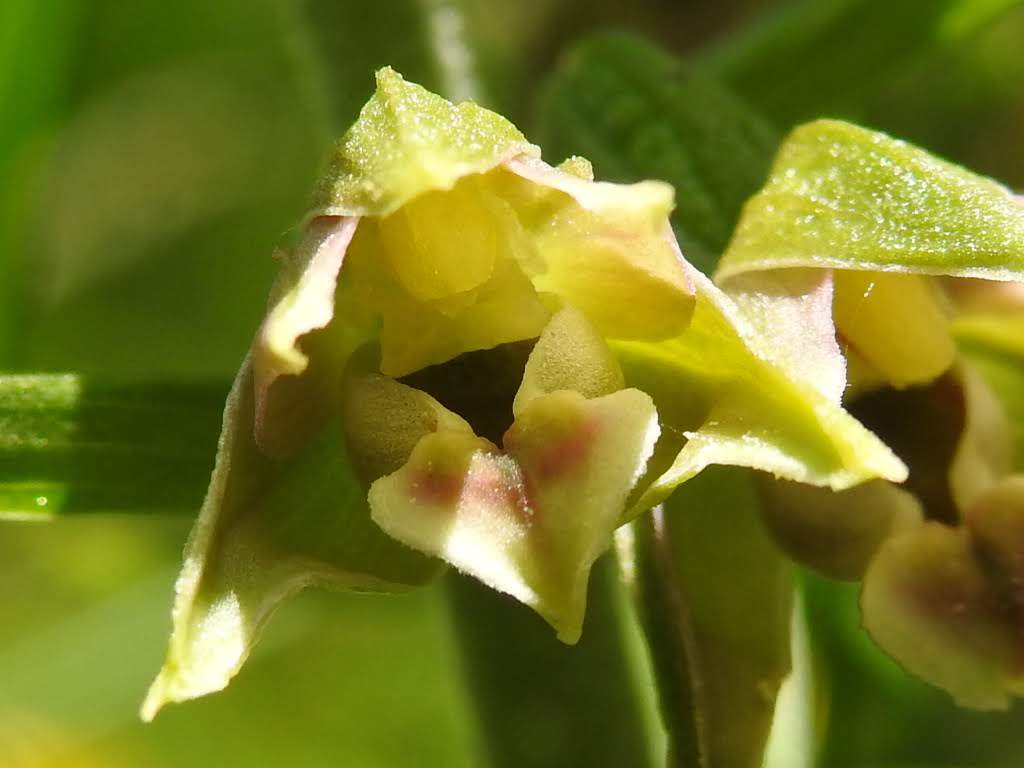
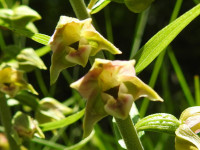
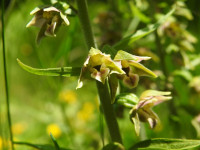
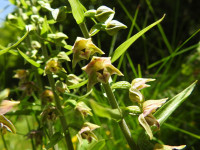
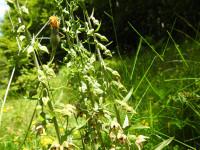
Perennial plant belonging to the Orchidaceae family, characterized by an erect and slender habit, typical of montane and woodland terrestrial orchids. The plant has leaves arranged alternately along the stem, lanceolate in shape and relatively soft in texture, with generally non-undulated margins. The leaves are oval-lanceolate in shape and do not show particular folds or curls.
The flowers, which bloom in the summer period, are modest in size with outer tepals measuring between 7 and 15 millimeters. The flower color varies from green to pink, giving the species a delicate and unobtrusive appearance. The labellum, a distinctive element of this species, is longer than wide and has a pointed shape, a characteristic that also inspired the Italian common name.
During opening, the flowers do not contain a viscous globule (viscidium), or it is already dry, an adaptation that makes the species autogamous: the pollinia disintegrate directly on the stigma inside the bud or during flowering, allowing self-pollination.
Specific data on fruits or root system are not available, but, as with many terrestrial orchids, the presence of a rhizome or tuber is presumed to support the plant and ensure its perenniality.
Habitat and distribution
The species is typical of mountainous and hilly environments, preferring shady beech woods and other forest formations with filtered light conditions. It grows in well-drained soils, often calcareous, but capable of retaining some moisture, an essential element for the development of terrestrial orchids. In Italy, the distribution is discontinuous and localized, with occurrences reported mainly in the Apennine and mountainous regions.
In the Mediterranean context, the species tends to be rarer and localized in areas with similar habitats, with a preference for cool and shady zones of mountain forests.
Flowering period
Flowering occurs mainly between July and August, corresponding to the central summer months. This period may undergo slight variations depending on altitude and local climatic conditions, with flowering anticipated or delayed by a few weeks depending on the microclimate.
Ecology and pollination
This species is distinguished by the autogamous pollination strategy, i.e., the ability to self-fertilize without the need for external pollinator vectors. At flower opening, in fact, the pollinia disintegrate directly on the stigma, thus ensuring fertilization even in the absence of pollinating insects.
Nevertheless, it is not excluded that insects may visit the flowers, but the absence of the viscidium and the early disintegration of the pollinia suggest that reproduction is mainly based on self-pollination. Seed dispersal, as in many orchids, is presumably anemochorous, exploiting the lightness and small size of the seeds to be transported by the wind over variable distances.
Curiosities and traditional uses
No particular ethnobotanical, medicinal, or food applications are known for this species, probably due to its rarity and specific habitat. Like many wild orchids, it is protected and subject to regulations that prohibit collection to preserve natural populations.
Etymology
The scientific name derives from Greek: "Epipactis" is an ancient name referring to a genus of orchids, while "leptochila" means "narrow-lipped", referring to the characteristic shape of the labellum which is longer than wide and pointed. The Italian common name "Narrow-Lipped Helleborine" directly recalls this morphological peculiarity, distinguishing the species from other epipactis with a stouter or wider labellum.
Sources
- World Flora Online (WFO)
Characteristics
Scheda botanica
| Famiglia | Orchidaceae |
|---|---|
| Fioritura | luglio – agosto |
| Forma biologica | Rhizomatous |
| Habitat | with green flowers, with pink flowers |
Domande frequenti
- Quando fiorisce Narrow-Lipped Helleborine?
- Narrow-Lipped Helleborine fiorisce luglio – agosto.
- Che tipo di pianta è Narrow-Lipped Helleborine?
- Narrow-Lipped Helleborine è una Geophytes (Rhizomatous) secondo la classificazione di Raunkiaer.
- A quale famiglia appartiene Narrow-Lipped Helleborine?
- Narrow-Lipped Helleborine appartiene alla famiglia botanica Orchidaceae.
Where I found it
The sighting locations of this species are not public for conservation reasons.
Classification
- Kingdom
- Plantae
- Family
- Orchidaceae
- Full name
- Epipactis leptochila (Godfery) Godfery
- Synonyms
- Epipactis savelliana Bongiorni, De Vivo & Fori
- Life form
- Geophytes rhizomatous
Similar species
Search for species with similar characteristicsFurther reading
Noticed an error in the identification? Write to me
Other species of the same family
Orchidaceae
Explore
Other species of Orchidaceae