Botanical species
Allium carinatum
L.
Keeled Garlic
Description
Morphological description
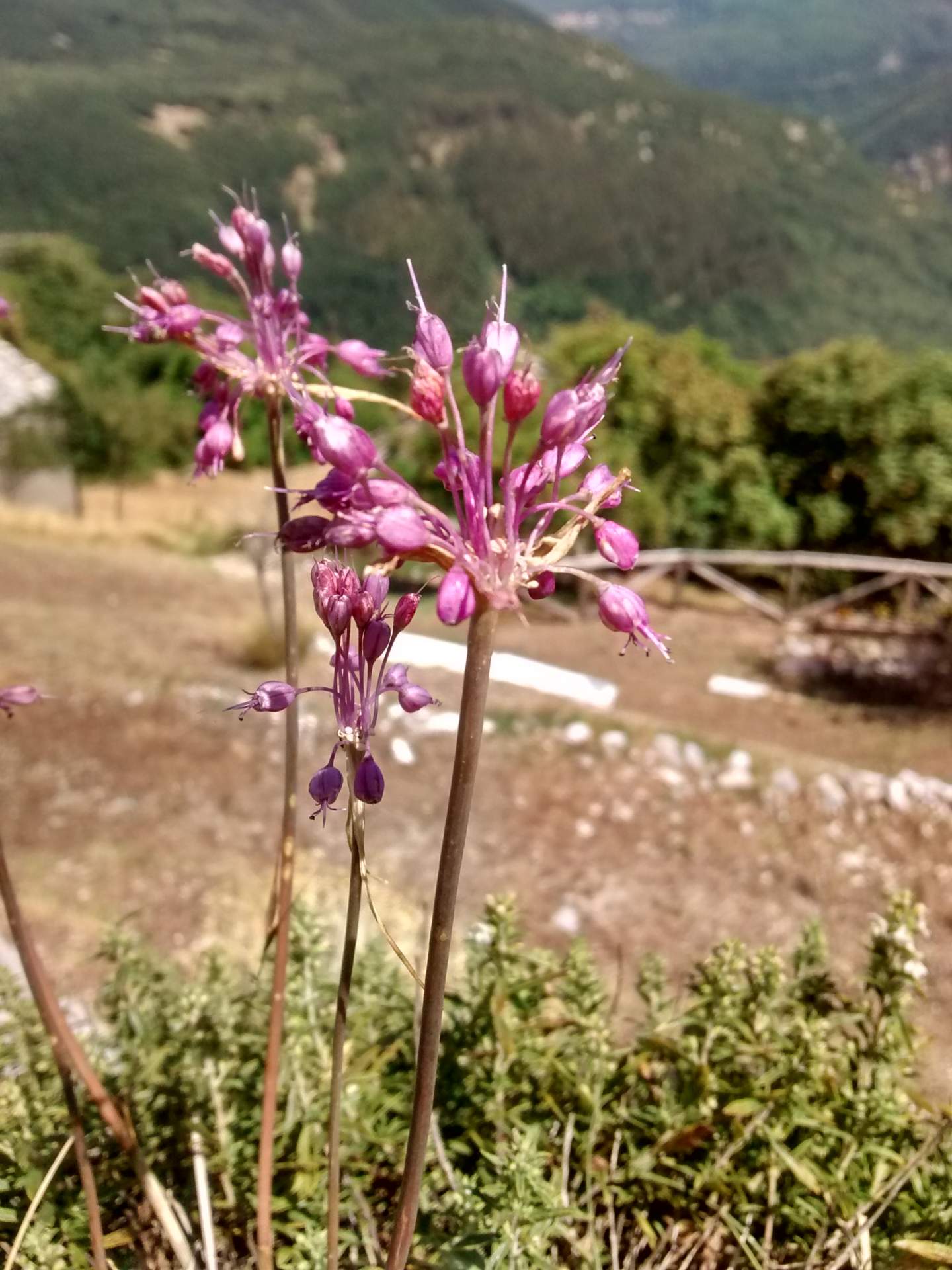
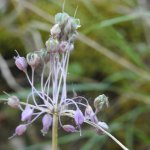
Perennial bulbous geophytic herbaceous plant, Keeled Garlic has a simple ovoid bulb, rarely with bulbils, about 1 cm in diameter, with white inner tunics and membranous outer tunics, often dissociated into brown fibers. The stem is erect, cylindrical and striated, 20 to 80 cm tall, with a smooth surface and leafy in the lower half. The leaves, from 2 to 5 per individual, are linear, flat or slightly channelled at the base, 2-4 mm wide, smooth and not fistulose, shorter than the scape, with margins sometimes slightly rough.
The inflorescence is generally a sparse and irregular umbel, often bulbiferous, with few flowers arranged on peduncles of variable length (from 1 to 4 cm), flexible and of unequal length, which exceed the size of the flowers by 2-4 times. The spathe has two unequal valves, very long and pointed, with the larger valve often reflexed. The flowers are pendulous or erect, with 6 obovate tepals of bright pink or lilac-violet color, 5-8 mm long, with an obtuse or slightly notched apex. The stamens protrude beyond the perigonium, with simple filaments and well-visible purple anthers. The style is even longer than the stamens, clearly protruding. The fruit is an ellipsoid ovate-trigonal capsule, typically with six seeds, with fine and smooth ribs.
Habitat and distribution
Species widespread in western Europe and in suboceanic and submediterranean climate zones, Allium carinatum grows particularly in Italy, especially in the northern and central-southern regions, also present on the islands. It prefers mountainous and hilly environments up to 1500 meters altitude, frequenting dry pastures, uncultivated areas, edges of thermophilous woods and riverbeds. It likes well-drained soils, often stony or sandy, and sunny or semi-shaded exposure. In France it is found in dry and sandy environments, from the East of the country to the Maritime Alps and the Pyrenees.
Flowering period
Flowering mainly occurs between June and September, with a peak concentrated from July to August. The duration of the flowering period may vary slightly depending on altitude and latitude, anticipating or prolonging in warmer or cooler areas.
Ecology and pollination
Keeled Garlic relies on pollinating insects for its pollination, thanks to the colorful and fragrant flowers that attract bees, bumblebees and other pollinators. The structure of the flowers, with pendulous tepals and protruding stamens, facilitates contact with pollinating insects. The presence of bulbils in the inflorescence contributes to vegetative reproduction, while the seeds produced in the capsules allow sexual dispersion. Seed dispersal probably occurs by falling and action of wind or small animals, although there are no specific data on the dispersal strategy.
Curiosities and traditional uses
The common name “Keeled Garlic” derives from ancient popular beliefs attributing to the plant the ability to keep away witches, vampires and evil spirits, probably also due to the disorderly and shaggy appearance of the inflorescence, which resembled witches' hair. From an ethnobotanical point of view, all parts of the plant are edible. Officially, Keeled Garlic is known for its purifying, gastric function stimulating, hypotensive, antiseptic and vermifuge properties. The fresh crushed bulb was traditionally used for topical applications on calluses, boils and abscesses. Historically, the medicinal use of garlic dates back to ancient Egypt, where it was used to promote the health of workers engaged in monument construction. The plant is also appreciated for its aroma and can be used in cooking, although it is less common than other Allium species.
Etymology
The genus name Allium derives from classical Latin “allium”, whose etymology is debated. Among the hypotheses are an Indo-European root *ālu- indicating “bitter herb”, connections with Sanskrit, Greek and Akkadian terms related to garlic or similar forms, and hypotheses linking it to the shape of the bulb divided into cloves, compared to “wings”. The specific epithet “carinatum” means “provided with a keel”, referring to the shape of the bulbils in the inflorescence, which appear “keeled”, that is equipped with a sort of ridge or keel. The Italian common name “Keeled Garlic” recalls ancient popular beliefs linked to protection against evil forces.
Sources
- Acta Plantarum - Flora delle regioni italiane (scheda di Silvano Radivo)
- Tela Botanica / H. Coste, "Flore descriptive et illustrée de la France"
- World Flora Online (WFO)
Characteristics
Scheda botanica
| Famiglia | Amaryllidaceae |
|---|---|
| Fioritura | giugno – settembre |
| Forma biologica | Bulbous |
| Habitat | edible plant, with lilac flowers, with pink flowers |
| Uso alimentare | Commestibile |
Domande frequenti
- Quando fiorisce Keeled Garlic?
- Keeled Garlic fiorisce giugno – settembre.
- È commestibile Keeled Garlic?
- Keeled Garlic è considerata commestibile. Verifica sempre le parti eduli e la preparazione corretta prima del consumo.
- Che tipo di pianta è Keeled Garlic?
- Keeled Garlic è una Geophytes (Bulbous) secondo la classificazione di Raunkiaer.
- A quale famiglia appartiene Keeled Garlic?
- Keeled Garlic appartiene alla famiglia botanica Amaryllidaceae.
Where I found it (11 sightings)
Classification
- Kingdom
- Plantae
- Family
- Amaryllidaceae
- Full name
- Allium carinatum L.
- Life form
- Geophytes bulbous
Similar species
Search for species with similar characteristicsFurther reading
Noticed an error in the identification? Write to me
Other species of the same family
Amaryllidaceae
Explore
Other species of Amaryllidaceae