Botanical species
Allium triquetrum
L.
Three-Cornered Garlic
Description
Morphological description
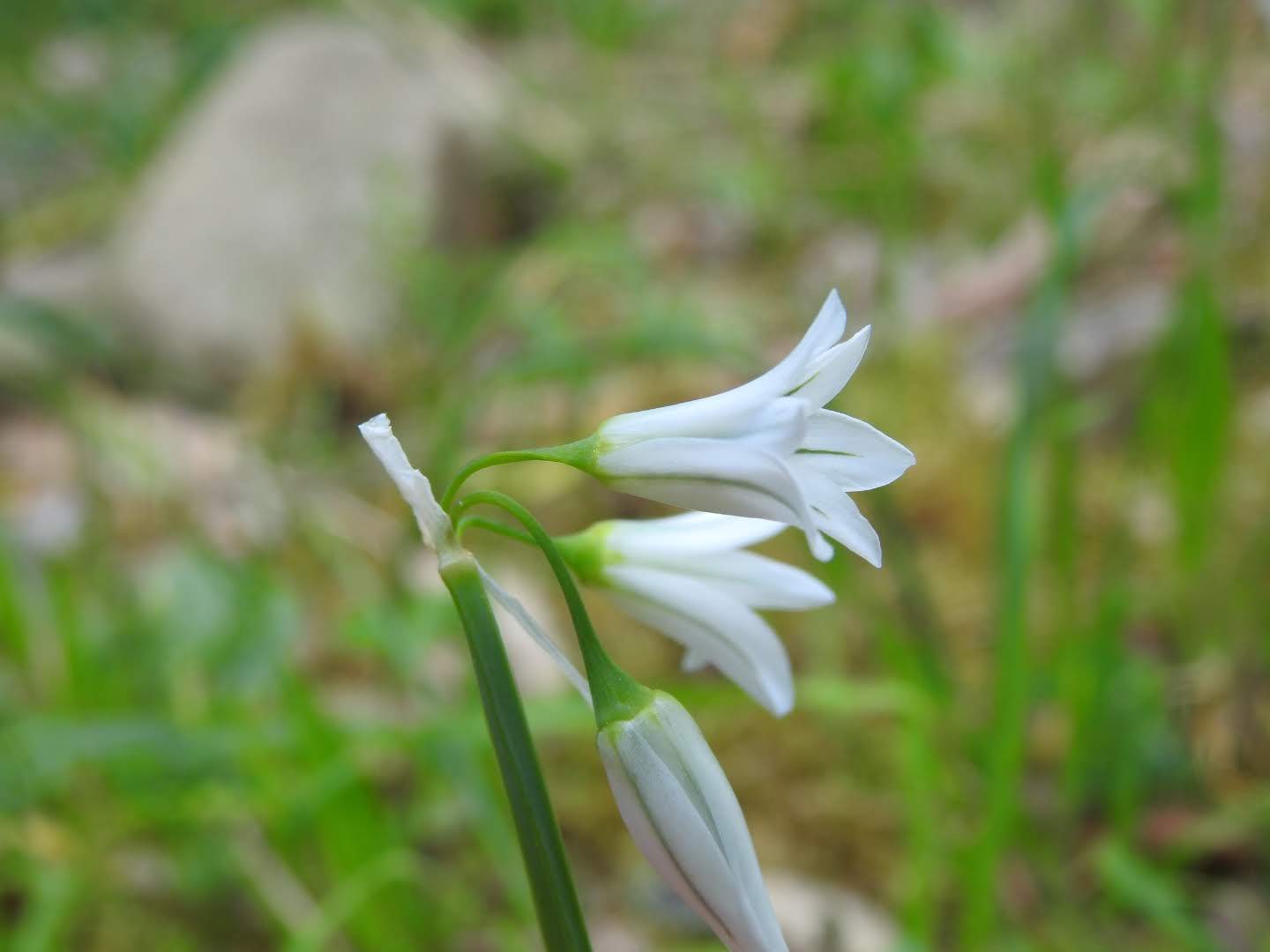
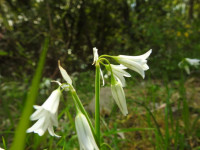
Perennial herbaceous plant belonging to the family Amaryllidaceae, it presents a scape-like habit and reaches a maximum height of about 30 cm. The root system consists of white, oblong, and compact bulbs, with a thickness that can reach up to 1.5 cm. The stem, or scape, is particularly characteristic for its triangular cross-section, with three pointed wings, from which the specific name derives. At the base of the stem, 2-3 ribbon-shaped leaves are inserted, flattened and keeled on the lower side, longer than the scape itself, with a width varying between 3 and 12 mm. The upper leaves are shorter and curved.
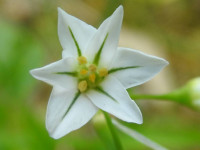
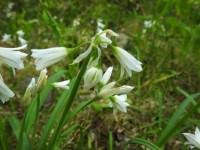
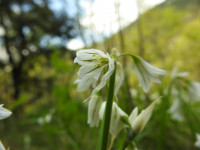
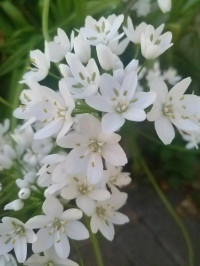
The flowers are grouped in loose and asymmetric umbels, with a variable number from 3 to 15 per inflorescence, and are borne on peduncles 1 to 4 cm long. At the base of the umbel there is a two-valved spathe of greenish color that, during flowering, splits and opens turning white. The flowers, hermaphroditic and fragrant, have a bell-shaped form and can reach a length of about 18 mm. They are composed of six pointed petaloid tepals of white color with a characteristic median green stripe. The stamens, also six in number, are contained within the perigonium and reach about half its length. The ovary is superior. The fruit is a loculicidal capsule that opens to release the seeds.
Habitat and distribution
This species is typical of humid and shady environments, such as woods, hedges, edges, and road embankments. It grows on generally fresh and well-drained soils, at an altitudinal range from 0 up to about 600 meters above sea level. Distributed in the western Mediterranean basin, its range includes Liguria, the coasts of Spain, and Algeria. In Italy it is mainly found in coastal regions with a Mediterranean climate, typically within the area called “dell’Olivo,” where the environment favors its growth.
Flowering period
Flowering mainly extends from November to April, with some variations linked to local climatic and geographic conditions. During this period, the pendulous white flower umbels can be observed in their typical unidirectional arrangement.
Ecology and pollination
The fragrant flowers and bell-shaped structure favor the attraction of pollinating insects, such as bees and other pollinators that facilitate sexual reproduction. The arrangement of flowers in asymmetric umbels and the presence of spathes that open at flowering time are functional adaptations to increase pollination efficiency. Seed dispersal occurs through the loculicidal capsule that spontaneously opens at maturity, favoring the release and distribution of seeds in the surrounding substrate.
Curiosities and traditional uses
Three-Cornered Garlic is an edible and medicinal species, known since ancient times for its beneficial properties. Like most Allium, it contains allicin, a compound with hypotensive, antibiotic, disinfectant, and hypoglycemic properties, and recent studies highlight its positive effects on cardiovascular diseases. Traditionally, both the scape and the small bulbs were consumed raw as salad or used to flavor legume soups.
Historically, garlic was highly valued already 5000 years ago by the Egyptians, who considered it precious enough to use it as a commodity for purchasing slaves. It was also an integral part of the diet of workers engaged in the construction of the Cheops pyramid, to increase their physical endurance.
In the Middle Ages and Renaissance, Allium triquetrum was attributed numerous therapeutic virtues: it was believed effective in combating intestinal worms, stimulating diuresis, treating viper bites, helping hydropics, clarifying the voice, relieving persistent cough, eliminating lice, resolving bruises, and promoting the regrowth of lost hair. These indications, although belonging to popular tradition, testify to the long history of medicinal use of the plant.
Moreover, Allium triquetrum is used in repellent preparations, exploiting its aromatic and antibiotic properties.
Etymology
The genus name, Allium, derives from classical Latin and historically identifies plants commonly known as garlic. The etymological origin is debated and could derive from Indo-European roots related to terms for bitter herbs or from ancient linguistic borrowings, such as Greek or Akkadian. One possible interpretation is linked to the image of the bulb divided into “wings,” that is, cloves.
The specific name triquetrum refers to the characteristic triangular shape of the stem, which has three protruding points.
The Italian common name “aglio con stelo trigono” directly recalls this peculiar shape of the stem, which constitutes the distinctive trait of the species.
Sources
- Acta Plantarum - Flora delle regioni italiane (actaplantarum.org)
- Acta Plantarum - Flora delle regioni italiane (scheda di Giuliano Salvai)
Characteristics
Scheda botanica
| Famiglia | Amaryllidaceae |
|---|---|
| Fioritura | gennaio, febbraio, marzo, aprile, novembre, dicembre |
| Forma biologica | Bulbous |
| Habitat | with white flowers, edible plant, Perennial plant |
| Uso alimentare | Commestibile |
| Uso officinale | Pianta officinale |
Domande frequenti
- Quando fiorisce Three-Cornered Garlic?
- Three-Cornered Garlic fiorisce gennaio, febbraio, marzo, aprile, novembre, dicembre.
- È commestibile Three-Cornered Garlic?
- Three-Cornered Garlic è considerata commestibile. Verifica sempre le parti eduli e la preparazione corretta prima del consumo.
- Che tipo di pianta è Three-Cornered Garlic?
- Three-Cornered Garlic è una Geophytes (Bulbous) secondo la classificazione di Raunkiaer.
- A quale famiglia appartiene Three-Cornered Garlic?
- Three-Cornered Garlic appartiene alla famiglia botanica Amaryllidaceae.
Where I found it (11 sightings)
Classification
- Kingdom
- Plantae
- Family
- Amaryllidaceae
- Full name
- Allium triquetrum L.
- Synonyms
- Nectaroscordum triquetrum (L.) Galasso & Banfi
- Life form
- Geophytes bulbous
Similar species
Search for species with similar characteristicsFurther reading
Noticed an error in the identification? Write to me
Other species of the same family
Amaryllidaceae
Explore
Other species of Amaryllidaceae