Botanical species
Allium vineale
L.
Crow Garlic
Description
Morphological description
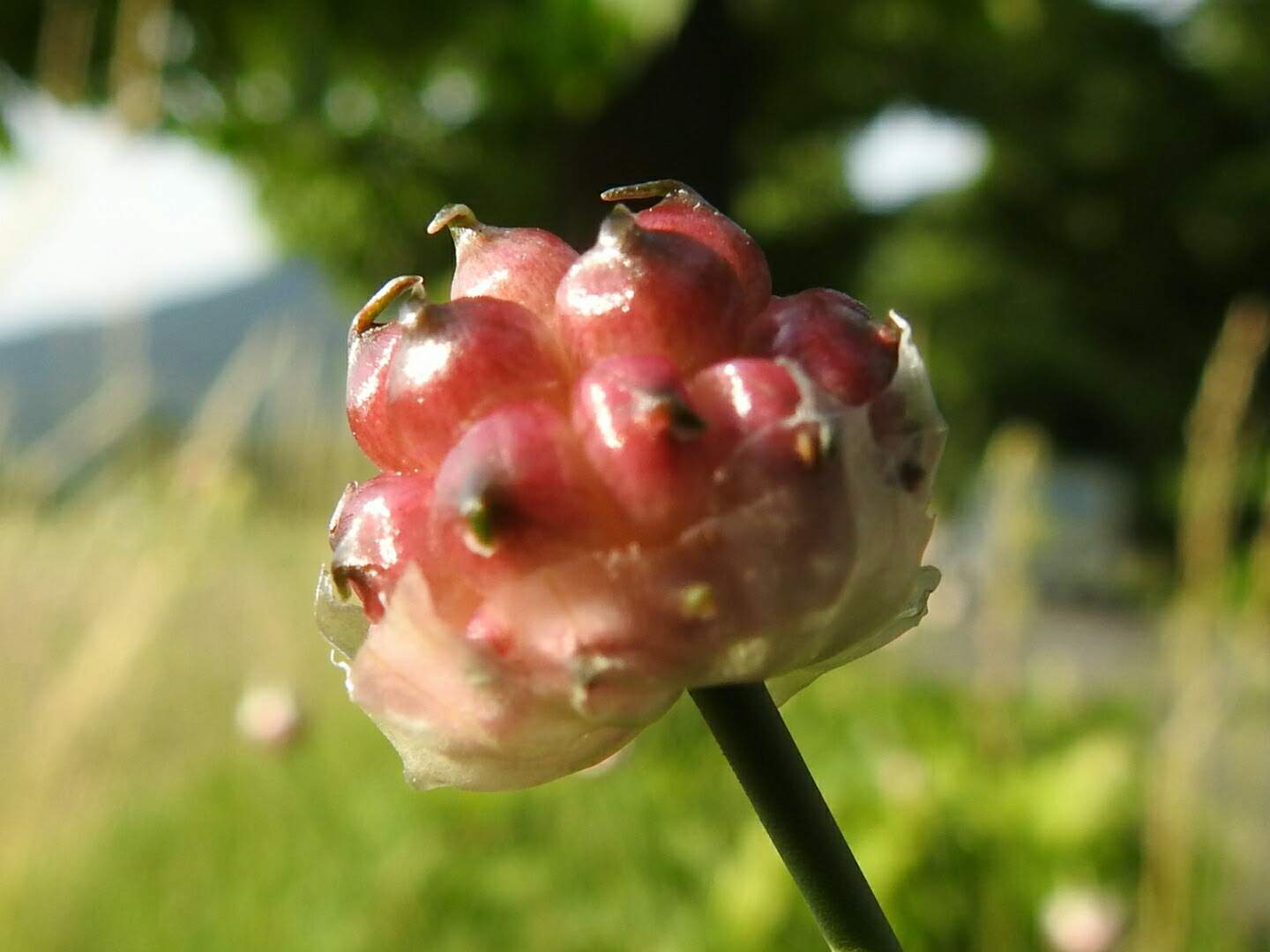
Perennial herbaceous plant belonging to the family Amaryllidaceae, with a slender habit and height ranging from 30 to 120 cm. The root system consists of a subround bulb, about 16-29 mm long and 14-30 mm wide, wrapped in a fibrous outer tunic. The main bulb is often accompanied by numerous pedunculated bulbils, smaller in size (9-18 x 5-11 mm), which develop externally and are capable of generating new plants.
The scape is erect, thin, and persistent, with leaves present up to halfway or slightly beyond its development. The lower leaves, located at the base, are transformed into sheaths, while those along the stem are generally 2 or 3, apparently alternately arranged and sheathed. The leaf blade is linear, elliptical, varying in size between 4-8 cm in width and 12-16 cm in length, with an obtuse apex and short petiole; the leaves are almost cylindrical, crested by a thin upper groove, thin in texture and glaucous in color.
The inflorescence appears as an irregular, loose, globose umbel, 2-3 cm in diameter, borne on peduncles 5-30 mm long. This umbel is often mainly composed of aerial bulbils, with few or no fertile flowers. The perianth is campanulate, whitish, wrapped by a univalve spathe that splits at anthesis and falls off quickly.
The true flowers are numerous (up to 50), small, with six erect, smooth tepals, pale pink or white, sometimes with greenish or purple spots on the central nerve. The outer tepals are simple, the inner ones tricuspidate and slightly longer (2-4.5 mm) than the perianth. There are six stamens, longer than the perianth, with finely ciliate filaments; the anthers are protruding, yellow or violet in color. The stigma is capitate, slightly thickened and not lobed, with an entire style 1.1-2.3 mm long.
The fruit is an ovoid loculicidal capsule 3-3.5 mm long containing 1-2 black seeds per locule, ovate-angular in shape and without an elaiosome. The presence of numerous aerial bulbils allows the plant to reproduce also vegetatively.
Habitat and distribution
Typical species of Mediterranean and Eurymediterranean regions, with a range extending from central and southern Europe to Syria and some areas of North America where it is naturalized as a weed. In Italy it is common in hilly and low mountainous areas, especially along the edges of cultivated fields, dry uncultivated land, vineyards, and anthropized environments. It prefers well-drained soils, often sandy or poor, with sunny exposure and warm temperate climate.
The species grows from sea level up to lower mountain elevations, adapting to different environmental conditions as long as there is light availability and substrate that is not too moist.
Flowering period
Flowering mainly occurs between May and July, with some geographic variability linked to the local climate. In milder climates and Mediterranean areas, the flowering peak is concentrated in June and July, while in cooler or mountainous areas it may start earlier or later slightly.
Ecology and pollination
Allium vineale is characterized by a dual reproductive strategy: besides fertile flowers, it produces numerous aerial bulbils that allow autonomous vegetative propagation, increasing colonization capacity even in the absence of pollination. The flowers have a structure suitable for pollination by pollinating insects, which, attracted by the scent and pale color, visit the inflorescence to collect nectar and pollen.
Seed dispersal mainly occurs by falling near the mother plant, while long-distance spread is favored by bulbils that, falling to the ground, root quickly. This vegetative mechanism allows the species to expand effectively even in disturbed or cultivated environments.
Curiosities and traditional uses
Crow Garlic is an edible and medicinal plant with a long tradition of use in cooking and phytotherapy. Bulbs and leaves, with their characteristic alliaceous aroma, are used both raw and cooked as an alternative to common garlic. The bulbils can be preserved in oil or vinegar for prolonged use.
All species of the genus Allium are known for their natural antibiotic properties, due to the presence of allicin, a sulfur-organic compound formed by tissue rupture. This molecule gives Crow Garlic an antimicrobial and antioxidant effect, traditionally exploited for the treatment of respiratory disorders and for general health protection.
From an ecological point of view, the plant plays an important role in maintaining biodiversity in vineyards and uncultivated lands, offering food resources to numerous pollinating insects.
Etymology
The genus name Allium derives from classical Latin “allium,” whose origin is debated: it could derive from an Indo-European root meaning “bitter herb,” or be a loan from ancient Greek or southern Italic languages, connected to the appearance of the bulb divided into cloves (ala-ala). The specific name “vineale” refers to the typical habitat of the species, namely vineyards.
In Italian it is known as “Aglio pippolino” or “Aglio delle vigne,” names that recall both the characteristic odor and the preferred growth environment.
Sources
- Acta Plantarum - Flora delle regioni italiane (scheda di Roberta Alberti)
- Tela Botanica / H. Coste, "Flore descriptive et illustrée de la France"
- World Flora Online (WFO)
Characteristics
Scheda botanica
| Famiglia | Amaryllidaceae |
|---|---|
| Fioritura | maggio – luglio |
| Forma biologica | Bulbous |
| Habitat | with white flowers, edible plant, with pink flowers |
| Uso alimentare | Commestibile |
Domande frequenti
- Quando fiorisce Crow Garlic?
- Crow Garlic fiorisce maggio – luglio.
- È commestibile Crow Garlic?
- Crow Garlic è considerata commestibile. Verifica sempre le parti eduli e la preparazione corretta prima del consumo.
- Che tipo di pianta è Crow Garlic?
- Crow Garlic è una Geophytes (Bulbous) secondo la classificazione di Raunkiaer.
- A quale famiglia appartiene Crow Garlic?
- Crow Garlic appartiene alla famiglia botanica Amaryllidaceae.
Where I found it (2 sightings)
Classification
- Kingdom
- Plantae
- Family
- Amaryllidaceae
- Full name
- Allium vineale L.
- Life form
- Geophytes bulbous
Similar species
Search for species with similar characteristicsFurther reading
Noticed an error in the identification? Write to me
Other species of the same family
Amaryllidaceae
Explore
Other species of Amaryllidaceae