Botanical species
Veronica officinalis
L.
Common Speedwell
Description
Morphological description
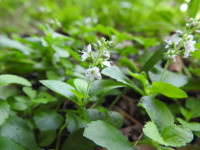
Perennial herbaceous plant with a creeping and prostrate habit, but with branch tips that rise slightly up to about 40-50 cm in length. The stem is branched, pubescent with hairs 0.5 to 1 mm long, patent, and rooting at the nodes, allowing the plant to spread horizontally. The leaves are arranged oppositely along the stem, subsessile or with a short petiole, ovate or elliptical in shape, 7 to 40 mm long and 15-40 mm wide, with a finely dentate or crenate-dentate margin. The leaf surface is densely pubescent with soft hairs, giving a slightly grayish appearance.
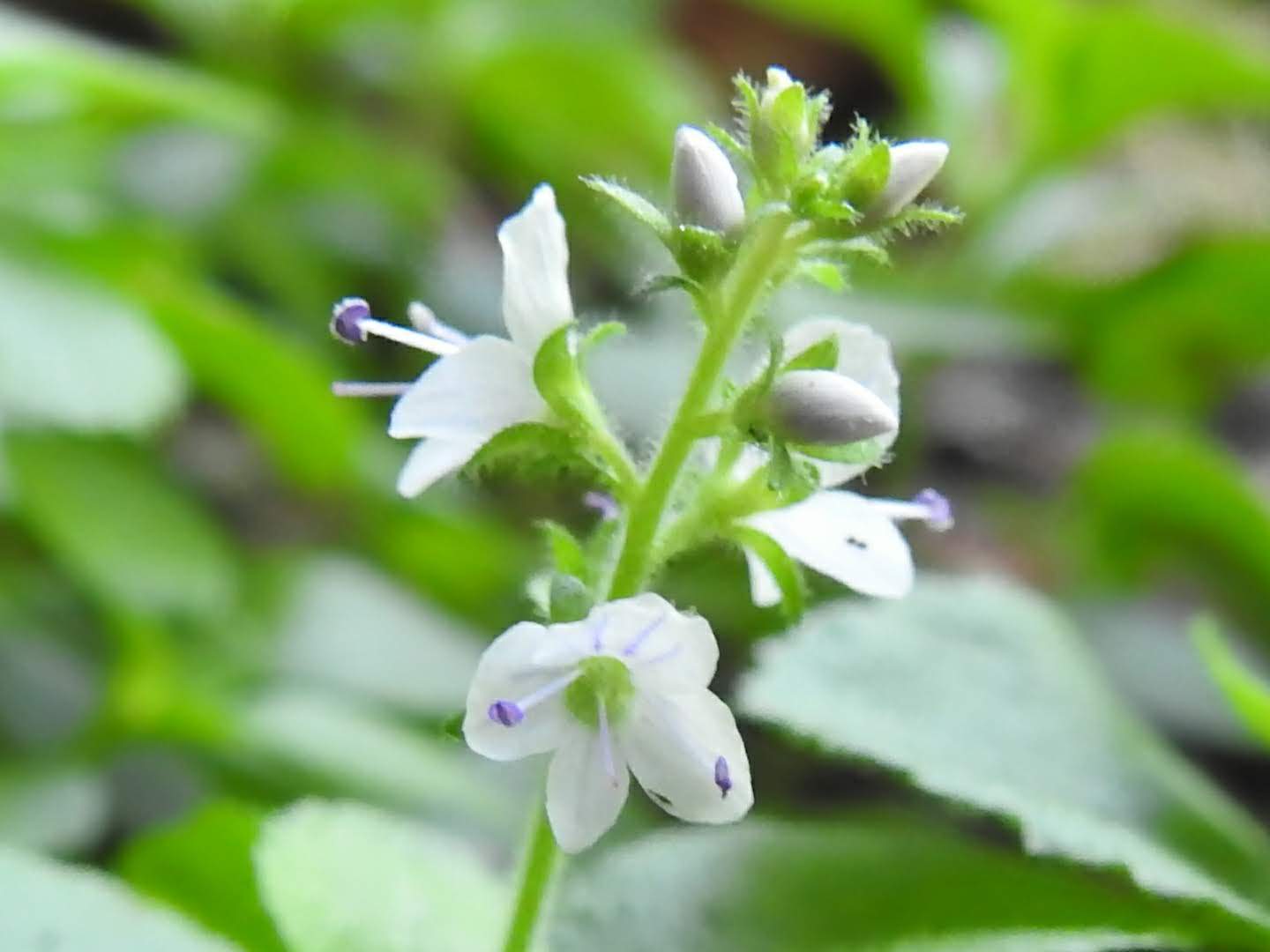
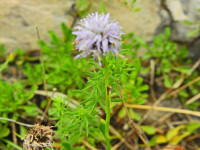
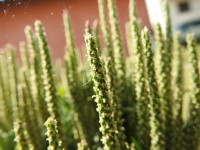
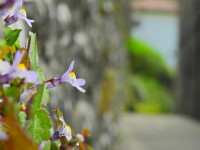
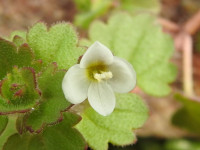
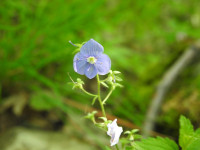
The flowers develop in slender and elongated racemes, generally 1 to 3 per plant, located in the axils of the upper leaves. Each raceme can bear 15 to 25 spaced flowers, each on very short peduncles also pubescent with elongated glandular hairs. The corolla is formed by four irregular petals, about twice the length of the calyx, with a diameter of 6-8 mm. Colors vary from light blue, sky blue, to lilac-purple or pinkish, often crossed by darker veins in shades of blue or purple. The calyx is divided into four lanceolate lobes, pubescent, slightly unequal. Two mauve-blue stamens are fused to the corolla. The long style (3-4 mm) ends with a flat stigma.
The fruit is a triangular-obcordate capsule, compressed and slightly notched, about 4 x 4 mm, also pubescent with glandular hairs. It contains 15 to 20 lenticular, ellipsoid seeds, brown-yellowish in color.
The root system consists of secondary roots that develop along the rooting stems, allowing the plant to spread in grassy and woodland substrates.
Habitat and distribution
It is a common and widespread species throughout Italy and the Mediterranean, also present in many other European regions and Western Asia. It grows from sea level up to about 2000 meters altitude. It prefers coppiced woodland environments, clearings, pastures, and grassy places, often on well-drained and moderately moist soils. It frequents broadleaf and coniferous forests, forest edges, rustic meadows, and hilly and mountainous environments, but also adapts to dry and sunny or partially shaded soils.
Flowering period
Flowering occurs from May to July, with small geographic variations related to altitude and latitude. In warmer areas flowering may start slightly earlier, while in mountainous areas it tends to extend until mid-summer.
Ecology and pollination
The plant reproduces mainly by entomophilous pollination, attracting pollinating insects such as bees, bumblebees, and other hymenopterans, thanks to its colorful flowers and dark veins that act as guides for insects. The presence of glandular hairs and the shape of the corolla facilitate access for pollinating insects. Seed dispersal occurs by dropping near the mother plant; the light structure and shape of the capsule favor a gradual release of seeds into the surrounding soil.
Curiosities and traditional uses
The common name "Common Speedwell" derives from the historical use of infusions of its flowering tops as a substitute for Chinese tea, very expensive in the 17th century. This use spread thanks to the physician-pharmacologist Friedrich Hoffmann, who promoted its preparation as a tonic and bitter beverage. Its infusion, rich in bitter, sudorific, expectorant, astringent, slightly diuretic and purifying properties, was traditionally used to relieve bronchial, rheumatic, arthritic disorders, and as an external remedy for eczema, gum inflammations, and small skin lesions.
In the Middle Ages the plant was known as "herba Veronica majoris" and the subject of herbal treatises; in France it was called “Herbe aux ladres” (herb of lepers) due to its alleged healing powers. The medicinal use, although now considered obsolete in modern herbalism, testifies to the historical importance of this species in European folk tradition.
The bitter taste of the infusion also favored its use as an aperitif herbal tea to stimulate appetite and digestion.
Etymology
The genus name Veronica has ancient and uncertain origins. It probably derives from popular names of Renaissance times and from a 15th-century Swiss pharmacopoeia. The name is commonly associated with the figure of Saint Veronica, the woman who, according to Christian tradition, wiped the face of Christ with a cloth during the Via Crucis, leaving an imprint (vera icon, i.e. “true image”). This connection is attributed both to the flowering period around Holy Week and to the dark veins on the petals that resemble a face. Some less credible sources suggest alternative derivations from terms such as "Betonica" or from the Old High German "wernickel," but these hypotheses are less convincing linguistically.
The specific name "officinalis" indicates the historical officinal importance of the plant, that is its use in phytotherapy and traditional medicine.
The Italian common name "Common Speedwell" recalls the traditional use of the infusion as an economical and local substitute for Asian tea.
Sources
- Prof. S. Pignatti, "Flora d'Italia"
- Acta Plantarum - Flora delle regioni italiane (scheda di Marinella Zepigi)
- Tela Botanica / H. Coste, "Flore descriptive et illustrée de la France"
- World Flora Online (WFO)
Characteristics
Scheda botanica
| Famiglia | Plantaginaceae |
|---|---|
| Fioritura | maggio – luglio |
| Forma biologica | Creeping plants |
| Habitat | with white flowers, creeping plant, Perennial plant |
| Uso officinale | Pianta officinale |
Domande frequenti
- Quando fiorisce Common Speedwell?
- Common Speedwell fiorisce maggio – luglio.
- Che tipo di pianta è Common Speedwell?
- Common Speedwell è una Hemicryptophytes (Creeping plants) secondo la classificazione di Raunkiaer.
- A quale famiglia appartiene Common Speedwell?
- Common Speedwell appartiene alla famiglia botanica Plantaginaceae.
Where I found it (4 sightings)
Classification
- Kingdom
- Plantae
- Family
- Plantaginaceae
- Full name
- Veronica officinalis L.
- Life form
- Hemicryptophytes creeping plants
Similar species
Search for species with similar characteristicsFurther reading
Noticed an error in the identification? Write to me
Other species of the same family
Plantaginaceae
Explore
Other species of Plantaginaceae