Botanical species
Plantago major
L.
Common Plantain
Description
Morphological description
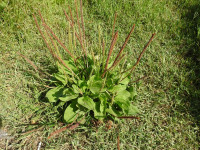
Perennial herbaceous plant, Plantago major has an erect or slightly ascending habit, with a height generally ranging between 10 and 50 cm. The root system consists of a short rhizome from which numerous thin and superficial roots arise. The stem is glabrous or slightly pubescent, often angular and lacking prominent striations.
The leaves are exclusively basal, arranged in a rosette pressed to the ground. The blade is oval or elliptical in shape, with dimensions varying from 3 to 20 cm in length and from 4 to 12 cm in width, and has an irregularly toothed margin, more pronounced especially at the base. The leaf surface is generally glabrous, sometimes slightly pubescent, with 3 to 9 main veins, parallel to the margin and converging towards the petiole, which is about 0.3-1.2 times the length of the blade, grooved on the upper side and winged especially in the lower part. The leaf apex is obtuse or rounded, but can also be acute in some variants.
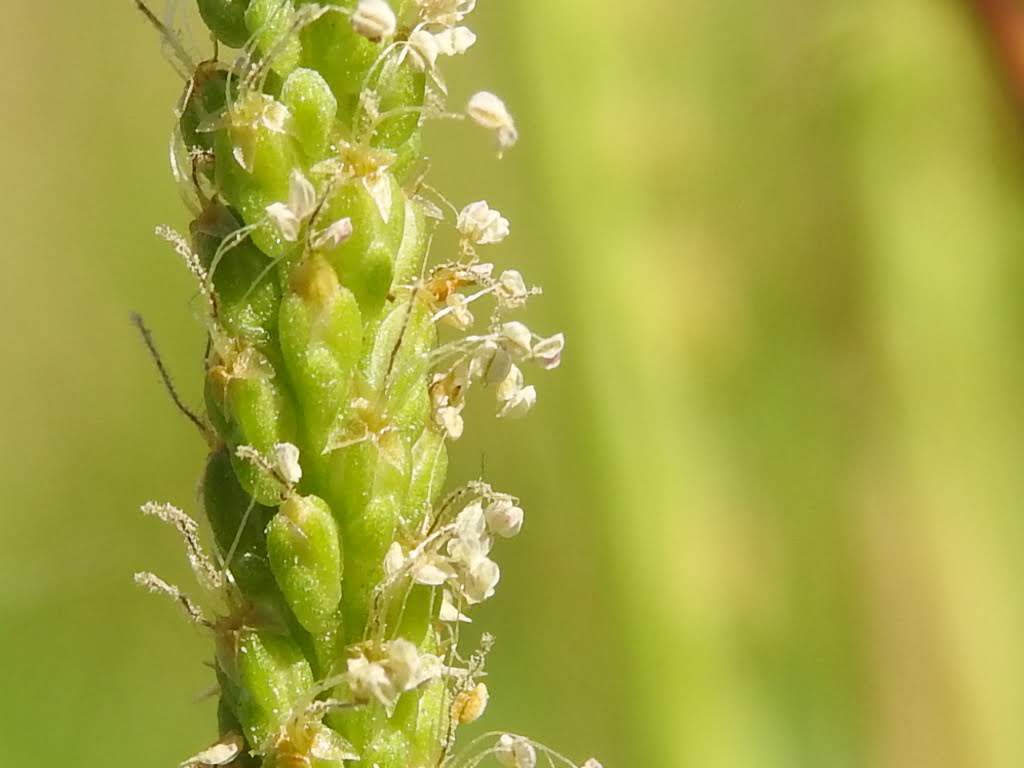
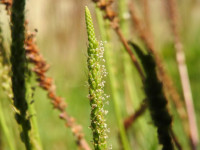
The flowering scapes are erect or ascending, angular and often pubescent, with a cylindrical and elongated spike inflorescence, 5 to 12 cm long, sometimes slightly loose at the base. The bracts are oval, about 1.5-1.7 mm long, green on the back with whitish and scarious margins. The flowers are small, hermaphroditic, with a calyx composed of 4-5 oval sepals and a tubular corolla divided into 4 patent and scarious lobes about 0.4-1 mm long. The anthers are protruding and measure about 0.6-0.8 mm, brown in color. Flowering occurs in dense spikes located at the apex of the scapes.
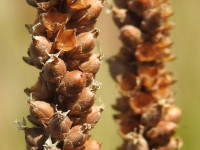
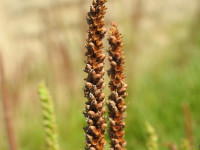
The fruit is an oval-oblong capsule (pyxidium), with circumscissile dehiscence, containing from 4 up to 35 small, dark and wrinkled seeds, slightly angular in shape and with a wavy surface, measuring about 0.8-1.1 mm. At maturity, the capsule detaches together with the upper part of the calyx, facilitating seed dispersal.
Habitat and distribution
Plantago major is a subcosmopolitan species, widespread in almost all temperate regions of the world, including Italy and the entire Mediterranean basin. It is a common and ubiquitous plant, present throughout the Italian territory and very frequent in anthropized environments.
It prefers open and disturbed habitats such as paths, road edges, uncultivated lands, urban areas and cultivated fields, often on moist soils rich in nitrates and well exposed to the sun. It can grow on a wide range of substrates, from clayey to sandy soils, with a preference for wet or slightly stagnant areas. The growth altitude ranges from 0 up to about 1500 meters above sea level.
Flowering period
Flowering extends from March to September, with possible continuation until November in regions with milder climates. In Italy, the flowering phase is generally concentrated in the spring and summer months. The duration and intensity of flowering may vary depending on climatic and altitudinal conditions.
Ecology and pollination
Plantago major is a hermaphroditic species with small and inconspicuous flowers, adapted to predominantly anemophilous reproduction, but also entomophilous. The flowers attract pollinating insects, particularly small hymenopterans and midges, which facilitate pollination through their activity on the flowering spikes.
Seed dispersal mainly occurs through the fall of the capsule which opens by circumscissile dehiscence, facilitating the release and spread of seeds on the surrounding ground. Additionally, seeds can be transported by animals and humans, contributing to the spread of the species in anthropized and disturbed environments.
Curiosities and traditional uses
Plantago major is a widely recognized medicinal plant used in traditional and popular medicine. It contains numerous active principles including allantoin, apigenin, aucubin, baicalein, vitamin C, fatty acids such as linoleic and oleanolic acid, silicic acid, sorbitol and tannins. These compounds confer astringent, diuretic, expectorant and anti-inflammatory properties to the plant.
It is used internally in cases of diarrhea, cystitis, bronchitis, catarrh, sinusitis and other bacterial infections. For external use, it is employed to promote the healing of wounds, insect bites, ulcers, ocular inflammations, herpes zoster, hemorrhoids and skin irritations. In phytotherapy it is also appreciated for soothing dry cough and as a remedy against toothache.
In cooking, young, tender and refreshing leaves are consumed raw in salads or cooked as a vegetable, often mixed with other wild herbs. The plant also plays an important ecological role as a food source for butterfly larvae and numerous wild animals, while its seeds are preyed upon by various bird species.
Etymology
The genus name "Plantago" derives from the Latin "planta," meaning "sole of the foot," probably referring to the broad and flattened shape of the leaves which resembles the sole of the human foot and to the frequent growth of the plant in trampled areas. The specific name "major" indicates the larger size of the leaves compared to other species of the genus.
The Italian common name "piantaggine maggiore" highlights the characteristic size of the leaves compared to piantaggine minore (Plantago lanceolata) and its widespread presence in fields and along paths. Vernacular names in other languages, such as "Englishman’s Foot" attributed by Native Americans, recall the plant's spread in areas frequented by humans.
Sources
- Prof. P.V. Arrigoni, "Flora analitica della Toscana", "Flora dell'Isola di Sardegna"
- Acta Plantarum - Flora delle regioni italiane (sheet by Marinella Zepigi)
- Tela Botanica / H. Coste, "Flore descriptive et illustrée de la France"
- World Flora Online (WFO)
Characteristics
Where I found it (9 sightings)
Classification
- Kingdom
- Plantae
- Family
- Plantaginaceae
- Full name
- Plantago major L.
- Synonyms
- Plantago major L. subsp. intermedia (Godr.) Lange; Plantago major L. subsp. pleiosperma Pilg.; Plantago major L. subsp. sinuata (Lam.) Negodi; Plantago major L. subsp. winteri (Wirtg. ex Geisenh.) W.Ludw.
- Life form
- Emicriptofite rosulate
Similar species
Search for species with similar characteristicsFurther reading
Noticed an error in the identification? Write to me
Other species of the same family
Plantaginaceae
Explore
Other species of Plantaginaceae