Botanical species
Solidago virgaurea
L.
Goldenrod
Description
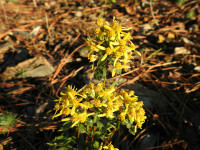
Morphological description
The Goldenrod is a perennial herbaceous plant belonging to the family Asteraceae, distinguished by its erect and scapose habit, with a height ranging from 6 to 120 cm. The stem is reddish, striated, and subglabrous, meaning almost hairless or with slight pubescence only on the upper part. The plant develops from an oblique rhizome, brown-reddish in color, which allows it to overwinter and spread in the soil.
The leaves are alternate and lanceolate or ovate-lanceolate in shape, with a toothed or crenate-toothed margin. The basal leaves have a winged petiole 5-8 cm long and a blade that can reach dimensions of 8 x 15 cm in sterile rosettes, while the cauline leaves are progressively smaller, sessile, and generally oriented towards the same side of the stem. The leaf texture is herbaceous and the surface tends to be smooth or slightly pubescent.
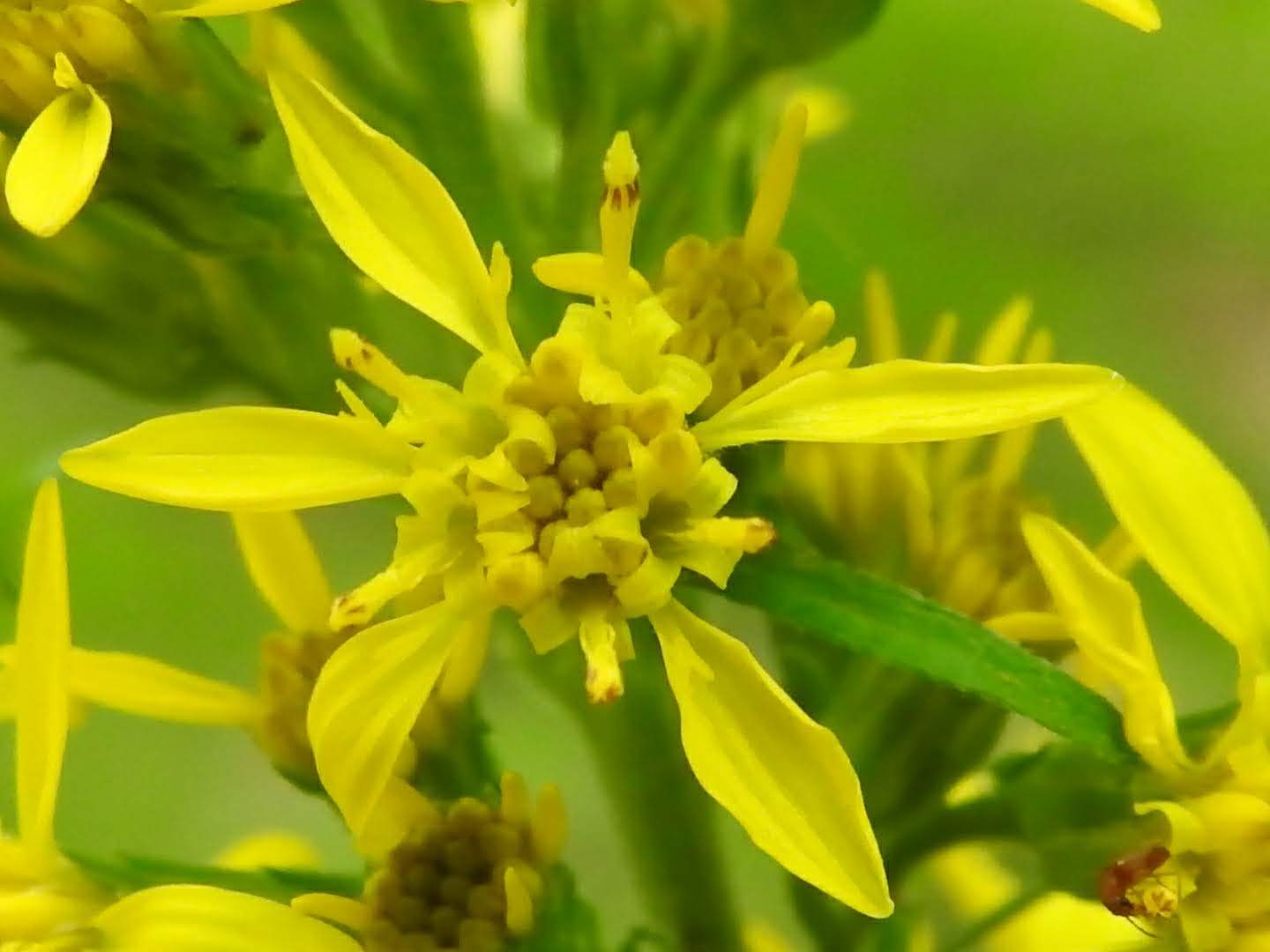
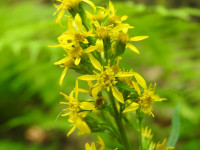
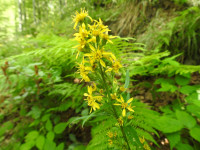
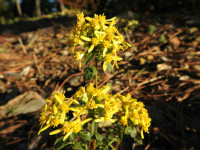
The flowers are grouped in capitula arranged in a terminal raceme inflorescence, more or less dense and multi-sided. Each capitulum, cylindrical and supported by pubescent peduncles 1-3 mm long, is composed of bright yellow ligulate flowers (10-16 mm long, with a ligule of 5-10 mm) and also yellow tubular flowers (7-9 mm). The capitula contain numerous petals, with actinomorphic symmetry. The fruit is an achene about 3 mm long, ribbed and pubescent.
Habitat and distribution
The Goldenrod is a circumboreal species, widespread in the cold and temperate-cold zones of Europe, Asia, and North America. In Italy, it is mainly present in the alpine and pre-alpine regions, where it grows in forests and forest edges, up to altitudes of about 1650 meters. It prefers fresh and semi-shaded woodland environments with well-drained soils, often siliceous and slightly acidic. The species favors exposures from partially shaded to sunny, also adapting to temperate-cold climate conditions.
Flowering period
Flowering extends from July to October, with possible altitudinal and geographical variations: in the higher areas of the Alps, flowering may be shorter and concentrated in the warmest summer months. The yellow flowers open progressively along the inflorescence, giving the plant the characteristic golden appearance from which the common name derives.
Ecology and pollination
The Goldenrod reproduces mainly sexually, attracting a variety of pollinating insects, including bees, bumblebees, and butterflies, which are drawn to the yellow flowers and the rich production of pollen and nectar. The structure of the capitulum, with ligulate and tubular flowers, promotes pollen dispersal through pollinating insects. Seed dispersal occurs through achenes equipped with a pappus, which facilitates aerial transport and colonization of new habitats.
Curiosities and traditional uses
The Goldenrod has a long tradition in ethnobotany, especially for its medicinal properties. Traditionally, it has been used as a phytotherapeutic remedy to promote diuresis and relieve urinary disorders, thanks to its anti-inflammatory and astringent properties. In some popular cultures, the plant was also valued for its supposed purifying virtues and as a general tonic. Although not commonly used as food, some parts of the plant have occasionally been used in herbal preparations.
Its common name, Goldenrod, derives from the characteristic intense yellow color of the flowers, which form a sort of “rod” or golden stick during flowering.
Etymology
The scientific name Solidago virgaurea comes from Latin: solidare means “to consolidate” or “to heal,” while virgaurea is composed of virga (“rod” or “stick”) and aurea (“golden”), referring to the golden appearance of the flower spike. The Italian common name “Verga d’oro” exactly reflects this morphological and chromatic characteristic, similar to a rod or stick of golden yellow color.
Sources
- Acta Plantarum - Flora delle regioni italiane (actaplantarum.org)
- Acta Plantarum - Scheda di Giuliano Salvai
- Tela Botanica / H. Coste, "Flore descriptive et illustrée de la France"
- World Flora Online (WFO)
Characteristics
Scheda botanica
| Famiglia | Asteraceae |
|---|---|
| Fioritura | luglio – ottobre |
| Forma biologica | Scapose |
| Habitat | with yellow flowers, Perennial plant, plant with a scapose habit |
Domande frequenti
- Quando fiorisce Goldenrod?
- Goldenrod fiorisce luglio – ottobre.
- Che tipo di pianta è Goldenrod?
- Goldenrod è una Hemicryptophytes (Scapose) secondo la classificazione di Raunkiaer.
- A quale famiglia appartiene Goldenrod?
- Goldenrod appartiene alla famiglia botanica Asteraceae.
Where I found it (6 sightings)
Classification
- Kingdom
- Plantae
- Family
- Asteraceae
- Full name
- Solidago virgaurea L.
- Life form
- Hemicryptophytes scapose
Similar species
Search for species with similar characteristicsFurther reading
Noticed an error in the identification? Write to me
Other species of the same family
Asteraceae
Explore
Other species of Asteraceae