Botanical species
Clinopodium nepeta
(L.) Kuntze
Lesser Calamint
Description
Morphological description
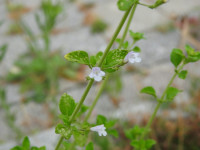
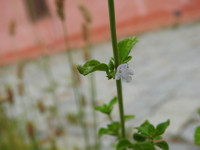
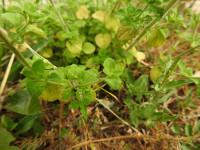
The plant is a perennial aromatic-woody herbaceous that reaches a height between 20 and 80 centimeters. It has a suffruticose habit with ascending stems, quadrangular in section, generally simple or branched only in the inflorescence. The base of the stem is lignified while the upper part is briefly pubescent. The plant develops from a creeping rhizome that produces numerous stolons, thus favoring its horizontal expansion.
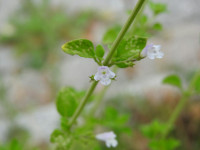
The leaves are opposite, shortly petiolate, oval-rounded or rhomboid in shape with a subacute apex, about 1-1.5 cm long. The upper surface is pubescent while the lower surface is covered with glandular hairs, giving the leaf a slightly velvety appearance. The margin is entire or toothed with irregular and obtuse teeth.
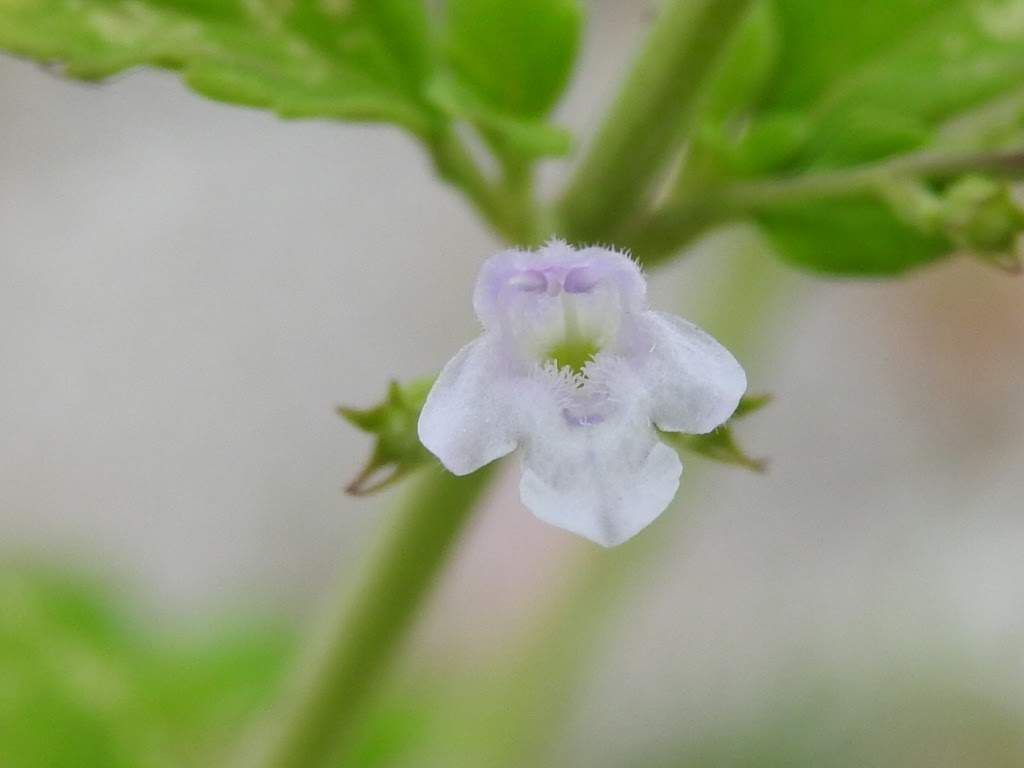
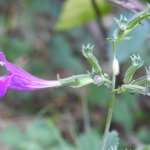
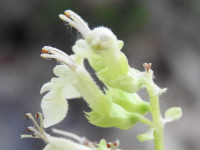
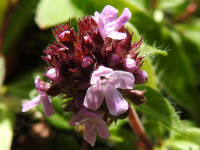
The inflorescence consists of verticillasters located in the axils of the upper leaves, comprising from 5 to 20 pedunculated and branched flowers. The small bracteoles are linear and 1-3 mm long, while the flower pedicels measure from 1 to 9 mm. The flowers are pale violet (lilac) in color and have a length of 8-10 mm, about twice the length of the calyx. The corolla, with a straight and pubescent tube, has a bifid upper lip and a trilobed lower lip, often darkly spotted at the throat, with internal hairs.
The calyx is cylindrical-campanulate, 3-4 mm long, with 11-13 nerves and numerous glands. The calyx teeth are five: three upper triangular and two lower linear, longer and pubescent. The stamens are tetradynamous (four) and protruding, while the stigma is divided into unequal lobes.
The fruit consists of four ovoid and smooth nutlets (tetrachenium), dark brown in color, about 1.2 mm long.
Habitat and distribution
This species is widely distributed throughout the Italian territory and the Mediterranean basin, also present in desert and subdesert areas extending to Central Asia. Its distribution ranges from Sardinia and the Balearic Islands to the mountainous regions of Corsica.
It typically grows in mountainous and submontane environments, from the plain up to 1500 meters altitude, preferring calcareous soils, often in dry meadows, uncultivated lands, slopes, walls, and rocky areas. It is a heliophilous and thermophilous species, adapted to sunny exposures and relatively dry and stony environments.
Flowering period
The flowering extends from June to September, with possible variations related to geographic and altitudinal location. In warmer climates and Mediterranean areas, the flowering period can start as early as June, while in cooler and mountainous areas it lasts until September.
Ecology and pollination
The flowers, with their lilac coloration and adapted shape, attract various pollinating insects, especially bees and other pollinators, which favor entomogamous pollination. The presence of hairs and dark spots in the corolla may facilitate insect orientation towards the nectar.
Seed dispersal occurs through the four nutlets produced by the fruit, which can be dispersed by falling or with the help of external agents such as small animals or weather events, although no particularly specialized dispersal strategies are known.
Curiosities and traditional uses
This plant is mainly known for its aromatic and medicinal properties. All parts contain essential oils rich in menthol, borneol, and other terpenes, which give an intense aroma, similar but more camphoraceous than mint. It is traditionally used for its digestive, antispasmodic, carminative, expectorant, and febrifuge properties.
In cooking, the leaves and flowering tops are used to flavor meat, fish, and vegetable dishes and are particularly appreciated for seasoning mushrooms, especially boletes. Additionally, it is used in the preparation of liqueurs and condiments and as a flavor corrector for pharmaceutical products.
For external use, the essential oil has a stimulating effect on superficial circulation and promotes skin repair processes, although very concentrated preparations can be excitatory.
Etymology
The genus name derives from the ancient Greek “κλίνω” (clino), meaning “to incline,” and “ποδείον” (podeion), diminutive of “πούς” (pous), meaning “foot,” referring to the plant’s stem (“little foot” or “small stem”).
The specific epithet “nepeta” derives from Latin and is an ancient name for a plant similar to mint, mentioned by Pliny in the “Historia Naturalis.” The origin of the word is uncertain but could derive from Italic or Etruscan languages, perhaps with the root *nep, meaning “moisture.” This reference might relate to the damp and shady places where the plant grew in ancient times.
In Italian, the common name “nepitella” or “common mentuccia” recalls the aromatic and morphological similarity with plants of the genus Mentha, while distinguishing it by its own characteristics.
Sources
- Acta Plantarum - Flora delle regioni italiane (sheet by Anja Michelucci)
- Tela Botanica / H. Coste, Flore descriptive et illustrée de la France
Characteristics
Where I found it (5 sightings)
Classification
- Kingdom
- Plantae
- Family
- Lamiaceae
- Full name
- Clinopodium nepeta (L.) Kuntze
- Synonyms
- Calamintha nepeta (L.) Savi, Melissa nepeta L., Satureja nepeta (L.) Scheele, Thymus nepeta (L.) Sm.
- Life form
- Emicriptofite scapose
Similar species
Search for species with similar characteristicsFurther reading
Noticed an error in the identification? Write to me
Other species of the same family
Lamiaceae
Explore
Other species of Lamiaceae