Botanical species
Stellaria media
(L.) Vill.
Common Chickweed
Description
Morphological description
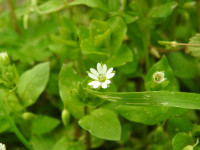
Annual or biennial herbaceous plant, Common Chickweed has prostrate or prostrate-ascending stems, branched from the base, generally 10 to 40 cm long, sometimes up to 50 cm. The stem is quadrangular in section, thin, green or with reddish hues, characterized by a single line of alternating hairs along each internode, which can sometimes be glabrous. At the nodes, the stem can produce roots, contributing to its widely spreading habit on the ground.
The leaves are opposite, ovate or ovate-rounded in shape, with entire margins and acute or acuminate apex. The lower leaves are petiolate with petioles as long as the leaf blade, while the upper ones are larger and sessile. The leaf texture is herbaceous, generally glabrous, with some slight ciliation at the base. The floral bracts are herbaceous, progressively smaller.
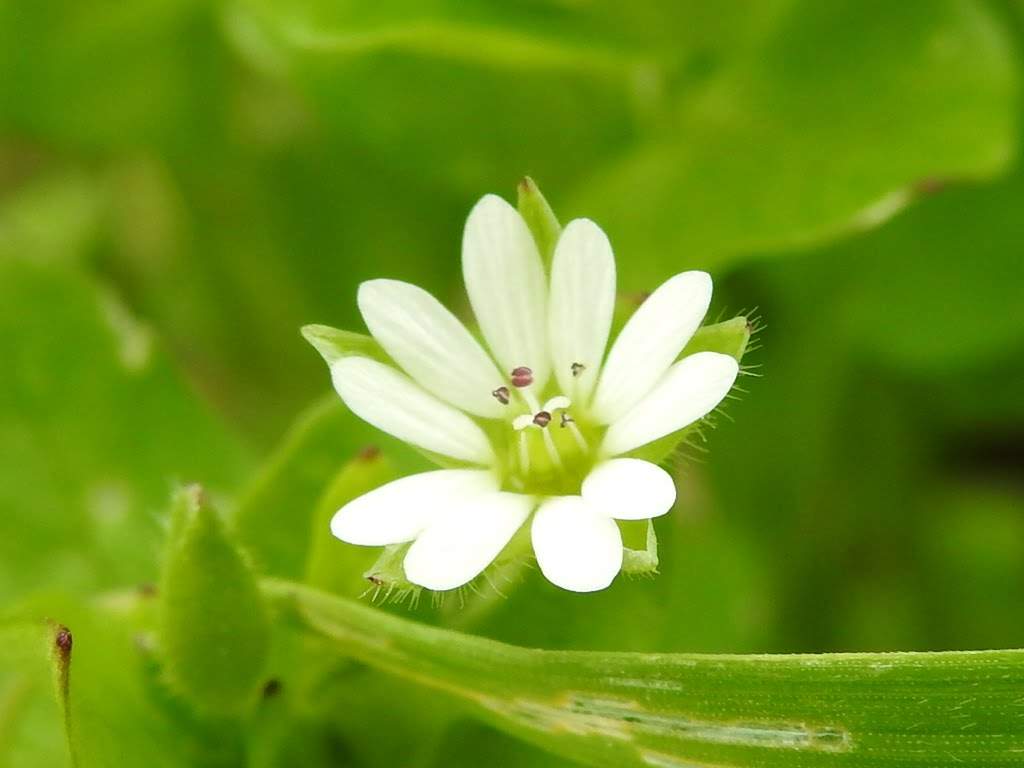
The flowers are small, numerous, gathered in rather loose terminal dichasial cymes. Each flower is borne on an erect pedicel 3-40 mm long, which elongates during fruiting to 4-6 times the length of the calyx and bends downward, often covered with spreading hairs.
The calyx consists of five lanceolate, obtuse sepals, 3-5(6) mm long, generally hairy on the outside and with narrow membranous margins. The petals are white, deeply bifid, about one-third to two-thirds the length of the sepals, but can sometimes be absent or reduced. The stamens are 3-5, with thin white filaments and rounded anthers, violet-reddish in color.
The ovary is unilocular, greenish-green, with three erect white styles that tend to curve in later stages. The fruit is a pyriform or ovoid capsule, 2.5-5 mm long, opening apically into six valves, slightly protruding beyond the persistent calyx. The seeds are small, reniform, reddish-brown, covered with rounded tubercles of flat or convex shape.
The root system consists of a thin, shallow taproot.
Habitat and distribution
Common Chickweed is a cosmopolitan species, widely distributed throughout the Italian territory and the Mediterranean basin, without significant gaps in its distribution. It mainly grows in anthropized environments, as a weed in cultivated fields, vegetable gardens, gardens, roadsides, dumps, and wet places. The species adapts to different soil types, preferring well-worked or disturbed soils, although it can tolerate variable conditions.
In Italy, it is found from the plains up to altitudes of 1600-2500 m a.s.l., showing remarkable ecological plasticity. It is frequent both in hilly and foothill areas and in high mountains, where it exploits open and sunny or partially shaded environments.
Flowering period
The flowering of Common Chickweed is very extended, potentially lasting from January to December in mild climate areas, with flowering peaks from spring to autumn. The presence of flowers almost throughout the year is favored by the plant's ability to adapt to variable climatic conditions and its annual or biennial nature.
Ecology and pollination
The species reproduces through hermaphroditic flowers, predominantly self-pollinating but potentially pollinated by small pollinating insects attracted by the white flowers. The flower structure, with deeply bifid petals and colored anthers, favors the attraction of small-sized pollinating insects.
Seed dispersal mainly occurs by falling near the mother plant, but also through animals that may accidentally transport them. The seeds are also appreciated by numerous granivorous bird species, which indirectly contribute to the plant's spread.
Curiosities and traditional uses
Common Chickweed is traditionally known for its medicinal properties and its use as an edible wild plant. It contains tannins, mineral salts, saponins, and vitamins that confer diuretic, laxative, diaphoretic, and expectorant properties. It is also used externally as a soothing and refreshing agent for eczema, itching, and ulcers.
In cooking, the young and tender parts of the plant are used in soups, fillings, and side dishes, but consumption is recommended in small amounts due to the saponin content, which can be toxic in excess. The popular name "centocchio" probably derives from the ease with which the plant grows everywhere, almost like "a hundred eyes" watching the surrounding environment.
Birds particularly like the seeds, from which various vernacular names such as “erba passerina” or “mordigallina” derive.
Etymology
The scientific name derives from the Latin stellaria, meaning “pertaining to the star,” recalling the star-shaped form of the flowers when fully open. The Italian name “centocchio” alludes to its abundance and widespread distribution, as if the plant had “a hundred eyes” on the ground.
Sources
- Prof. S. Pignatti, "Flora d'Italia"
- Acta Plantarum - Flora delle regioni italiane (scheda di Giuliano Salvai)
- Tela Botanica / H. Coste, "Flore descriptive et illustrée de la France"
- World Flora Online (WFO)
Characteristics
Scheda botanica
| Famiglia | Caryophyllaceae |
|---|---|
| Fioritura | tutto l'anno |
| Forma biologica | Creeping plants |
| Habitat | with white flowers, edible plant, biennial plant |
| Uso alimentare | Commestibile |
Domande frequenti
- Quando fiorisce Common Chickweed?
- Common Chickweed fiorisce tutto l'anno.
- È commestibile Common Chickweed?
- Common Chickweed è considerata commestibile. Verifica sempre le parti eduli e la preparazione corretta prima del consumo.
- Che tipo di pianta è Common Chickweed?
- Common Chickweed è una Therophytes (Creeping plants) secondo la classificazione di Raunkiaer.
- A quale famiglia appartiene Common Chickweed?
- Common Chickweed appartiene alla famiglia botanica Caryophyllaceae.
Where I found it (6 sightings)
Classification
- Kingdom
- Plantae
- Family
- Caryophyllaceae
- Full name
- Stellaria media (L.) Vill.
- Synonyms
- Alsine media L.
- Life form
- Therophytes creeping plants
Similar species
Search for species with similar characteristicsFurther reading
Noticed an error in the identification? Write to me
Other species of the same family
Caryophyllaceae
Explore
Other species of Caryophyllaceae