Botanical species
Silene latifolia
Poir.
White Campion
Description
Morphological description
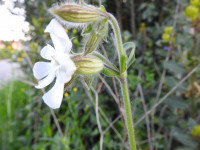
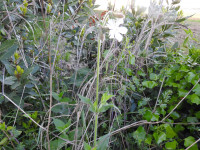
Biennial or perennial herbaceous plant, with an erect habit, generally 30 to 80 cm tall, but sometimes up to 100 cm. The stem is branched, with appressed pubescence; the base is hairy while the apex is viscid-glandular. The root system is taprooted and woody at the base.
The leaves are arranged oppositely along the stem. The basal leaves, often petiolate and with an oblong-lanceolate or elliptical blade, tend to wither during flowering, while the cauline leaves are sessile, lanceolate or elliptical, varying in size from 3 to 12 cm in length and 6-30 mm in width, with an acute apex and entire margin. The leaves generally have appressed pubescence, but often tend to become glabrous. They are traversed by three main veins, and bundles of bracts may be present in the leaf axil.
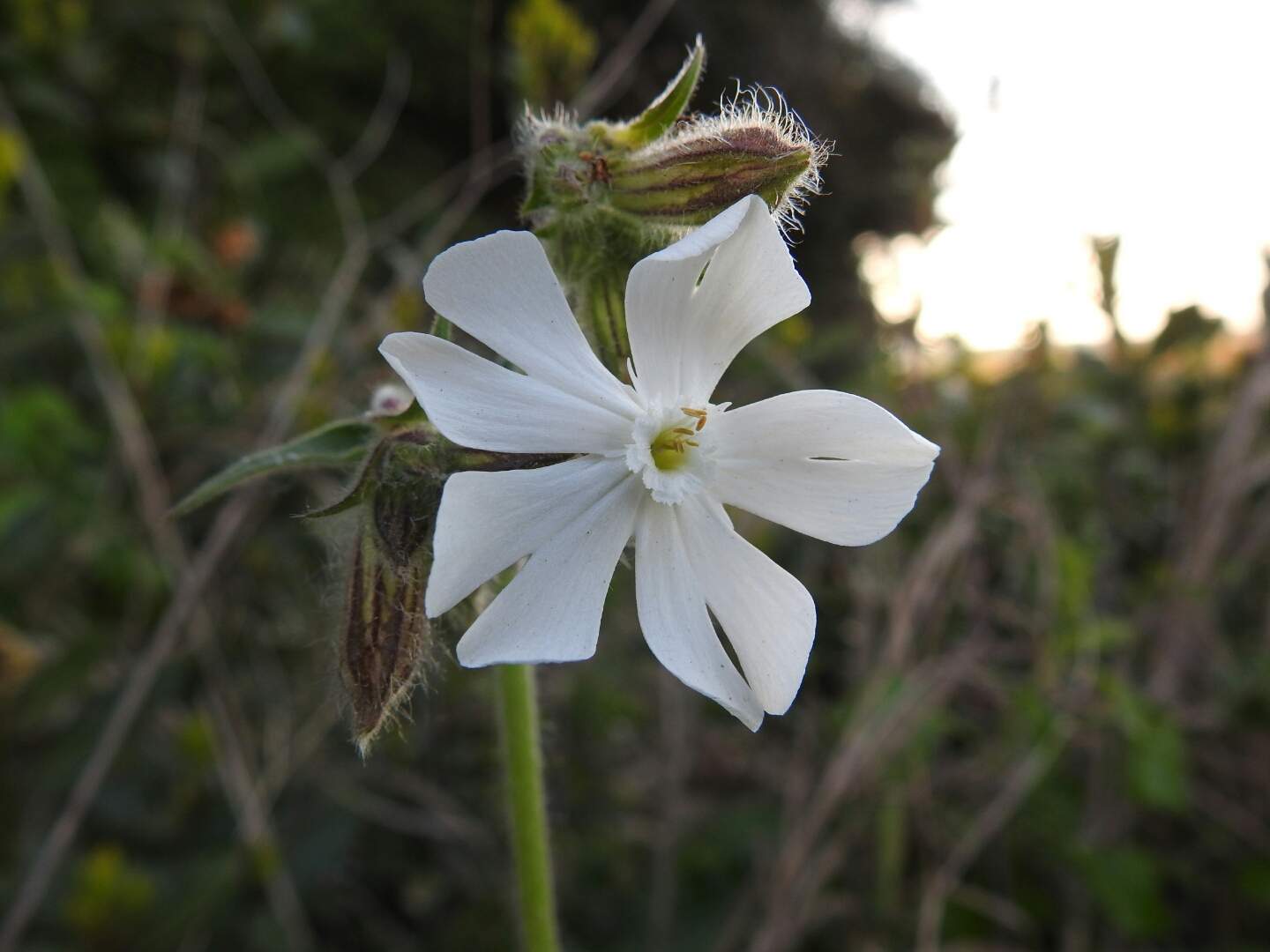
The inflorescence is an open and sparse dichasium, with unisexual flowers (dioecious plant), of medium size: the male flowers have a tubular-campanulate calyx with 10 longitudinal veins, while the female ones have a tubular-ovoid calyx, swollen for about half the length and contracted at the apex, with 20 veins. The calyx, brown-reddish and hairy, has acute and often acuminate teeth, about two thirds the length of the calyx tube. The calyx surface is covered with fine hairs and viscid glands.
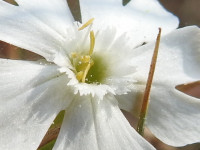
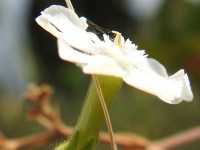
The corolla consists of five white petals, sometimes slightly tinged with pink, glabrous and bilobed for half their length, with an obovate shape. The stamens are included in the calyx and the female styles are five, protruding beyond the calyx. The flowers are fragrant and about 25-35 mm wide.
The fruit is a conical capsule, similar in size to the calyx, which opens by 4-5 spreading or slightly revolute teeth, long and acute. Inside it contains numerous reniform seeds, dark gray-brown in color, convex on both faces and with a tuberculate surface. The chromosome number of the species is 2n=24.
Habitat and distribution
Typical species of Mediterranean regions, with a range mainly extending along the coasts of the Mediterranean basin, but also present in the temperate European continental belt. In Italy it is common and widespread from the plains up to about 1900 meters altitude, frequenting many anthropized or semi-natural environments.
It prefers nitrophilous soils, often disturbed, such as cultivated fields, gardens, uncultivated lands, ruins, roadsides and places near manure heaps or organic fertilizers. It is a synanthropic plant, i.e. it thrives in human-modified environments, and adapts to soils of various types provided they are sufficiently fertile and well-drained. Exposure is usually sunny or partially shaded.
Flowering period
Flowering generally extends from May to September, with peaks in the summer months. In some Mediterranean areas and at low altitudes flowering may start early in spring and continue until early autumn, depending on local climatic conditions.
Ecology and pollination
The species is characterized by unisexual flowers, with separate plants bearing only male or only female flowers (dioecy). The flowers, white and sometimes slightly pinkish, are fragrant and attract various pollinating insects, mainly hymenopterans (bees and bumblebees) and lepidopterans, which facilitate cross-pollination.
The capsule, once mature, opens releasing the seeds through teeth that spread outward, facilitating dispersal mainly by falling near the mother plant. No long-distance dispersal strategies by wind or animals are known, but proximity to anthropized habitats favors local spread.
Curiosities and traditional uses
White Campion contains saponins, natural compounds that confer some mild toxicity if consumed in large quantities, therefore caution is advised in dietary use.
The young leaves are edible if cooked, used in soups or sautéed. Traditionally, the whole plant was used in the preparation of “minestrella,” an ancient poor soup made of many wild herbs, typical of some Italian regions, which was accompanied by corn flatbreads.
The root, after boiling, was used as a natural soap substitute due to the presence of saponins, exploited for their cleansing properties.
In some English traditions, this plant is known as "Flower of the Dead," due to its frequent presence in cemeteries.
Etymology
The genus name probably derives from the Greek "sialon," meaning saliva, referring to the viscid consistency of some species of the genus, due to the mucilaginous secretions of the stem and calyx. Another possible origin is linked to the mythological figure Silenus, companion of Bacchus, known for his swollen belly and “full” appearance, a metaphor for the swollen calyx of these flowers.
The specific epithet "latifolia" indicates the presence of relatively broad leaves compared to related species, with a well-developed and lanceolate blade. The Italian common name “White Campion” refers to the predominant color of the flowers, white or slightly pinkish.
Sources
- Prof. S. Pignatti, Flora d'Italia
- Acta Plantarum - Flora delle regioni italiane (scheda di Marinella Zepigi)
- Tela Botanica / H. Coste, Flore descriptive et illustrée de la France
- World Flora Online (WFO)
Characteristics
Where I found it (6 sightings)
Classification
- Kingdom
- Plantae
- Family
- Caryophyllaceae
- Full name
- Silene latifolia Poir.
- Synonyms
- Silene alba (Mill.) E.H.L.Krause
- Life form
- Emicriptofite bienni
Similar species
Search for species with similar characteristicsFurther reading
Noticed an error in the identification? Write to me
Other species of the same family
Caryophyllaceae
Explore
Other species of Caryophyllaceae