Botanical species
Cerastium semidecandrum
L.
Little Mouse-Ear
Description
Morphological description
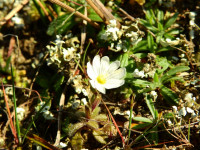
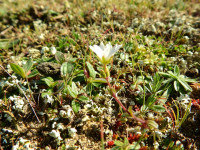
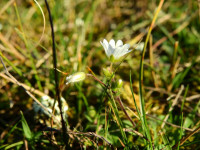
Annual herbaceous plant, Little Mouse-Ear presents a scapose habit, that is, with an elongated floral axis generally devoid of leaves in the upper part. The height ranges from 5 to 20 cm, with erect or ascending stems, greenish-yellow in color, covered by a dense pubescence composed of short hairs, both glandular and simple, which give a sticky surface to the touch. The stems branch dichotomously, meaning they divide into two symmetrical branches, developing corymbose inflorescences.
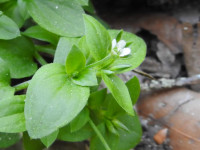
The leaves are arranged oppositely along the stem; they have a lanceolate, elliptical, or ovate shape, with dimensions varying from 4-8 mm in width to 6-20 mm in length. They are herbaceous in texture, with an obtuse or rounded apex, and have a pubescent indumentum, especially on the upper surface. Basal leaves tend to be wider and sometimes spatulate.
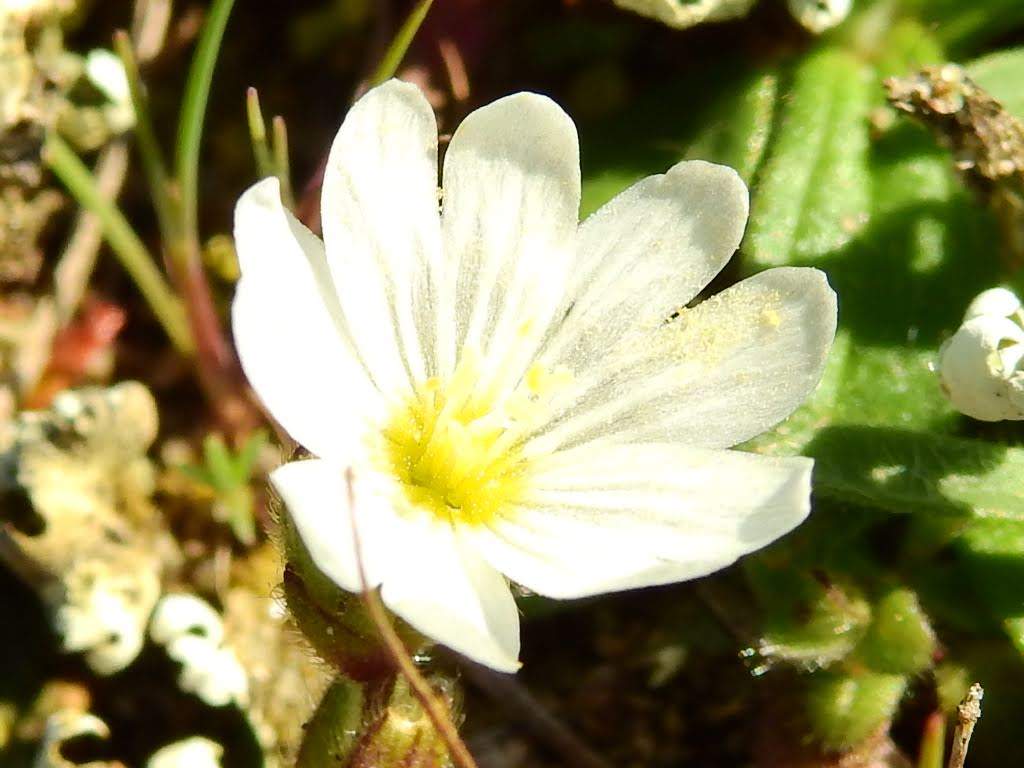
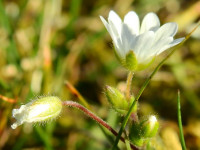
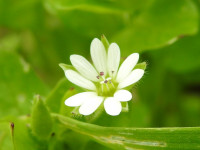
The flowers are pentamerous, with five white petals that can be entire or bilobed; in the latter case, the division is minimal, about one-tenth or one-eighth of their length. The petals are generally shorter than the sepals, which are narrowly lanceolate or oval, 3-5 mm long, with a broad membranous (scarious) margin and an indumentum of glandular and simple hairs, especially towards the apex. The number of stamens is five, with glabrous filaments, sometimes some sterile, and very small anthers (0.25-0.5 mm). The styles are five and about 1 mm long.
The inflorescence is a loose terminal cyme, composed of 3 to 30 flowers, with peduncles 5-15 mm long, often curved at the apex and sometimes folded at fruiting, covered by glandular hairs. The bracts accompanying the flowers vary from leafy and hairy in the basal parts to almost sepal-like with scarious margins in the upper parts.
The fruit is a cylindrical or slightly curved capsule, 3.5-7 mm long, about twice the length of the calyx, with 8-10 erect and revolute teeth that open to release the seeds. The seeds are very small, light brown or yellow-brown in color, 0.3-0.6 mm in diameter, with a finely tuberculate surface. The root system is a dense thin taproot, typical of annual plants.
Habitat and distribution
Little Mouse-Ear is a cosmopolitan species, widespread in all Italian regions and the Mediterranean basin, with an extended presence also in other temperate areas of the world. It prefers warm and dry climates, colonizing especially arid, sandy, or gravelly soils, as well as ruderal and semi-ruderal sites, such as rocky outcrops and disturbed areas.
It typically grows from hill to moderate mountain altitudes, adapting to sunny exposures and poor, well-drained soils often calcareous or siliceous. Its ability to survive in low moisture conditions and on poor substrates makes it common in Mediterranean habitats characterized by hot and dry summers.
Flowering period
Flowering generally extends from March to May, with possible local variations related to climate and specific environmental conditions. In the milder Mediterranean climates, Little Mouse-Ear may begin flowering as early as late winter, while in cooler and mountainous areas flowering is concentrated later in spring.
Ecology and pollination
Little Mouse-Ear, with its small white flowers, attracts a variety of pollinating insects, particularly small hymenopterans and dipterans that feed on nectar and pollen. The flower structure, with bilobed or entire petals and numerous stamens, favors entomogamous pollination, although the plant is capable of self-fertilization in the absence of visitors.
Seed dispersal mainly occurs through the capsule which, upon opening of the teeth, releases the small tuberculate seeds that can be carried by wind or small animals. The presence of glandular and sticky hairs on the stem and peduncles may also help retain seeds near the mother plant, facilitating local colonization.
Curiosities and traditional uses
No significant medicinal or food uses are documented for this species. The common name “peverina” probably refers to the small size and the presence of glandular hairs that can give a slight prickly or spicy sensation to the touch. The plant has no marked economic or cultural relevance but represents an interesting component of pioneer flora and typical plant communities of poor Mediterranean soils.
Etymology
The scientific name derives from Greek: the genus Cerastium comes from “κεράστης” (kerastēs), meaning “horned,” referring to the elongated and pointed shape of the fruiting capsule which resembles a horn. The specific name semidecandrum combines “hemi-” (half), “deca” (ten), and “andros” (male), emphasizing the characteristic of the plant having five stamens, that is half of the ten stamens typical of other Cerastium.
The Italian common name “peverina annuale” refers to the annual biological cycle of the plant and its delicate habit, perhaps recalling the term “peverino” for the slightly prickly tactile sensation due to glandular hairs.
Sources
- Prof. S. Pignatti, Flora d'Italia
- Acta Plantarum - Flora delle regioni italiane (scheda di Piera Pellizzer)
- World Flora Online (WFO)
Characteristics
Scheda botanica
| Famiglia | Caryophyllaceae |
|---|---|
| Fioritura | marzo – maggio |
| Forma biologica | Scapose |
| Habitat | with white flowers, annual plant, plant with a scapose habit |
Domande frequenti
- Quando fiorisce Little Mouse-Ear?
- Little Mouse-Ear fiorisce marzo – maggio.
- Che tipo di pianta è Little Mouse-Ear?
- Little Mouse-Ear è una Therophytes (Scapose) secondo la classificazione di Raunkiaer.
- A quale famiglia appartiene Little Mouse-Ear?
- Little Mouse-Ear appartiene alla famiglia botanica Caryophyllaceae.
Where I found it (10 sightings)
Classification
- Kingdom
- Plantae
- Family
- Caryophyllaceae
- Full name
- Cerastium semidecandrum L.
- Synonyms
- Cerastium balearicum F.Herm.; Cerastium semidecandrum L. subsp. balearicum (F.Herm.) Litard.
- Life form
- Therophytes scapose
Similar species
Search for species with similar characteristicsNoticed an error in the identification? Write to me
Other species of the same family
Caryophyllaceae
Explore
Other species of Caryophyllaceae