Botanical species
Moehringia trinervia
(L.) Clairv.
Three-Nerved Sandwort
Description
Morphological description
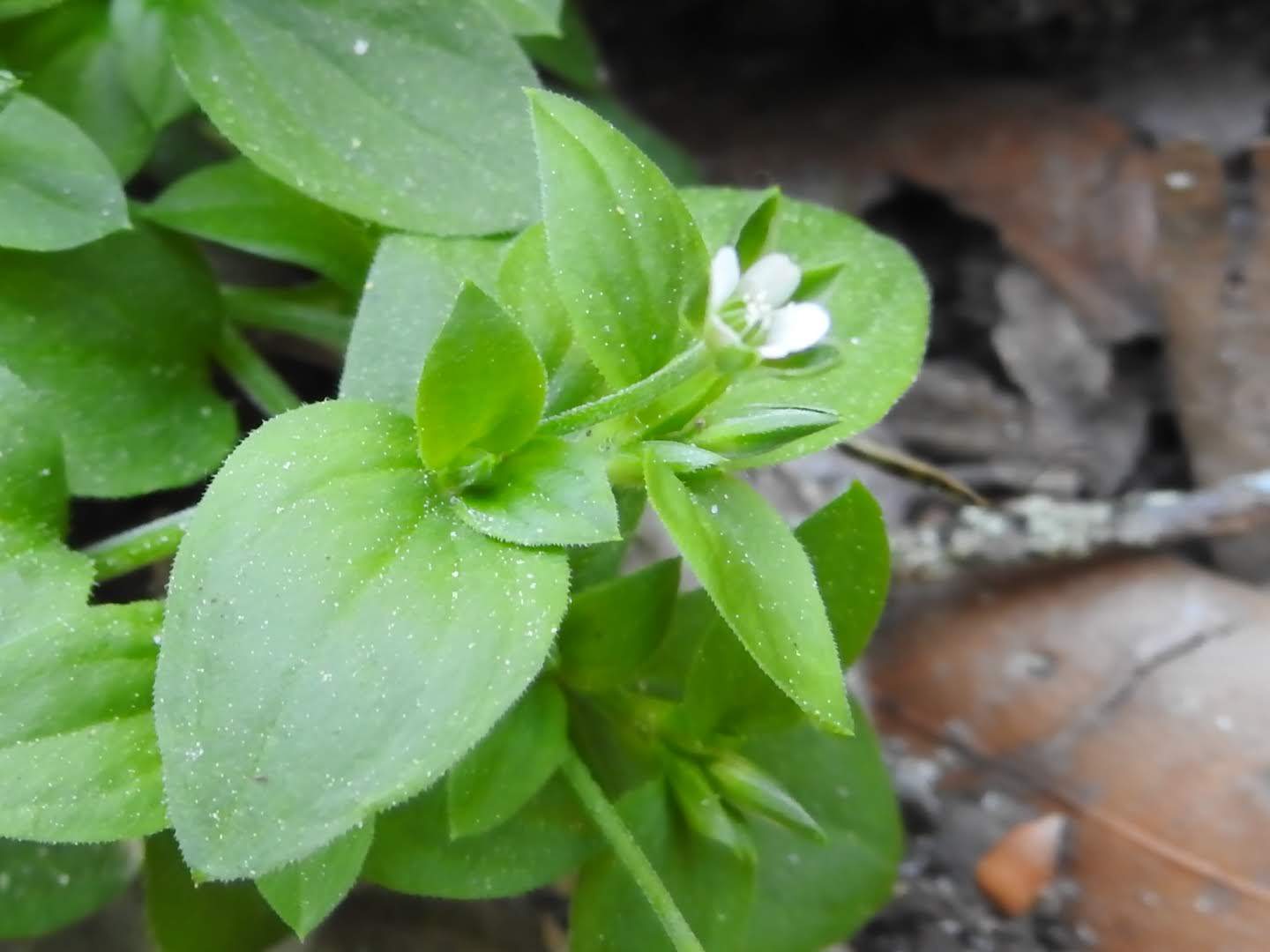
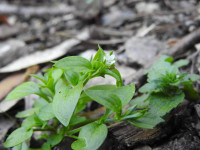
Annual or short-lived perennial herbaceous plant, Three-Nerved Sandwort has a scapose habit, with prostrate or prostrate-ascending stems, branched at the base and generally between 10 and 40 cm long. The stems are pubescent, characterized by two distinct lines of short hairs. The root system consists of thin roots, suitable for rapid development in woodland environments.
The leaves are opposite, ovate with an acuminate apex, up to 25-30 mm long, about 5-20 mm wide, with entire and ciliate margins. They are herbaceous and pubescent on both sides, with 3-5 prominent veins (hence the specific name), including arcuate lateral veins. The lower leaves are petiolate, while the upper ones are sessile.
The inflorescence consists of white, pentamerous flowers (with five petals), arranged singly in terminal or axillary cymes. The peduncles are thin and pubescent, 5 to 25 mm long. The sepals, oblong-lanceolate, measure 4-5 mm, are trinerved, with a broad, scarious, and ciliate margin both on the edge and on the central vein. The petals are obovate, white, half to two-thirds the length of the sepals. The corolla has 8 to 10 stamens, shorter than the petals.
The fruit is an ovoid or sub-spherical capsule 2.5-3 mm long, with reflexed dehiscence teeth at the apex. The seeds are black, shiny, globose or reniform, about 1-1.3 mm, with a smooth or slightly rough surface on the margin and equipped with a small laciniate strophiole.
Habitat and distribution
Three-Nerved Sandwort is widespread throughout much of Europe, with a presence extending to the Mediterranean basin and temperate Asia, up to Japan. In Italy, it mainly prefers woodland environments, particularly beech forests and shady, moist areas of deciduous woods. It also grows along hedges, walls, and forest clearings, showing a preference for fresh substrates and well-drained but moist soils.
It is mainly found in hilly and mountainous areas up to the subalpine level, with an altitude range approximately between 200 and 1,500 meters. The species prefers shady or semi-shady exposures, typical of mature woodland environments, where competition with other herbaceous species is moderate.
Flowering period
Flowering generally extends from May to July, with slight geographic variability linked to local climatic conditions. In some regions, it may start as early as late April and continue until early August, especially in milder climates or at lower altitudes.
Ecology and pollination
The species is mainly pollinated by pollinating insects attracted by the white flowers, including small hymenopterans and dipterans, although the flower morphology with petals shorter than the sepals suggests some adaptability to smaller-sized pollinators. Three-Nerved Sandwort has a reproductive strategy that combines sexual fertilization with the production of seeds equipped with a strophiole, a structure that facilitates anemochory or dispersal by small animals.
The capsule opens with reflexed teeth that favor seed release, the seeds being shiny and globose or reniform in shape, facilitating dispersal on the forest floor. The species can also survive as a scapose hemicryptophyte or scapose therophyte, depending on environmental conditions and the biological cycle.
Curiosities and traditional uses
There are no specific data or widespread traditional, food, or medicinal uses for Three-Nerved Sandwort. However, like many species of the Caryophyllaceae family, it may play an important ecological role in woodland environments, contributing to herbaceous biodiversity and soil stabilization. Its presence is indicative of well-preserved woodland habitats.
Etymology
The generic name Moehringia is a tribute to Heinrich Philipp Moehring (1720-1792), an 18th-century German naturalist. The specific name trinervia derives from Latin, with the prefix tri- meaning "three" and nervus meaning "vein," referring to the three prominent veins of the leaves, a distinctive characteristic of the species. The Italian common name "Moehringia a tre nervi" precisely recalls this morphological peculiarity.
Sources
- Prof. P.V. Arrigoni, "Flora analitica della Toscana", "Flora dell'Isola di Sardegna"
- Acta Plantarum - Flora delle regioni italiane (scheda di Roberta Alberti)
- World Flora Online (WFO)
Characteristics
Scheda botanica
| Famiglia | Caryophyllaceae |
|---|---|
| Fioritura | marzo – luglio |
| Forma biologica | Scapose |
| Habitat | with white flowers, annual plant, plant with a prostrate-ascending habit |
Domande frequenti
- Quando fiorisce Three-Nerved Sandwort?
- Three-Nerved Sandwort fiorisce marzo – luglio.
- Che tipo di pianta è Three-Nerved Sandwort?
- Three-Nerved Sandwort è una Therophytes (Scapose) secondo la classificazione di Raunkiaer.
- A quale famiglia appartiene Three-Nerved Sandwort?
- Three-Nerved Sandwort appartiene alla famiglia botanica Caryophyllaceae.
Where I found it (10 sightings)
Classification
- Kingdom
- Plantae
- Family
- Caryophyllaceae
- Full name
- Moehringia trinervia (L.) Clairv.
- Synonyms
- Arenaria trinervia L.
- Life form
- Therophytes scapose
Similar species
Search for species with similar characteristicsNoticed an error in the identification? Write to me
Other species of the same family
Caryophyllaceae
Explore
Other species of Caryophyllaceae